




Universities are often viewed as bastions of freedom of expression – spaces where ideas can be interrogated and discussed and reformulated. Students have long used campus spaces as sites of protest, counter-protests, and demonstrations, including here at the University of Manitoba, located on Treaty 1 Territory and the homeland of the Red River Métis. However, not all campus protests are treated equally and universities across Canada have responded to campus demonstrations in very different ways.
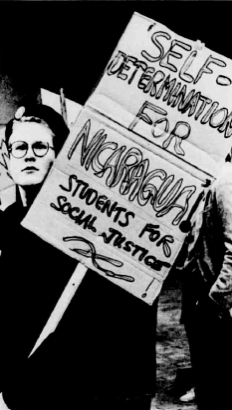
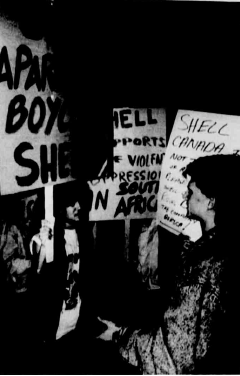
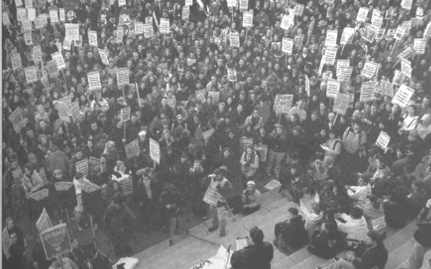
In response to the humanitarian disaster, famine, displacement, destruction, and genocide unfolding in Gaza, Free Palestine encampments emerged at McGill, the University of Toronto, and other campuses in Canada and throughout the world. In Canada, these encampments were often met with academic disciplinary actions, injunctions, heavy policing, and in some cases, forcible evictions, including the use of “tear gas and pepper spray to disperse protesters.”[1] University administrators justified these actions with references to “safety, security, and health risks.”[2] Statements from university administrators emphasized disruption, property control, and institutional order.[3]
At the same time, anti-abortion demonstrations (many of which featured graphic and gendered disinformation and disturbing imagery) and counter-protests to those demonstrations are a regular occurrence on Canadian campuses. Residential school denialists have also taken to campus spaces across the country, including on days of significance such as National Day for Truth and Reconciliation. In the fall of 2026, the University of Manitoba was papered with posters with anti-immigrant sentiments. Anti-abortion demonstrations, gatherings spearheaded by residential school denialists, and posters with white nationalist sentiments have been generally addressed by the institution, if at all, through space restrictions, signage, and/or student union policies.[4]
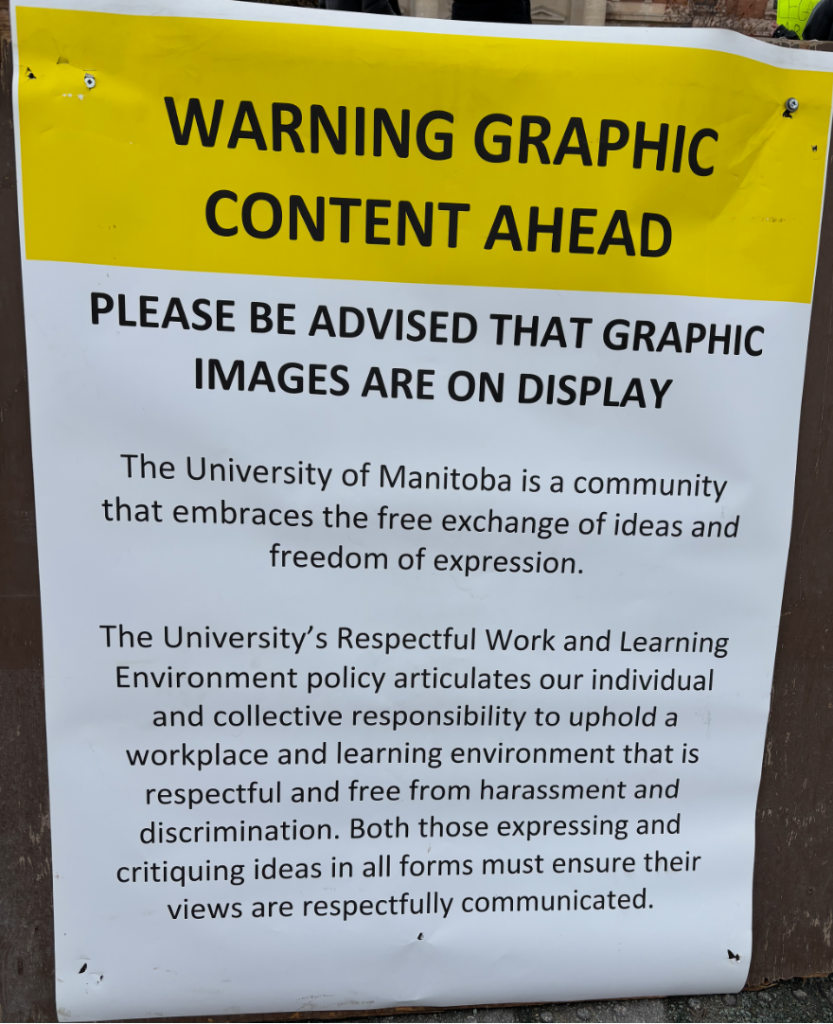
Court rulings repeatedly affirm that the Canadian Charter of Rights and Freedoms does not apply to universities or student unions in these contexts, granting them discretion to limit or deny protest activities at will.[5] Yet the language surrounding the encampments protesting against genocide compared to anti-abortion and residential school denialists’ demonstrations was different: institutions and courts framed anti-abortion and denialist demonstration restrictions as a matter of balancing freedom of expression with safety,[6] rather than treating the protests as existential threats to campus order, the way they did with the Free Palestine protests.
This comparison raises important questions about institutional power, bias, and the politics of protest. Whose voices are protected under the banner of “free expression,” and whose are suppressed under the language of “safety” or “security”? What kinds of protests are deemed legitimate, and what does this reveal about the values universities seek to uphold?
The uneven treatment of campus protests invites reflection on the broader implications for freedom of expression, academic values, and human rights. Ultimately, it asks us to consider: is there such a thing as the “right” kind of protest, and who gets to decide?
[1] Liddle, Hannah. “Timeline: Protest encampments.” University Affairs, 31 May 2024, https://universityaffairs.ca/features/timeline-encampments/.
[4] Sarah Cohen, “Anti-Choice Advocates Return to U of M Campus,” The Manitoban, September 19, 2023, https://themanitoban.com/2023/09/anti-choice-advocates-return-to-u-of-m-campus/45649/; Colton McKillop, “Anti-Abortion Group CCBR Holds Rally on Campus,” The Manitoban, September 13, 2022, https://themanitoban.com/2022/09/anti-abortion-group-ccbr-holds-rally-on-campus/43598/; “College Students Arrested for Displaying Graphic Abortion Photos Without Approval,” Catholic News Agency, October 12, 2010, https://www.catholicnewsagency.com/news/21134/college-students-arrested-for-displaying-graphic-abortion-photos-without-approval.
[5] Grant v. Ryerson Students’ Union, 2016 ONSC 5519, Ontario Superior Court of Justice, October 3, 2016, https://www.canlii.org/en/on/onsc/doc/2016/2016onsc5519/2016onsc5519.pdf; Arriola v. Ryerson Students’ Union, 2018 ONSC 1246, Ontario Superior Court of Justice, February 26, 2018, https://www.jccf.ca/wp-content/uploads/2018/02/Arriola-et-al.-v.-Ryerson-Students-Union-Feb.-26-2018.pdf; Zettel v. University of Toronto Mississauga Students’ Union, 2018 ONSC 1240, Ontario Superior Court of Justice, February 26, 2018, https://www.jccf.ca/wp-content/uploads/2018/02/Zettel-et-al.-v.-University-of-Toronto-Mississauga-Students-Union-Feb.-26-2018.pdf; Naggar v. The Student Association at Durham College and UOIT, 2018 ONSC 1247, Ontario Superior Court, February 26, 2018, https://www.jccf.ca/wp-content/uploads/2018/02/Naggar-et-al.-v.-The-Student-Association-at-Durham-College-and-UOIT-Feb.-26-2018.pdf.
[6] Wilson v. University of Calgary, 2014 ABQB 190 (Court of Queen’s Bench of Alberta, April 4, 2014), https://www.jccf.ca/wp-content/uploads/2014/04/Wilson-v-U-of-Calgary-April-2014-Judgment.pdf.