




In the past few decades, we have seen a rise in violence within and across borders, driven by increasingly oppressive and securitized immigration policies in the Global North.
This past month, this violence flooded our screens as US Immigration and Customs Enforcement (ICE) doubled down on their arrests, with many agents inflicting violence not just towards migrants, but also towards US citizens seeking to protect their neighbours. On January 7, 2026, an ICE agent fatally shot 37-year-old mother and writer Renée Good, sparking a series of protests in Minneapolis.[1] Following widespread calls to end border violence and policing as initiated by Renee’s death,[2] we must also remember countless women, many of whom are racialized, whose lives have been disrupted by oppressive border regimes across the globe and call for their rights and justice this March 8th on International Women’s Day.
In Canada, Bill C-12 (an Act respecting certain measures relating to the security of Canada’s borders and the integrity of the Canadian immigration system and respecting other related security measures) passed its second reading in the Senate on February 5, 2026. Similar to the direction being taken within US immigration policy, Bill C-12 proposes changes to Canada’s immigration policy which further securitizes and militarizes Canada’s borders. This includes amendments which give Immigration, Refugees, and Citizenship Canada (IRCC) the ability to access personal information collected by other federal and provincial agencies, as well as the ability to cancel or refuse existing applications and suspend new applications.[3] Moreover, the bill would prohibit those who have stayed in Canada for more than a year from making a refugee claim.[4] As of February 25, 2026, these amendments have stayed intact after multiple readings of Bill C-12, despite many migrant justice organizations across Canada calling for its removal. In the words of the Immigrant Workers Centre in Montreal,
“Bill C12 is not about public interest. It is about protecting a system that profits from insecurity. Migrant workers refugees and international students deserve better than a revolving door of broken promises.”
Immigrant Workers Centre – Montreal (IWC-CTI), “Bill C12 and the Manufactured Crisis of Migration“
Similar policies have been implemented by the European Union, where the enforcement of the Schengen Zone has not only consolidated European borders but has also externalized it to nearby countries in Asia and Africa who are coerced into reinforcing these borders in exchange for financial resources.[5] For a portion of the population, the Schengen Zone opens up borders within the European Union, facilitating the free movement of goods and people between EU countries; but for many others, the Schengen Zone essentially creates an impenetrable fortress, especially for migrants seeking asylum in EU countries.
The rise in anti-immigrant policies in the Global North is not coincidental but follows the fundamental role of borders to the functioning of the global capitalist and imperialist order. Within the Canadian economy, for example, immigration policies have long maintained a pool of temporary, vulnerable workers to fill its demands for “low-skilled” labour.[6] Even before Confederation, immigration policies and programs have served to stratify the labour force in Canada by determining who belongs and who does not.[7] Countries in the Global North such as Canada depend on migrant workers, many of whom come from developing countries, where underdevelopment and neoliberal policies have pushed workers to seek employment elsewhere as flexible and mobile labour.[8]
Who pays the price?
As borders are increasingly enforced in the Global North, racialized migrant women pay the price through intensifying the precarious conditions they live and work in. In Canada, where racialized immigrant women make up 8.4% of the population,[9] racialized women are more likely to take on precarious or unstable work as a consequence of their intersecting identities (including gender, race, and citizenship).[10] This includes jobs which involve temporary status, part-time hours, low wages, and/or little to no access to benefits, many of which are non-unionized.[11] These unstable conditions do not only affect the work that racialized migrant women undertake; it also seeps into other aspects of their life, including their personal well-being and that of their families.[12]
For racialized migrant women, intensifying the enforcement of borders compounds upon their existing experiences of precarity because of the role that citizenship plays in shaping these precarious conditions. Citizenship or immigration status determines migrant workers’ access to rights and security, wherein those with temporary status are usually conferred less protections than those who have permanent residency status or citizenship. Because of this, scholars have used the term “hyperprecarity” to describe the ways in which migrant workers experience a higher degree of precarity because of they exist both as precarious workers and as precarious citizens.[13] Border securitization and militarization heighten the precarity of racialized migrant women both in the US and in Canada through intensified surveillance, policing, and violence justified through citizenship and immigration status. Moreover, the external enforcement of borders in Canada through Bill C-12 would further worsen the likelihood of gender-based violence for migrant and refugee women throughout their migration journeys.[14]
Borders have also disrupted the ways in which racialized migrant women perform care work: not just in the ways that families are torn apart in the Global South because of the necessity of economic migration created by underdevelopment,[15] but also in the dependence of the Global North on paid care work. Canada has long depended on migrant care work as shown through the Live-In Caregiver Program (LCP), through which thousands of racialized women have entered Canada to work as domestic workers. The temporary nature of the LCP is not accidental: it reflects the ways in which care work is undervalued and made invisible in the home and in broader society.[16] Today, care work continues to be essential but disposable in Canada: in December 2025, IRCC announced that as of March 2026, they would be shutting down two home care worker immigration programs which would have provided domestic workers a pathway to permanent residency.[17] In the US, racialized women (many of whom are Hispanic) working in the childcare sector now fear for their safety as the Trump administration rescinded a prohibition on immigration enforcement actions around sensitive locations including preschools and childcare centres.[18]
The effects of border securitization and militarization have been apparent through its direct and structural impacts on the lives of racialized women. However, borders not only manifest through the effects of stringent immigration policy, but also in our everyday lives.[19] Yuval-Davis et al. (2018) describes how borders can transcend the physical and influence our everyday lives through a process they refer to as ‘bordering’, which affects our feelings of belonging within our communities. As borders are physically and politically consolidated, anti-migrant discourse has infiltrated our communities, where migrants are used as scapegoats for socioeconomic issues such as unemployment and the housing crisis. This deeply racist rhetoric only serves to divide and demarcate borders between us, excluding those who are already made precarious within our political and economic systems.
What is to be done?
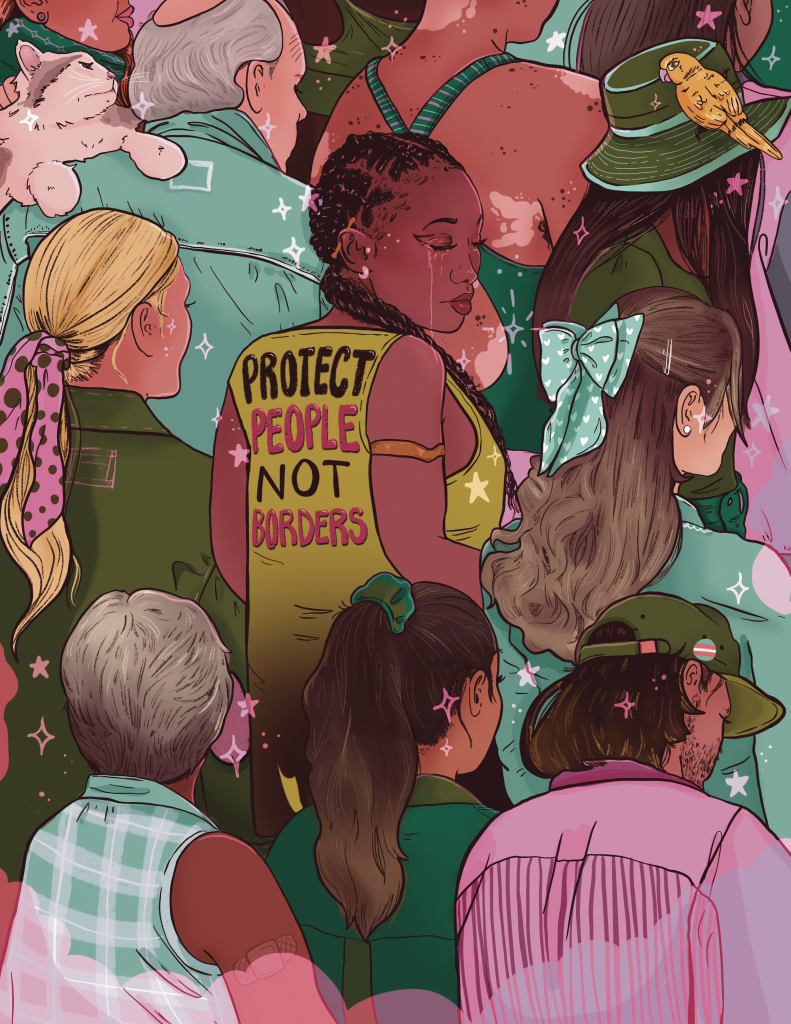
As such, resisting these processes of bordering requires a dual project. First, we must advocate for increased protections for migrant workers and refugees, especially racialized migrant women, who disproportionately bear the burden of precarity amidst increasing border securitization and militarization. Second, we must identify and actively resist these processes of bordering that occur in our everyday lives. In discussing the ways in which Filipino migrant care workers have organized to fight for their rights and welfare, Tungohan (2023) uses the concept of ‘critical hope’, which describes “an acknowledgment of the unjust and unequal societies where we live… while attempting to construct, imaginatively and materially, a different lifeworld”.[20] It is precisely through critical hope that we can contest the ways in which everyday bordering can isolate us from one another through organizing within our communities. By imagining a world without borders this International Women’s Day, not only can we envision what is politically and economically possible beyond our current capitalist and imperialist system, we can also create communities of care which meaningfully builds solidarities for migrant and refugee women across the borders that serve to divide us.
[1] Wertheimer, “Renee Nicole Good.”
[2] Lavietes and Acevedo, “Thousands Rally against ICE in Minneapolis in Below-Zero Temperatures.”
[3] Immigrant Workers Centre (IWC-CTI), The Adoption of Bill C-12 Will Put the Safety of Migrant People at Risk.
[4] Canadian Council for Refugees, Bill C -12: Strengthening Canada’s Immigration System and Borders Act: Submission to the Standing Committee on Public Safety and National Security (SECU).
[5] Walia, Border & Rule : Global Migration, Capitalism, and the Rise of Racist Nationalism.
[6] Liu, “The Precarious Nature of Work in the Context of Canadian Immigration.”
[7] Stasiulis, “Elimi(Nation).”
[8] Henaway, Essential Work, Disposable Workers: Migration, Capitalism, and Class.
[9] Statistics Canada, “Special Interest Profile, 2021 Census of Population – Profile of Interest.”
[10] Cranford and Vosko, “Conceptualizing Precarious Employment: Mapping Wage Work across Social Location and Occupational Context.”
[11] Vosko, Managing the Margins: Gender, Citizenship, and the International Regulation of Precarious Employment.
[12] Kalleberg and Vallas, Precarious Work, vol. 31.
[13] Frozzini and Law, Immigrant and Migrant Workers Organizing in Canada and the United States: Casework and Campaigns in a Neoliberal Era.
[14] Sisic et al., “The Continuum of Gender-Based Violence Experienced by Migrant and Refugee Women in Canada: Perspectives from Key Informants.”
[15] Parrenas, “Mothering from a Distance.”
[16] Shah and Lerche, “Migration and the Invisible Economies of Care.”
[17] Immigration, Refugees and Citizenship Canada, “Pausing Home Care Worker Immigration Pilots Application Intake.”
[18] Chris M. Herbst and Erdal Tekin, How ICE Immigration Enforcement Disrupts Child Care and Mothers’ Employment.
[19] Yuval-Davis et al., “Everyday Bordering, Belonging and the Reorientation of British Immigration Legislation.”
[20] Tungohan, citing Bozalek Carolissen, and Leibowitz (2014), in Care Activism: Migrant Domestic Workers, Movement-Building, and Communities of Care.