



Every year on September 30, people in Canada commemorate National Day for Truth and Reconciliation, otherwise known as Orange Shirt Day. Published in 2015 following extensive research done in collaboration with Residential School survivors, their families, community members, former staff, and others, the Truth and Reconciliation Commission of Canada ascertained that reconciliation relies not only on acknowledging past harms, but also on ongoing efforts of public education and engagement, particularly for settlers. As the tenth principle of truth and reconciliation states,
“Reconciliation requires sustained public education and dialogue, including youth engagement, about the history and legacy of residential schools, Treaties, and Indigenous rights, as well as the historical and contemporary contributions of Indigenous peoples to Canadian society.”
– What We Have Learned: Principles of Truth and Reconciliation, 2015
Below is a toolkit of resources that settlers and educators can use to strengthen their knowledge about the ongoing legacies and harms of Residential Schools in Canada.
Doing the Work
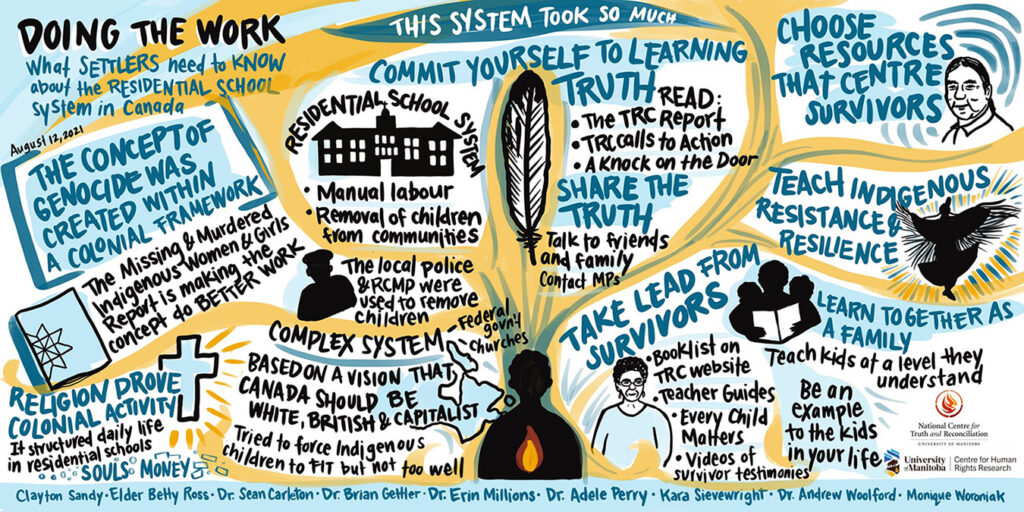
On Thursday, August 12th 2021, the Centre for Human Rights Research hosted “Doing the Work: A virtual Q & A on what settlers need to know about the residential school system in Canada.” This was a virtual Q&A session where our panel answered submitted questions and suggested available resources to help increase awareness and education about residential schools and the impact of colonialism in Canada. Watch the Q&A below.
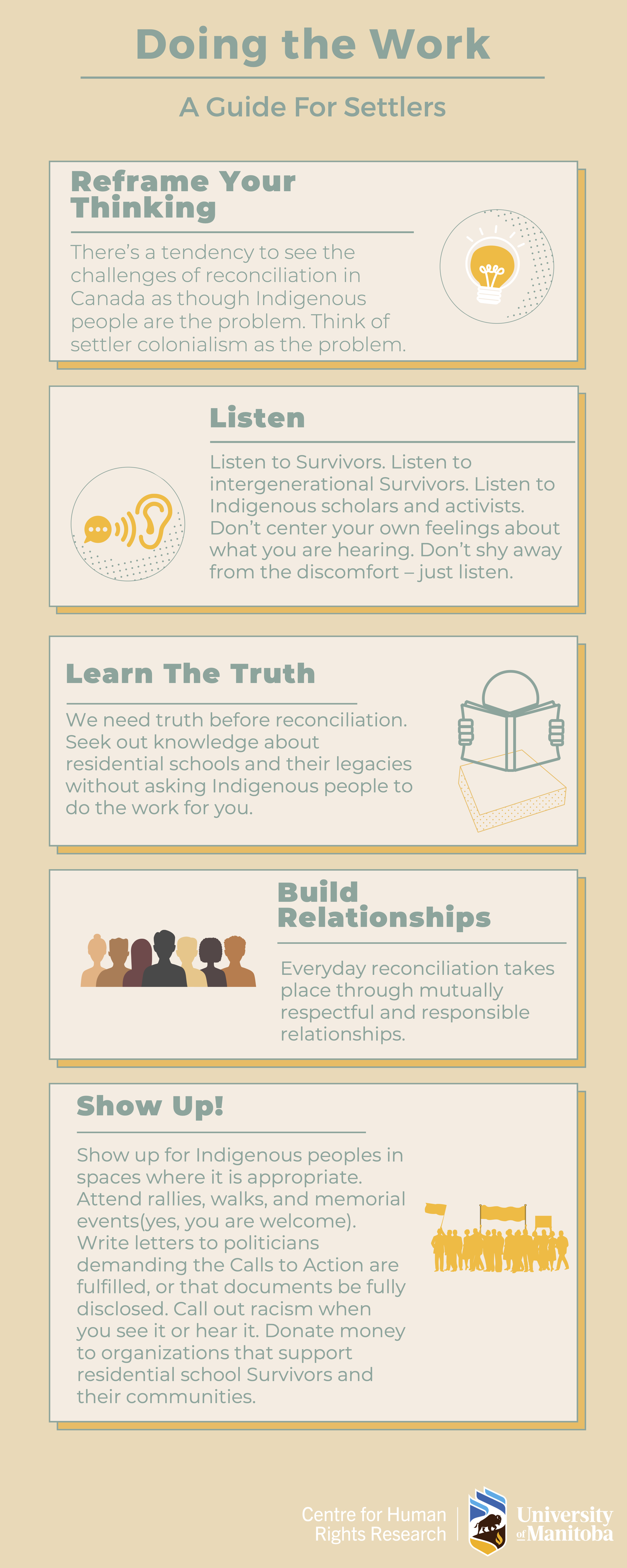
Following the virtual Q&A, the CHRR developed further resources that settlers can use to understand the importance of truth and reconciliation in Canada, including a resource guide, an infographic, and a guide for allies. All these resources can be accessed on our resource hub.
Recommended Readings
In commemoration of the National Day for Truth and Reconciliation in 2026, Dr. Adele Perry recommended several readings for settlers looking to educate themselves about truth and reconciliation with Indigenous peoples in Canada:
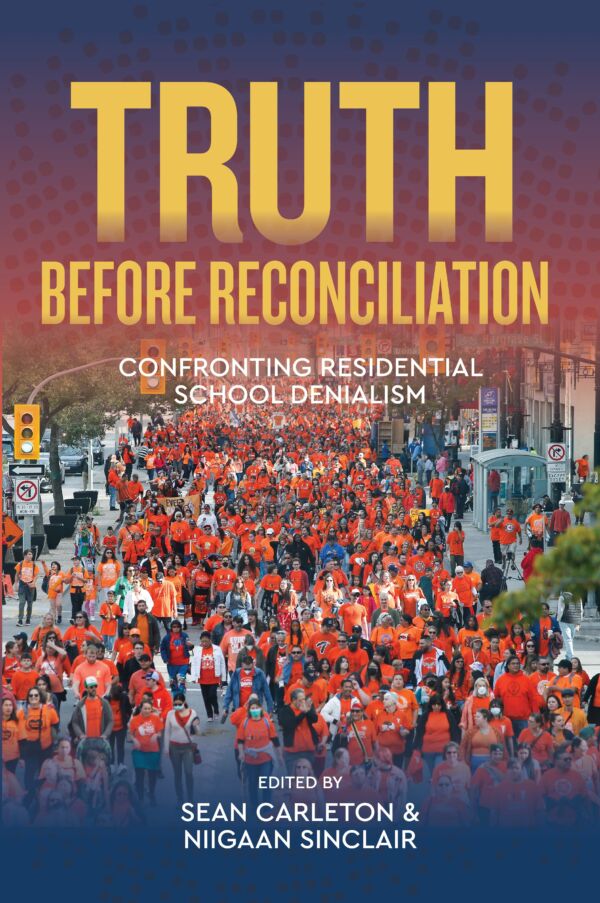
Truth Before Reconciliation: Confronting Residential School Denialism (2026)
eds. Sean Carleton and Niigaanwewidam James Sinclair
Countering soundbites with substance, Sean Carleton and Niigaan Sinclair, along with a team of expert historians, educators, Survivors, archivists, and archeologists, analyze the genesis, methods, and consequences of denialism; push back on denialist claims; and highlight some of the primary sources and peer-reviewed scholarship that denialists ignore or misrepresent. Importantly, they also document the harms denialists have inflicted on Survivors and communities.
Embedded in the lived experiences of Survivors and supported by the evidentiary record, Truth Before Reconciliation is a valuable tool to help develop the historical and information literacy needed to identify and combat denialism and anti-Indigenous racism as we collectively build a more honourable future for all.
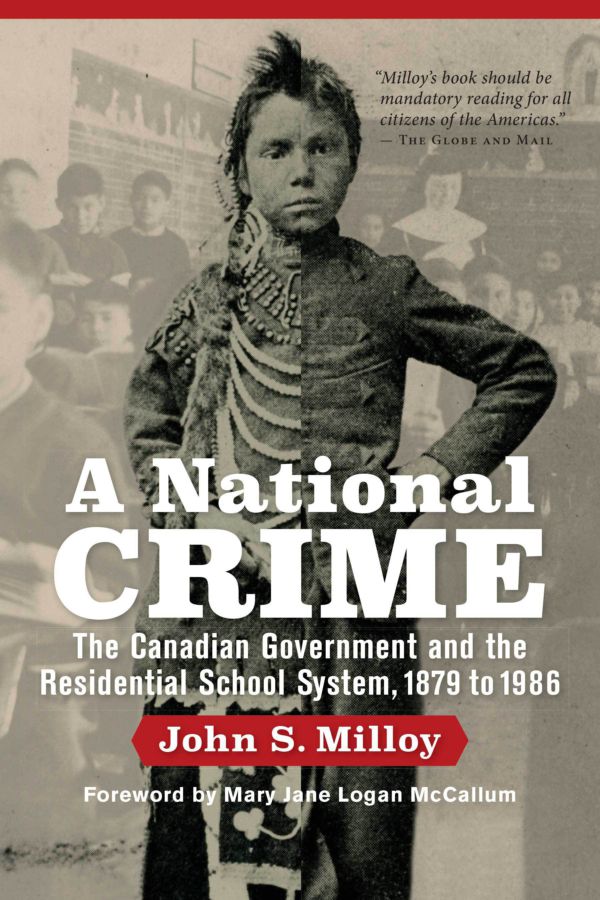
A National Crime: The Canadian Government and the Residential School System, 2nd ed. (2017)
John S. Milloy, foreword by Mary Jane Logan McCallum
Using previously unreleased government documents, historian John S. Milloy provides a full picture of the history and reality of the residential school system. He begins by tracing the ideological roots of the system, and follows the paper trail of internal memoranda, reports from field inspectors, and letters of complaint. In the early decades, the system grew without planning or restraint. Despite numerous critical commissions and reports, it persisted into the 1970s, when it transformed itself into a social welfare system without improving conditions for its thousands of wards.
A National Crime shows that the residential system was chronically underfunded and often mismanaged, and documents in detail how this affected the health, education, and well-being of entire generations of Indigenous children.
By Strength, We Are Still Here: Indigenous Peoples and Indian Residential Schooling in Inuvik, Northwest Territories (2024)
Crystal Gail Fraser
By Strength, We Are Still Here shares the lived experiences of Indigenous northerners from 1959 until 1982, when the territorial government published a comprehensive plan for educational reform. Led by Survivor testimony, Fraser shows the roles both students and their families played in disrupting state agendas, including questioning and changing the system to protect their cultures and communities.
Centring the expertise of Knowledge Keepers, By Strength, We Are Still Here makes a crucial contribution to Indigenous research methodologies and to understandings of Canadian and Indigenous histories during the second half of the twentieth century.
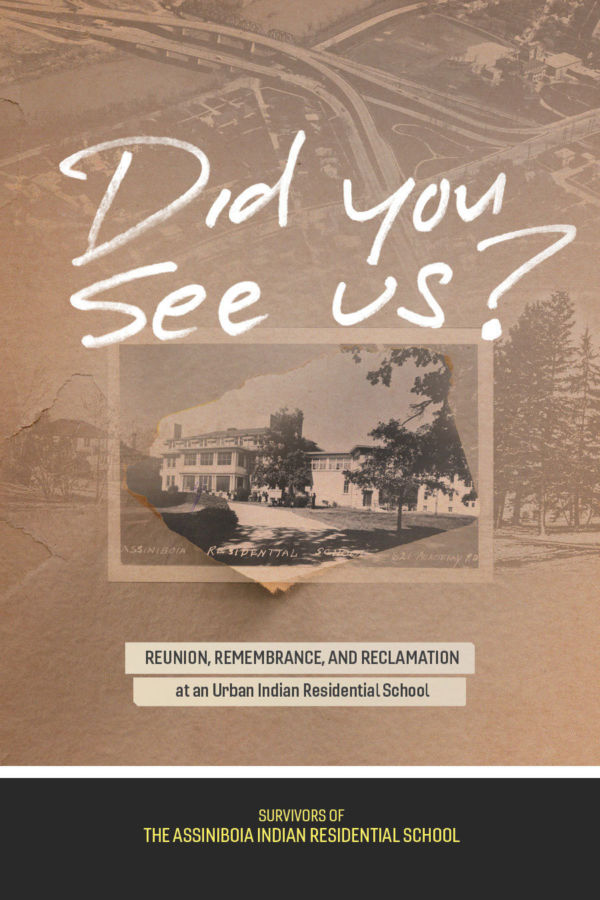
Did You See Us?: Reunion, Remembrance, and Reclamation at an Urban Indian Residential School (2021)
Survivors of the Assiniboia Indian Residential School, edited by Andrew Woolford
Stitching together memories of arrival at, day-to-day life within, and departure from the school with a socio-historical reconstruction of the school and its position in both Winnipeg and the larger residential school system, Did You See Us? offers a glimpse of Assiniboia that is not available in the archival records. It connects readers with a specific residential school and illustrates that residential schools were often complex spaces where forced assimilation and Indigenous resilience co-existed.
These recollections of Assiniboia at times diverge, but together exhibit Survivor resilience and the strength of the relationships that bond them to this day. The volume captures the troubled history of residential schools. At the same time, it invites the reader to join in a reunion of sorts, entered into through memories and images of students, staff, and neighbours. It is a gathering of diverse knowledges juxtaposed to communicate the complexity of the residential school experience.
Teach-in for Reconciliation 2023
On September 29th 2023, the Nursing Students’ Association in collaboration with the Office of the Vice-President (Indigenous), the National Centre for Truth and Reconciliation, the Centre for Human Rights Research, the University of Manitoba’s Student Union, PINE (Pathway to Indigenous Nursing Education), and the Indigenous Students’ Association hosted a day of events in recognition of the National Day for Truth and Reconciliation. Part of the day’s events included a Teach-In for Reconciliation that took place at the Investors Group Athletic Centre. Watch a video of the teach-in below.
The Teach-In covered topics including combating Residential School denialism; the Doctrine of Discovery and the Pope’s apology; the Peace and Friendship treaties which were formed at the Treaty of Niagara; and the Truth and Reconciliation Commission and the United Nations Declaration on the Rights of Indigenous Peoples.
History in the Hot Seat
Created through a SSHRC Knowledge Synthesis grant, the History in the Hot Seat project synthesized a decade of reckoning with Canada’s past and what it means to learn and teach it considering ongoing histories of colonialism and Indigenous dispossession. As such, this project produced:
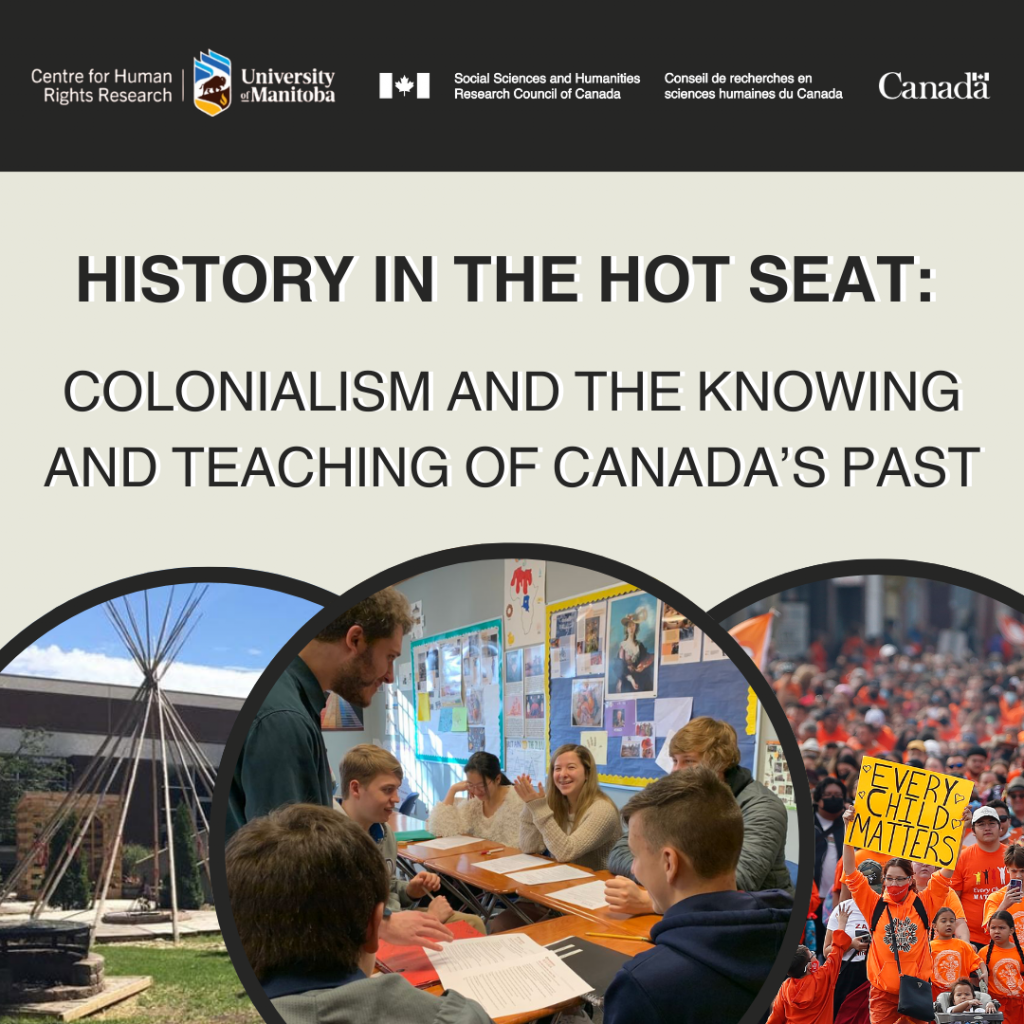
- An open-access report that summarizes the research results.
- An accessible and usable bibliography.
- A podcast series.
- A synthesis of scholarly literature, digital and print media, and grey literature about Canada’s past and colonialism since 2013.
Affiliate Publications
Over the past few years, several of CHRR’s research affiliates have published on truth and reconciliation in Canada: