Imagining the Peg as a Human Rights City
October 12
Centre for Human Rights Research, Centre for Social Sciences Research and Policy, Erica Bota, ThinkLink Graphics
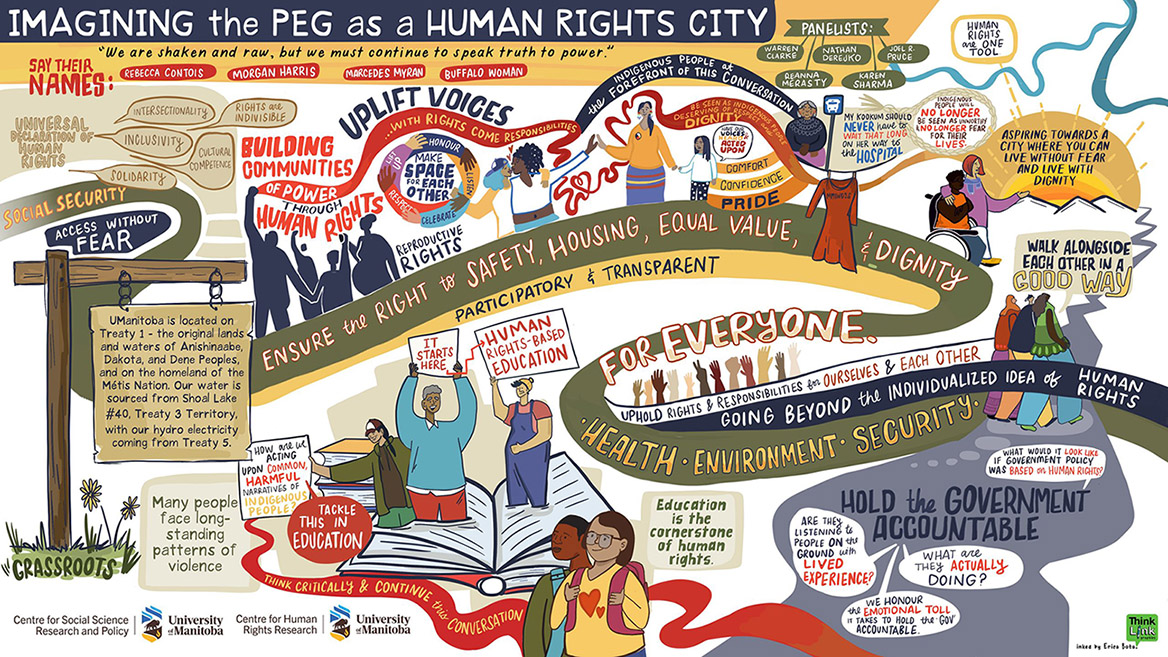
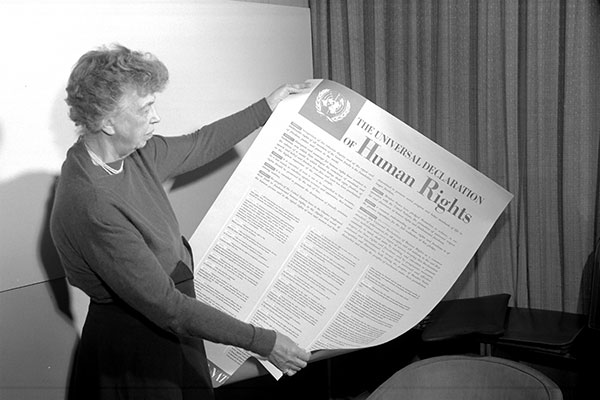
Human Rights Day is celebrated by the international community every year on 10 December. It commemorates the day in 1948 that the United Nations General Assembly adopted the Universal Declaration of Human Rights.In recognition of Human Rights Day, the CHRR alongside the Centre for Social Science Research and Policy at the University of Manitoba will host a virtual conversation entitled ‘Imagining the ‘Peg as a Human Rights City.’
Imagining the Peg as a Human Rights City
December 9, 2022
Dr. Warren Clarke, Dr. Nathan Derejko, Reanna Merasty, Dr. Joel R. Pruce, Karen Sharma
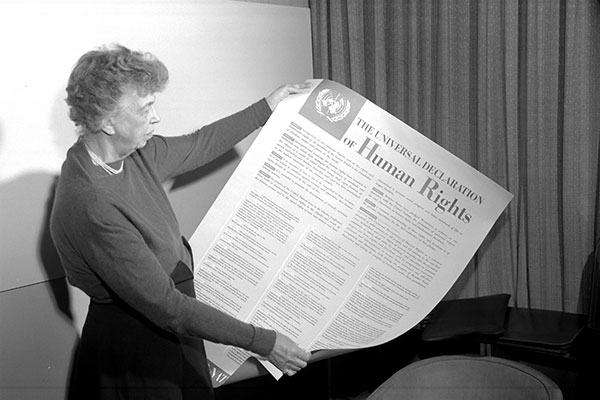
Human Rights Day is celebrated by the international community every year on 10 December. It commemorates the day in 1948 that the United Nations General Assembly adopted the Universal Declaration of Human Rights.In recognition of Human Rights Day, the CHRR alongside the Centre for Social Science Research and Policy at the University of Manitoba will host a virtual conversation entitled ‘Imagining the ‘Peg as a Human Rights City.’
Human Rights Cities: A Resource Guide
2022
Dr. Pauline Tennent
Human Rights Day is celebrated by the international community every year on 10 December. It commemorates the day in 1948 that the United Nations General Assembly adopted the Universal Declaration of Human Rights.In recognition of Human Rights Day, the CHRR alongside the Centre for Social Science Research and Policy at the University of Manitoba will host a virtual conversation entitled ‘Imagining the ‘Peg as a Human Rights City.’
For more information on Human Rights Cities, please see as a starting point:
Legal Conventions, Declarations, Frameworks
Canadian Charter of Rights and Freedoms, Part 1 of the Constitution Act, 1982, being Schedule B to the Canada Act 1982, 1982, c 11.
United Nations (UN) General Assembly. The Universal Declaration of Human Rights (UDHR). New York: United Nations General Assembly, 1948.

UN General Assembly. Convention on the Elimination of All Forms of Discrimination Against Women (CEDAW), 18 December 1979, United Nations, Treaty Series, vol. 1249, p. 13.
UN General Assembly, International Convention on the Elimination of All Forms of Racial Discrimination, 21 December 1965, United Nations, Treaty Series, vol. 660, p. 195.
UN General Assembly. Convention on the Rights of Peasants, 28 September 2018. United Nations, 39th session.
UN General Assembly. Convention on the Rights of Persons with Disabilities: resolution / adopted by the General Assembly, 24 January 2007, A/RES/61/106.
UN General Assembly, Convention on the Rights of the Child, 20 November 1989, United Nations, Treaty Series, vol. 1577, p. 3.
UN General Assembly. United Nations Declaration on the Rights of Indigenous Peoples. resolution / adopted by the General Assembly, 2 October 2007, A/RES/61/295.
UN General Assembly. International Covenant on Civil and Political Rights, 16 December 1966, United Nations, Treaty Series, vol. 999.
UN General Assembly. International Covenant on Economic, Social and Cultural Rights, 16 December 1966, United Nations, Treaty Series, vol. 993, p. 3
** For more information on the core United Nations human rights instruments and their monitoring bodies, see: https://www.ohchr.org/en/core-international-human-rights-instruments-and-their-monitoring-bodies
On Human Rights and Human Rights Cities
Danish Institute for Human Rights. 2020. Human rights impact assessment guidance and toolbox.
Global Charter – Agenda for Human Rights in the City: www.uclg-cisdp.org/sites/default/files/UCLG_Global_Charter_Agenda_HR_City_0.pdf
Human Rights Cities Alliance: www.uclg-cisdp.org/en/observatory/national-human-rights-cities-alliance
Human Rights Cities Network: https://humanrightscities.net/who-we-are/
McCracken, Molly. 2019. Poverty in the Hometown of Human Rights. Winnipeg: Canadian Centre for Policy Alternatives Manitoba Office.
Raoul Wallenberg Institute. 2020. What is a Human Rights City: https://rwi.lu.se/blog/what-is-a-human-rights-city/
Smith, Jackie and Joshua Cooper. 2019. Bringing human rights home: new strategies for local organizing. OpenGlobalRights.
US Human Rights Network: www.ushrnetwork.org/
University of Minnesota Human Rights Library: http://hrlibrary.umn.edu/
World Human Rights Cities Forum. 2014. Gwangju Guiding Principles for a Human Rights City.
MMIWG2S+
Aboriginal Justice Implementation Commission. 1999. The Deaths of Helen Betty Osborne and
John Joseph Harper. Commissioners A.C. Hamilton and C.M. Sinclair.
Amnesty International – Canada. 2004. Stolen Sisters: A Human Rights Response to Discrimination and Violence against Indigenous Women in Canada.
Gunn, Brenda. 2017. Engaging a Human Rights Based Approach to the Murdered and Missing Indigenous Women and Girls Inquiry. Lakehead Law 2(2): 89-116.
Ladner, Kiera and Shawna Ferris. A digital archive of the Walking With Our Sisters project initiated by Métis artist and activist Christi Belcourt.
National Inquiry into Missing and Murdered Indigenous Women and Girls. 2019. Reclaiming Power and Place: the Final Report of the National Inquiry into Missing and Murdered Indigenous Women and Girls.
National Inquiry into Missing and Murdered Indigenous Women and Girls. 2019. Calls for Justice.
Native Women’s Association of Canada. 2009. Voices of our Sisters in Spirit: A Report to Families and Communities. 2nd ed.
Perry, Adele, Jocelyn Thorpe and Karine Duhamel. 2021. Missing the Bus: Indigenous Women and Two-Spirit Plus People and Public Transit in Western Canada. Podcast and report available here.
On Indigenous and Human Rights
At the Forks. A meeting place for conversation and information about the intersection between Indigenous rights and human rights, with a focus on the prairies and its neighbours led by Dr. Adele Perry and Dr. Kiera Ladner, University of Manitoba.
Aboriginal Law Resources, see: https://chrr.info/other-resources/aboriginal-law-resources/
Gunn, Brenda. 2011. Understanding and Implementing the Universal Declaration on the Rights of Indigenous Peoples: An Introductory Handbook. Winnipeg.
On Human Rights Education
Freire, Paulo, 1921-1997. Pedagogy of the Oppressed. New York: Continuum, 2000.
Related Resources
Support Us
Whether you are passionate about interdisciplinary human rights research, social justice programming, or student training and mentorship, the University of Manitoba offers opportunities to support the opportunities most important to you.
Fighting for Reproductive Rights in 2022
July 13, 2022
Karen Sharma, Nahanni Fontaine, Kemlin Nembhard, Dr. Sarah Elvins, Dr. Lindsay Larios
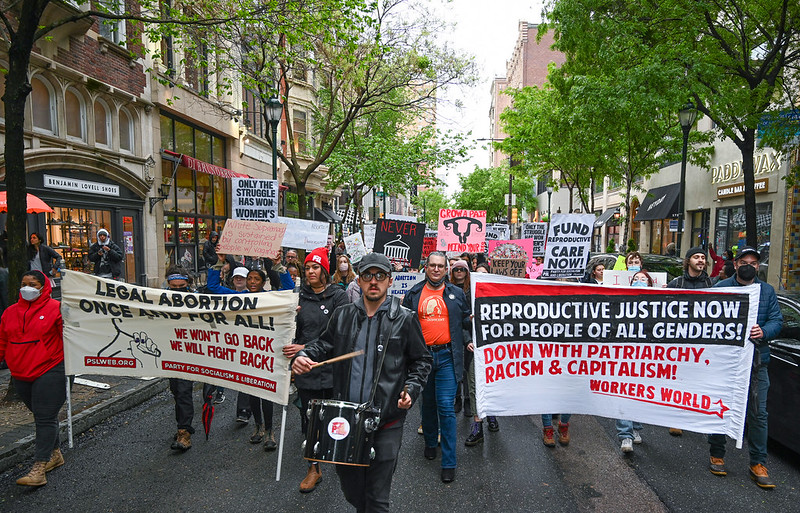
On July 13, 2022 the Centre for Human Rights Research at the University of Manitoba hosted an informative, webinar roundtable discussion “Fighting for Reproductive Rights in 2022.”
This discussion brought together a variety of scholars and advocates – and those who identify as both – including Karen Sharma, Nahanni Fontaine, Kemlin Nembhard, Dr. Sarah Elvins, and Dr. Lindsay Larios, to provide context, information and solidarity as we move forward.
Across Oceans of Law
March 14, 2022
Dr. Renisa Mawani
In 2022, the University of Manitoba’s Centre for Human Rights Research annual seminar series was held online, and ran in conjunction with a senior/honours course in the Department of History, Faculty of Arts. Our theme was “Historic Wrongs and Human Rights in Canada.” Leading scholars from across Canada discussed their research examining different moments of dispossession, unfreedom, incarceration, and expulsion, and how researchers and curators have navigated them.
Civilian Internment in Canada: Histories & Legacies
March 2022
Dr. Rhonda Hinther, Dr. Jim Mochoruk
In 2022, the University of Manitoba’s Centre for Human Rights Research annual seminar series was held online, and ran in conjunction with a senior/honours course in the Department of History, Faculty of Arts. Our theme was “Historic Wrongs and Human Rights in Canada.” Leading scholars from across Canada discussed their research examining different moments of dispossession, unfreedom, incarceration, and expulsion, and how researchers and curators have navigated them.
Resource Hub
Working with Journalists: Human Rights, Research and the Realities of the Newsroom
March 10, 2022
Lenard Monkman, Helen Fallding
In this interactive workshop Lenard Monkman (CBC Indigenous) and Helen Fallding (former political reporter, Winnipeg Free Press) provide guidance on how students and researchers doing human rights work can appropriately and effectively disseminate their research to a broader audience and get their work “out there”.
Resource Hub
Experiences of Enslaved Black People in Colonial Canada
April 7, 2022
Dr. Harvey Amani Whitfield
In 2022, the University of Manitoba’s Centre for Human Rights Research annual seminar series was held online, and ran in conjunction with a senior/honours course in the Department of History, Faculty of Arts. Our theme was “Historic Wrongs and Human Rights in Canada.” Leading scholars from across Canada discussed their research examining different moments of dispossession, unfreedom, incarceration, and expulsion, and how researchers and curators have navigated them.
Resource Hub
Spreading the Word: Statements, Interviews, and Oral Histories
January 17, 2022
Kaila Johnston, Misha Falk, Dr. Shayna Plaut Dr. Chantal Fiola
As part of the “Methods and Mediums” workshop series, the Centre for Human Rights Research hosted “Spreading the Word”: Statements, Interviews and Oral Histories on January 17th, 2022. The presenters all shared their own experiences, techniques and challenges with different kinds of verbal based data gathering/creating.
Join us for the next webinar in The Last Drop Water Researchers Speaker Series with panelists Aimée Craft (University of Ottawa), Linda Mendez-Barrientos (University of Denver), Deborah McGregor (Anishinabe, Whitefish River First Nation, Professor, University of Calgary), Anaís Roque (Duke University), and Sameer H. Shah (University of Washington).
Water and climate change are inextricably linked — extreme weather events are making water more scarce, more unpredictable, and more polluted. These impacts throughout the water cycle threaten all aspects of human relationships with water. Work at the intersection of water and climate justice is needed to understand how socio-cultural, political, and economic relationships at different scales serve to co-create and maintain injustices in diverse hydrosocial systems (i.e., transition to low-carbon futures using large-scale hydroelectricity generation requires assessment of water justice impacts).

Furthermore, critical assessment of the human drivers of water and climate crises can advance understandings of the ways that water- related climate risks and impacts are not strictly natural phenomena, rather they are produced by the interaction between socio-economic and political marginalization as well as physical changes in water dynamics. Overall, a combined water and climate justice lens adds nuance to ongoing and emergent water and climate crises, as they prompt us to ask who benefits, who loses out, in what ways, where, and why? At the same time, more work is needed to understand the points of intersection and divergence between water and climate injustices. This session brings together diverse scholars whose work addresses water and climate justice to explore the intersections and divergences between water and climate justices, including how these overlap with other patterns and experiences of marginality and injustice.
Registration required. To register, visit: https://umanitoba.zoom.us/meeting/register/0rzhln4-SQWrazhJCNNtxg
About the Speakers
Aimée Craft is an award-winning teacher and researcher, recognized internationally as a leader in the area of Indigenous laws, treaties and water. She holds a University Research Chair Nibi miinawaa aki inaakonigewin: Indigenous governance in relationship with land and water.
An Associate Professor at the Faculty of Common law, University of Ottawa and an Indigenous (Anishinaabe-Métis) lawyer from Treaty 1 territory in Manitoba, she is the former Director of Research at the National Inquiry into Missing and Murdered Indigenous Women and Girls and the founding Director of Research at the National Centre for Truth and Reconciliation. She practiced at the Public Interest Law Centre for over a decade and in 2016 she was voted one of the top 25 most influential lawyers in Canada. In 2021 she was awarded the prestigious Canadian Bar Association President’s Award.
Prof. Craft prioritizes Indigenous-lead and interdisciplinary research, including through visual arts and film, co-leads a series of major research grants on Decolonizing Water Governance and works with many Indigenous nations and communities on Indigenous relationships with and responsibilities to nibi (water). She plays an active role in international collaborations relating to transformative memory in colonial contexts and relating to the reclamation of Indigenous birthing practices as expressions of territorial sovereignty.

Linda Mendez-Barrientos is an Assistant Professor at the Josef Korbel School of Global and Public Affairs at the University of Denver. In this role, she leads the Environmental Justice & Policy Research lab (ejpr), which is dedicated to understanding how inequality and power asymmetries shape institutional change processes and environmental justice. She is also the co-founder of s2e-Science to Empower, an environmental justice initiative that leverages data and innovative research to facilitate environmental accountability and human rights protection, and increase the participation of diverse and historically excluded voices in the decisions that define new sustainable trajectories.
Dr. Mendez-Barrientos research lies at the intersection of institutional change, public policy implementation, environmental justice, and natural resource governance, with a focus on water policy and management. Her work has been published in top interdisciplinary journals including Scientific Reports, Society & Natural Resources, Ecology & Society, Environmental Policy & Planning, Environmental Policy & Governance, and Environment and Planning E: Nature & Space, as well as leading water journals, including Nature Water, Wiley Interdisciplinary Reviews: Water, Water Security, Water Policy, and the International Journal of Water Resources Development. She is also the recipient of a number of prestigious and competitive awards, including the National Science Foundation (NSF) Graduate Research Fellowship (2016-2021), NSF Integrative Graduate Education & Research Traineeship (2015-2017), and European Commission Agris Mundus Scholarship (2008-2010).
Dr. Mendez-Barrientos earned her Ph.D. in Ecology from the University of California Davis, and holds a MSc. in Water Management from Wageningen University in the Netherlands, and a MSc. on Tropical Agrarian Systems from Montpellier SupAgro in France. Before academia, Dr. Mendez-Barrientos served as an environmental policy analyst for several years with the Environmental Defense Fund.

Deborah McGregor, Anishinabe, Whitefish River First Nation, Professor, University of Calgary. Dr. McGregor’s research has focused on Indigenous knowledge systems in diverse contexts including environmental and water governance, environmental and climate justice, health and Anishinaabe legal traditions. She remains actively involved in a variety of First Nation initiatives, continuing to serve as an advisor and engaging in community-based research and initiatives.

Dr. Anaís Delilah Roque Antonetty (she/her/ella) is an environmental social scientist and anthropologist who studies resource insecurity and health in the Anthropocene. Currently, her research agenda is interested in how households and communities experience, prepare for, and respond to food, energy, and water insecurity during “normal” times and in the wake of a hazard (e.g., geophysical, climatological) or disaster. Dr. Roque is also interested in the health outcomes of such experiences and the extent to which strategies to address insecurity across scales (e.g., household, community, policy) shape pathways to better or worse health and well-being. Trained as a mixed-methods scholar, Dr. Roque uses a range of methodologies in her research, including ethnographic research methods, participatory research methods (e.g., photovoice, participatory mapping, CBPR, action research), social networks, and surveys, among others.
Inspired by scholarship that embraces diverse epistemological approaches, Dr. Roque is part of several interdisciplinary and transdisciplinary teams that advance research at the intersections of environmental behaviors, community resilience, and social vulnerability. She conducts research in Puerto Rico, the U.S. Gulf Coast, and the U.S./Mexico Borderlands.

Dr. Sameer Shah (he/him) is a John C. Garcia Professor and Assistant Professor of Climate Adaptation in the School of Environmental & Forest Sciences (SEFS) at the University of Washington. He is also an Affiliate with the UW Center for Studies in Demography in Ecology, Center for Environmental Politics, and Clean Energy Institute. Dr. Shah holds expertise in the human dimensions of climate change vulnerability and adaptation. He aims to understand how systemic marginalization, and climate-related change and disasters interact to create and amplify uneven water, food, and energy insecurities for communities on the frontlines of climate change. In particular, his research develops theoretical, conceptual, and empirical analyses of the equity, justice, and sustainability outcomes of climate adaptation and disaster response at multiple scales.
Dr. Shah’s most current research is focused on the causal drivers and impacts associated with “climate maladaptation.” Through research in South/Southeast Asia, the contiguous U.S., and Puerto Rico, he and his collaborators seek to advance interventions that reduce the disproportionately larger climate risks experienced by marginalized groups, and to shape long-term policy strategies that transform the underlying systems that heighten these impacts. At SEFS, Dr. Shah directs the WATERS Research Collaborative (Water, Adaptation & Transformation: Equity, Resilience and Sustainability). He is also a co-founder of the SOLVER (Social Vulnerability and Resilience) Research Laboratory.

Support Us
Whether you are passionate about interdisciplinary human rights research, social justice programming, or student training and mentorship, the University of Manitoba offers opportunities to support the opportunities most important to you.
Contact Us
We’d love to hear from you.
442 Robson Hall
University of Manitoba
Winnipeg, Manitoba
R3T 2N2 Canada
204-474-6453
Quick Links
Subscribe to our mailing list for periodic updates from the Centre for Human Rights Research, including human rights events listings and employment opportunities (Manitoba based and virtual).
Traditional Territories Acknowledgement
The University of Manitoba campuses are located on the original lands of the Anishinaabeg, Ininiwak, Anisininewuk, Dakota Oyate, Dene and Inuit, and on the National Homeland of the Red River Métis.
Centre for Human Rights Research 2023© · Privacy Policy