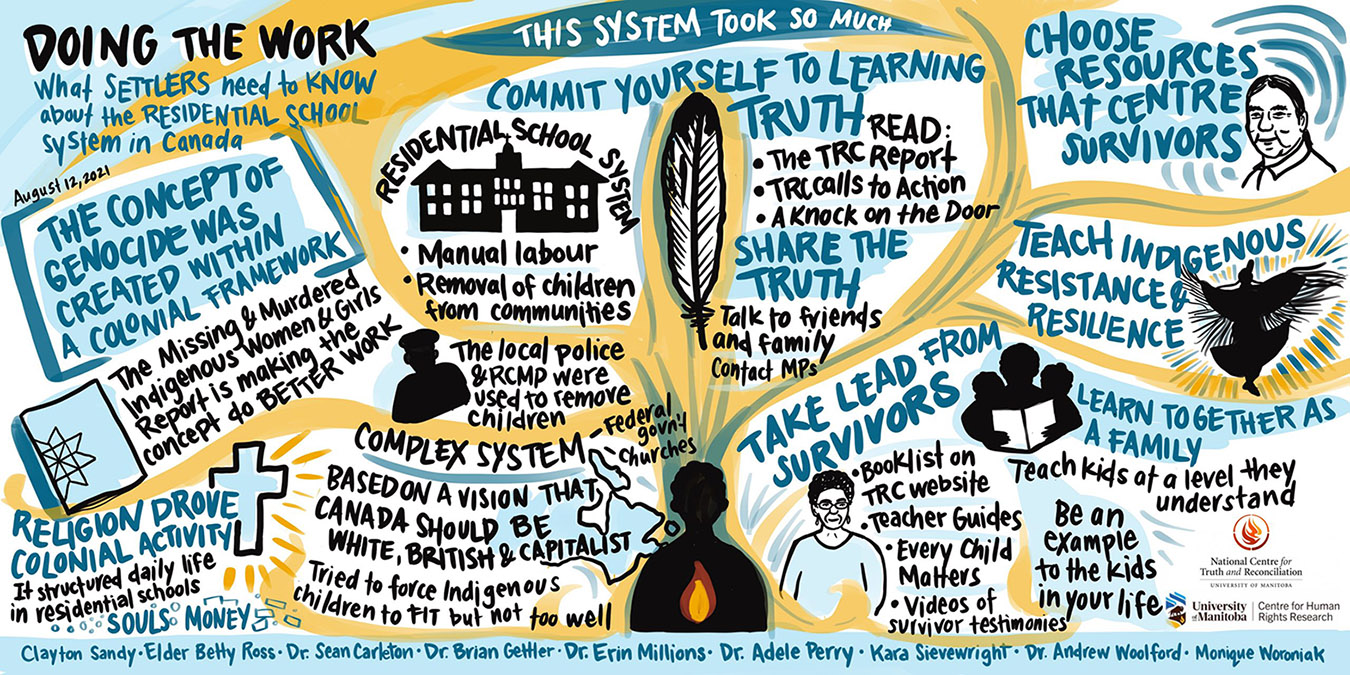
Doing the Work: What Settlers need to know about the Residential School System
August 12, 2021
Elder Betty Ross, Clayton Sandy, Dr. Sean Carleton, Dr. Brian Gettler, Dr. Erin Millions, Dr. Adele Perry, Dr. Andrew Woolford, Monique Woroniak
On Thursday, August 12th 2021, the Centre for Human Rights Research hosted “Doing the Work: A virtual Q & A on what settlers need to know about the residential school system in Canada.”This was a virtual Q&A session where our panel answered submitted questions and suggested available resources to help increase awareness and education about residential schools and the impact of colonialism in Canada.
At the Forks: Virtual Launch
June 25, 2021
Dr. Adele Perry, Dr. Kiera Ladner, Amy Jackson, Kayla Lariviere
The Centre for Human Rights Research (CHRR) presents: At the Forks: A Virtual Launch. ‘At the Forks’ is a project led by Dr. Adele Perry, Director of the Centre for Human Rights Research alongside Dr. Kiera Ladner and the Mamawipawin Centre for Indigenous Governance and Community-Based Research at the University of Manitoba. ‘At the Forks’ will feature accessible, open access writing that deals with the intersection of Indigenous and human rights in and around the prairies.
Pride Month - A Conversation with Dr Jocelyn Thorpe
June 22, 2021
Dr. Jocelyn Thorpe, Kayla Lariviere
The Centre for Human Rights Research (CHRR) presents: Pride Month — A Conversation with Dr. Jocelyn Thorpe. June 22, 2021
Resource Hub
The Right to Food and Community Gardens in Winnipeg: The Meadowood Victory Garden
June 2021
Laura Funk Fabiana Li
The COVID-19 pandemic caused disruptions in the food system that have sparked interest in growing food in home and community gardens. This research investigated the concept of “Victory Gardens” (food gardens popularized during wartime) as a response to the COVID-19 pandemic, using the Meadowood Victory Garden in Winnipeg as a case study. The research examined the potential of using the city’s green spaces, water and infrastructure to grow food for urban residents during the pandemic and beyond.
Resource Hub
Three UM Researchers to Examine more Equitable and Sustainable Public Transport Opportunities
June 7, 2021
UM Today Staff
Resource Hub
A screening of the David Suzuki Foundation’s LAND BACK
April 22, 2021
Aimée Craft, Danielle Morrison, Taylor Galvin
On April 22, 2021, The Centre for Human Rights Research (CHRR) presents: A screening of the David Suzuki Foundation’s LAND BACK. Panel dscussion featured Aimée Craft – Co-Producer, LAND BACK video series, Author, Associate Professor, University of Ottawa; Danielle Morrison – Lawyer, Narrator, University of Manitoba alumna; and Taylor Galvin – President, Indigenous Concerns on the Environment (UMICE). The LAND BACK video series consists of three videos. We welcome you to watch videos two and three in the series (PRESENT and FUTURE, respectively) on the David Suzuki Website.
World Water Day: Why Menstrual Justice Matters Too
March 21, 2025
Emma Cowman
Every March 22, the United Nations’ World Water Day calls attention to the importance of water and access to safe water. Yet these discussions on the importance of water often ignore how in many contexts, lack of clean water is a direct form of colonial violence, including here in Canada, disproportionately impacting Indigenous communities, particularly Indigenous women, Two-Spirit, and gender-diverse people. The ongoing water crisis is not just an environmental issue, but a gender justice issue. It is also an issue of menstrual justice.
The systemic neglect of water infrastructure on reserves, driven by colonial policies and environmental racism, exacerbates the barriers Indigenous menstruators face in managing their periods with dignity. As we observe World Water Day, we must acknowledge access to clean water as fundamental to ensuring menstrual and gender justice and to achieving human rights.
The Colonial Legacy of Water Injustice
The lack of clean water on many Indigenous reserves is a direct consequence of colonial policies that forcibly displaced Indigenous peoples to remote areas where clean water is inaccessible, and water infrastructure is inadequate. Historically, these waters were safe and accessible, but the harmful impacts of resource extraction, hydroelectric projects, and contamination – driven by colonial and neoliberal agendas – have rendered them unsafe. The inability to access clean water is also an issue of access to hygiene. On some reserves, the water may so contaminated that it causes severe skin conditions such as scabs, sores, or eczema from bathing in it. When water is made usable for consuming and hygiene purposes, it is often accomplished by the labour of community members, who are more than often women. As a result, securing clean water becomes a labor-intensive, unpaid, and time-consuming responsibility that is domesticated and feminized, reinforcing gendered divisions of care work.
Despite Canada’s international reputation as a water-rich nation, the federal government has stated that they have no legal duty to ensure First Nations communities have clean drinking water. This deliberate negligence leaves Indigenous menstruators – who require clean water for hygiene, comfort, and health – without the resources needed to manage their periods with dignity. The financial burdens of purchasing bottled water for hygiene, in addition to the overpriced menstrual supplies in remote areas, deepens the economic hardships and social exclusion faced by menstruators.
Menstrual Justice and Water Justice
Water and menstrual justice are inextricably linked. Without access to clean water, menstruators cannot safely use reusable menstrual products or maintain basic hygiene. The lack of clean water for Indigenous communities is a form of ongoing colonial violence that is not only affecting the hygiene of Indigenous menstruators but invariably impacts Indigenous peoples’ relationships to and with water and menstruation. And yet, as settler colonial violence works to sever Indigenous peoples’ connections to land, culture, and family, Indigenous peoples have always resisted.
This crisis extends beyond Indigenous communities. Unhoused and incarcerated menstruators also experience significant barriers to managing their periods. Public washrooms often lack free menstrual products or privacy for unhoused folk to manage their menstrual cycles with privacy. Correctional facilities frequently restrict, deny, or weaponize the distribution of menstrual supplies and access to water for incarcerated menstruators.
In a country that prides itself on gender equity, human rights, and access to clean water, the realities faced by menstruators, particularly Indigenous menstruators and unhoused or incarcerated menstruators, across Canada is unacceptable.
A Call for Anti-Colonial Action
Addressing the intertwined injustices of water and menstruation requires an anti-colonial approach. The federal government must be held accountable for its failure to provide Indigenous communities with clean water and ensure equitable water infrastructure on reserves. In addition, unhoused and incarcerated menstruators in Canada must have reliable access to clean water so that they can manage menstruation with dignity. Water is not a luxury item, and neither are menstrual supplies. Universal access to safe and clean water and menstrual supplies is essential to ensure the safety, privacy, dignity, and human rights of all menstruators.
This is a water justice, menstrual justice, and gender justice issue that demands urgent action. We must dismantle the colonial and capitalist systems that commodify essential resources, advocate for policy changes that prioritize Indigenous water sovereignty, and challenge the social stigmas that keep menstrual and water justice on the sidelines.
On this World Water Day, let us commit to recognizing water and menstrual justice as fundamental human rights. Only by addressing these interconnected crises can we create a more just and equitable Canada.
Manitoba 150 Disrupted
March 16, 2021
Aimée Craft, Dr. Sherry Farrell Racette Dr. Erin Millions, Katherena Vermette
On March 16, 2021, the CHRR Presents Manitoba 150 Disrupted. Please note there is explicit language in this video.
150 Seen Through the Lens of Treaty One
After introducing her latest book “Treaty Words: For as Long As the Rivers Flow”, University of Ottawa Law Professor and Author Aimée Craft said now is a good time to revisit treaty agreements and interpretations.
“One of the things I’ve spent most of my life arguing is that treaties were made was an agreement to share,” she continued, “I think that this is still fundamentally misunderstood.”
Craft noted that “at the core” of Indigenous Treaty interpretations are concepts of reciprocity, respect, and renewal.
“[Manitoba 150] is an opportunity to reflect on what is the agreement, what it should look like today, and how we should honour it and respect it,” she said.
*****
Kwataa-nihtaawakihk: A Hard Birth
Scholar and Artist Sherry Farell Racette spoke about her role in rebooting and re-engaging Kwataa-nihtaawakihk: A Hard Birth, a Métis art exhibit that was initially planned for a May 2020 opening.
Some goals of the exhibit, which is now scheduled to open on the 5th of February 2022, include centering the role of the Métis in the creation of Manitoba, contextualizing Louis Riel, and recreating impressions of Métis unique artistic and material culture. The exhibit will be home to significant historic documents, contemporary and historic art, as well as community centred programming.
“We hope to be able to have that laughing, dancing, and music,” she continued, “We hope to bring in artists for artist talks, film screenings, and talking circles in front of works of art because they invite dialogue.”
*****
Manitoba 150 x HBC 350
Manitoba Indigenous Tuberculosis Photo Project Research Director Dr. Erin Millions spoke about the intersection between Hudson Bay Company’s (HBC) 350th anniversary and Manitoba 150.
Dr. Millions noted that the famous Winnipeg downtown HBC building is a reminder of a colonial legacy that targeted, exploited, and devastated Indigenous communities. She said the disruptions of both HBC 350 and Manitoba 150 is an opportunity to rethink “commemoration in Manitoba in a way that lets us prioritize Indigenous perspectives.”
*****
A Girl Called Echo
The panel’s final speaker, Métis Writer Katherena Vermette, spoke about the latest book in her graphic novel series “A Girl Called Echo.”
The series follows Echo Desjardins, a 13-year-old Métis girl who struggles with loneliness and separation as she adjusts to a new home and school. Her journey of learning about her Métis identity becomes an extraordinary tale that brings the past to the present as Echo travels through time to live and experience Métis history in the prairies.
Vermette closed her discussion with a recitation of her poem When Louis Riel Went Crazy, which can be found here.
UN Declaration on the Rights of Peasants
February 24, 2021
Geneviève Savigny, Jessie MacInnis, Nadia Lambek, Dr. Annette Aurélie Desmarais
On Feb. 24, 2021, the Centre for Human Rights Research presented a panel on the “UN Declaration on the Rights of Peasants: What it Means for Canada” with a focus on:
- Why is UNDROP necessary? (Geneviève Savigny, La Vía Campesina’s Peasant Rights Collective, Confédération Paysanne, France)
- What Does UNDROP Mean for Canada? (Jessie MacInnis, La Vía Campesina’s Peasant Rights Collective, National Farmers Union)
- The Rights of Migrant Farm Workers in Canada (Nadia Lambek, human rights lawyer & chair, Canadian Association for Food Law and Policy)
The United Nations Declaration on the Rights of Peasants (UNDROP) provides a framework for transforming “the corporate-led industrial system to a more socially just and ecologically sustainable food system,” according to University of Manitoba Prof. Annette Desmarais. She chaired an online panel discussion Feb. 24, 2021, about what the relatively new document might mean for Canada.
People of the land
UNDROP defines a peasant as “any person who engages or who seeks to engage alone, or in association with others or as a community, in small-scale agricultural production for subsistence and/or for the market, and who relies significantly, though not necessarily exclusively, on family or household labour and other non-monetized ways of organizing labour, and who has a special dependency on and attachment to the land.”
History of UNDROP
Early negotiations around developing international instruments to support farmers and peasants began at the turn of the 21st century.
Geneviève Savigny, a leading member in La Vía Campesina’s Peasant Rights Collective, said the 2008 food crisis helped catalyze international recognition of the importance of food security.
“In September 2012, there was a resolution passed in the United Nations Human Rights Council to establish the first Open-Ended Intergovernmental Working Group (OEIWG) to start negotiating, finalizing and to submit a draft of the declaration,” she said.
In five OEIWG sessions held between 2013 and 2018, the intended scope of the declaration was expanded to include fishermen, pastoralists, Indigenous peoples and other food producers.
The final draft of the declaration included 28 articles ranging from the rights to natural resources and development, to the rights to education and training. It passed in the UN General Assembly Dec. 18, 2018.
Canada abstained from the vote.
UNDROP in Canada
The Canadian constitution divides jurisdiction over work on farms between the federal and provincial governments.
Nadia Lambek, chair of the Canadian Association for Food Law and Policy, said provincial employment standards legislation excludes farm workers. This means there are no maximum hours of work, no legislated rest periods and no minimum wage.
“An employer can have an employee work for 14 days straight without any overtime and without any public holidays,” she said.
In 2011, the Supreme of Canada ruled that farm workers do not have the right to unionize and bargain collectively.
Although Canada abstained from the declaration vote, National Farmers Union Youth Vice-President Jessie MacInnis said UNDROP can still be used a “legal tool for change.”
“Many of the rights violations often assumed to be closely associated with lower-income countries are actually well and alive here in Canada,” she said.
MacInnis highlighted that the movement for food sovereignty underway in Canada signals a shift from a market-based approach to agricultural policy. To steer this momentum towards reform, MacInnis suggests using the language of the declaration as a “rallying point.”
“In my opinion, the declaration is really the best holistic framework to address the rights violations that the peasant farmers and farmworkers in Canada are experiencing today,” she said.
Isha Khan in Conversation with Dr. Adele Perry
February 16, 2021
Isha Khan, Dr. Adele Perry
On Feburary 16, 2021, Isha Khan, President of the Canadian Museum for Human Rights sat down for a virtual conversation with Dr. Adele Perry, director of the Centre for Human Rights Research, University of Manitoba.
Contact Us
We’d love to hear from you.
442 Robson Hall
University of Manitoba
Winnipeg, Manitoba
R3T 2N2 Canada
204-474-6453
Quick Links
Subscribe to our mailing list for periodic updates from the Centre for Human Rights Research, including human rights events listings and employment opportunities (Manitoba based and virtual).
Traditional Territories Acknowledgement
The University of Manitoba campuses are located on the original lands of the Anishinaabeg, Ininiwak, Anisininewuk, Dakota Oyate, Dene and Inuit, and on the National Homeland of the Red River Métis.
Centre for Human Rights Research 2023© · Privacy Policy