Pride in Health 2024: Two Spirit History and Health -- Graphic Recording
October 25, 2024
Miranda Maslany, Drawing Change
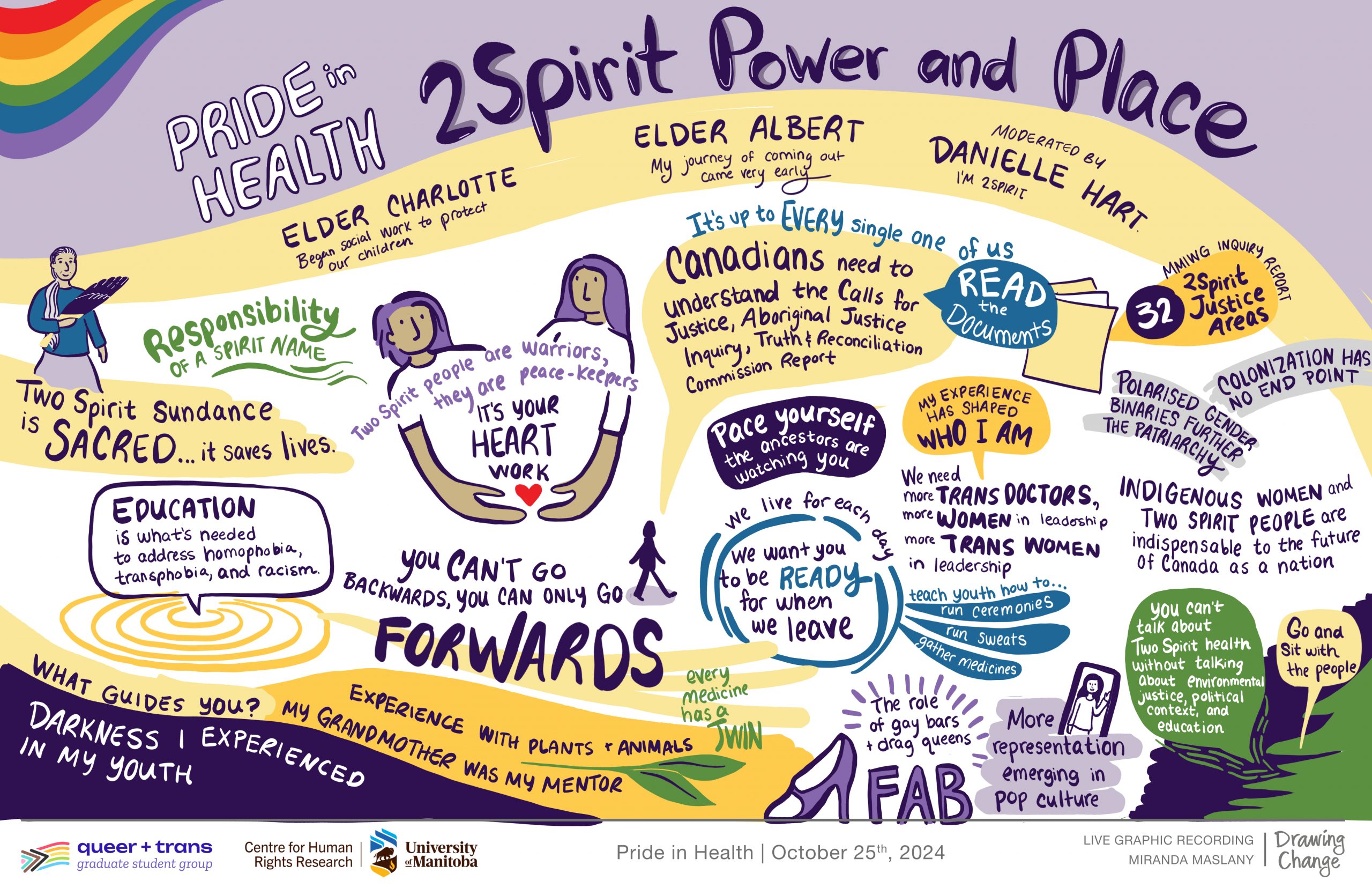
As part of Pride and Health 2024, we were honoured to host a panel on Two Spirit History and Health with Elders Albert McLeod and Charlotte Nolin. Elders Nolin and McLeod shared the history of Two Spirit and how that identity intersects with the health and healthcare needs of Two Spirit people. This panel, moderated by Community Health Sciences graduate student Danielle Hart, provided an opportunity for Two Spirit teachings to be shared, and centers the Two Spirit experience with healthcare, which is fraught with homophobia/transphobia in addition to racism.
This panel was held on the land colonially called Winnipeg, where Two Spirit was gifted to Elder Myra Laramee in a dream, 34 years ago in 1990. The gift of Two Spirit was introduced in 1990 at the third annual international LGBT Native American gathering in Winnipeg.
This event is funded in part by 2SLGBTQIA+ History Month Canada, the University of Manitoba Office of Equity Transformation.
A graphic recording of the Conversation was created by Miranda Maslany from Drawing Change.


History in the Hot Seat: The Teaching and Knowing of Canada’s Past
History in the Hot Seat: The Teaching and Knowing of Canada’s Past
July 18, 2024
Hannah Belec
The “History in the Hot Seat: The Teaching and Knowing of Canada’s Past” Project is part of the 2024 Knowledge Synthesis Grant Competition, funded by the Social Sciences and Humanities Research Council (SSHRC) in partnership with Canadian Heritage, Genome Canada, and UK Research Innovation’s Arts and Humanities Research Council (UKRI-AHRC). The theme of the 2024 Knowledge Synthesis Grant Competition, “Evolving Narratives of Cultures and Histories,” aims to assess and mobilize the existing knowledge on how factors such as globalization, war, colonization, racism, slavery, climate change, technology, social media, and more have shaped or changed cultural and historical narratives
Following the theme and goals of “Evolving Narratives of Cultures and Histories,” the “History in the Hot Seat” Project, in collaboration with the Centre for Human Rights Research and 101.5 UMFM, has produced a podcast series that explores what it means to learn and teach Canadian history, considering ongoing histories of colonialism and Indigenous dispossession
Episode 1
In the first episode of the “History in the Hot Seat: The Teaching and Knowing of Canada’s Past” Podcast, Dr. Adele Perry, Dr. Jarvis Brownlie, and Dr. Jocelyn Thorpe discuss the project’s objectives, outcomes, and impacts with interviewer Hannah Belec. The group also reflects on historical education and commemoration in Canada before and after the Truth and Reconciliation Commission’s 2015 Report
About Phyllis Webstad and the Orange Shirt Society: https://orangeshirtday.org/phyllis-story/
Whitfield, Harvey Amani. North to Bondage: Loyalist Slavery in the Maritimes. UBC Press, 2016.https://search.lib.umanitoba.ca/permalink/01UMB_INST/1f1g7b3/cdi_proquest_ebookcentral_EBC5331322
Herstein, H.H., L.J. Hughes, and R.C. Kirbyson. Challenge & Survival: The History of Canada, 1970. https://search.lib.umanitoba.ca/permalink/01UMB_INST/gnigpm/alma99122656420001651
Menchú, Rigoberta and Elisabeth Burgos-Debray. I, Rigoberta Menchú: An Indian Woman in Guatemala, 1984. https://search.lib.umanitoba.ca/permalink/01UMB_INST/gnigpm/alma99118874220001651
Frankenburg, Ruth. White Women, Race Matters, 1993. https://search.lib.umanitoba.ca/permalink/01UMB_INST/1f1g7b3/cdi_proquest_ebookcentral_EBC5298946
Truth and Reconciliation Commission of Canada. Final Report of the Truth and Reconciliation Commission of Canada. Volume One, Summary: Honouring the Truth, Reconciling for the Future, 2015. https://search.lib.umanitoba.ca/permalink/01UMB_INST/gnigpm/alma99148985229201651
Episode 2
In the second episode of the “History in the Hot Seat: The Teaching and Knowing of Canada’s Past” Podcast, Métis educator and administrator Kim Dudek and interviewer Hannah Belec discuss Kim’s evolving approach to teaching social studies in Manitoba; the relationship between curriculum mandates and classroom practice; recent updates to and the shortcomings of the curriculum that addresses Canada’s history of Indigenous dispossession; the role and availability of professional development for teachers to decolonize education; the importance of student activism; and the role of administration in advancing decolonization efforts in schools.
Episode 3
In the third episode of the “History in the Hot Seat: The Teaching and Knowing of Canada’s Past” Podcast, host Hannah Belec speaks with Dr. Lindsay Gibson, an Assistant Professor in the Department of Curriculum and Pedagogy at the University of British Columbia. Dr. Gibson discusses his research on commemoration controversies in Canada, exploring how historical figures and events are remembered in classrooms and the challenges educators face when teaching commemoration controversies that broach sensitive topics like colonialism and racism. The conversation delves into the role of teacher education programs in addressing these issues, how commemoration aligns with Canada’s current history curricula, and the broader debates surrounding statues and public memorials. Listeners will gain insight into the complexities of teaching history in an era of evolving public attitudes and the significance of pedagogical methods, historical thinking, and technology in navigating these controversies.

History in the Hot Seat Zotero Library
History in the Hot Seat Zotero Library
2025
Author
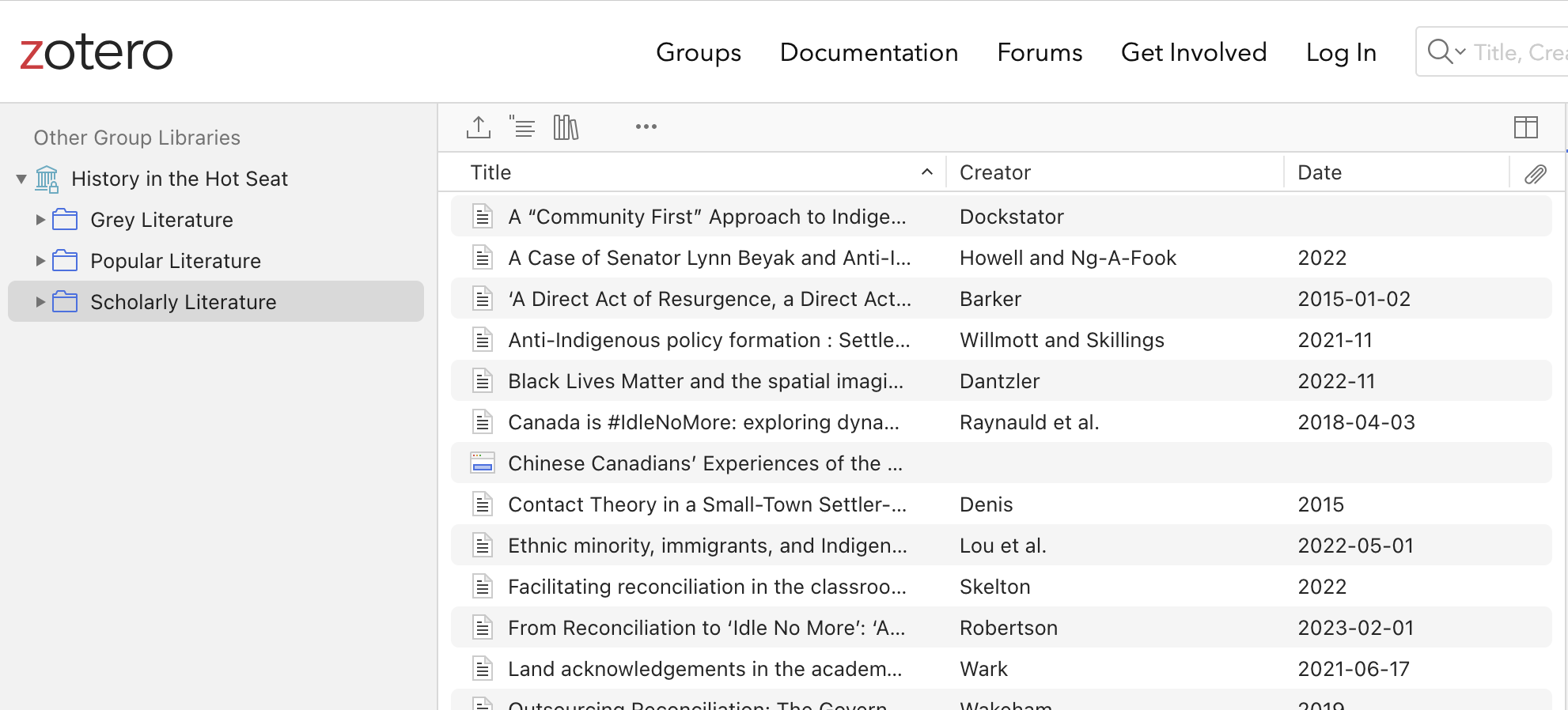
As a part of History in the Hot Seat; Colonialism and the Knowing and Teaching of Canada’s Past, a Zotero library was created to aid in gathering and organizing resources related to the project. Zotero is a free, easy-to-use tool to help you collect, organize, annotate, cite, and share research.
To access the Zotero library, click here.
The creation of this library was a collaborative project. We are grateful to student research assistants Hannah Belec, Katja Buchholz, and Jamie Nienhuysen for their work on this project.
History in the Hot Seat is a Knowledge Synthesis Grant funded by Social Sciences and Humanities Research Council (SSHRC) in partnership with Canadian Heritage, Genome Canada, and UK Research and Innovation’s Arts and Humanities Research Council (UKRI-AHRC) that aimed to mobilize, examine and synthesize social sciences and humanities research on Evolving Narratives of Cultures and Histories. To learn more about History in the Hot Seat, visit https://chrr.info/current-projects-2/past-projects/history-in-the-hot-seat-the-teaching-and-knowing-of-canadas-past/.
Missing the Bus Zotero Library
Missing the Bus Zotero Library
January 8, 2025
Angela Ciceron

As a part of Missing the Bus, a Zotero library was created to aid in gathering and organizing resources related to the project. Zotero is a free, easy-to-use tool to help you collect, organize, annotate, cite, and share research.
To access the Zotero library, click here.
The creation of this library was a collaborative project. We are grateful to student research assistants Betchel Belachew, Hannah Bowers, Sarah Hourie, and Trixie Maybituin for their work on this project.
Missing the Bus is a Knowledge Synthesis Grant, funded by the Social Sciences and Humanities Research Council (SSHRC) and Infrastructure Canada to study public transit issues, identifying gaps and opportunities to guide policy-makers and service providers. To learn more about Missing the Bus, visit https://chrr.info/current-projects-2/missing-the-bus/.
The British Empire & the Culture War: When Colonial History Becomes Politics with Prof. Alan Lester
The British Empire & the Culture War: When Colonial History Becomes Politics with Prof. Alan Lester
December 11, 2024
Prof. Alan Lester
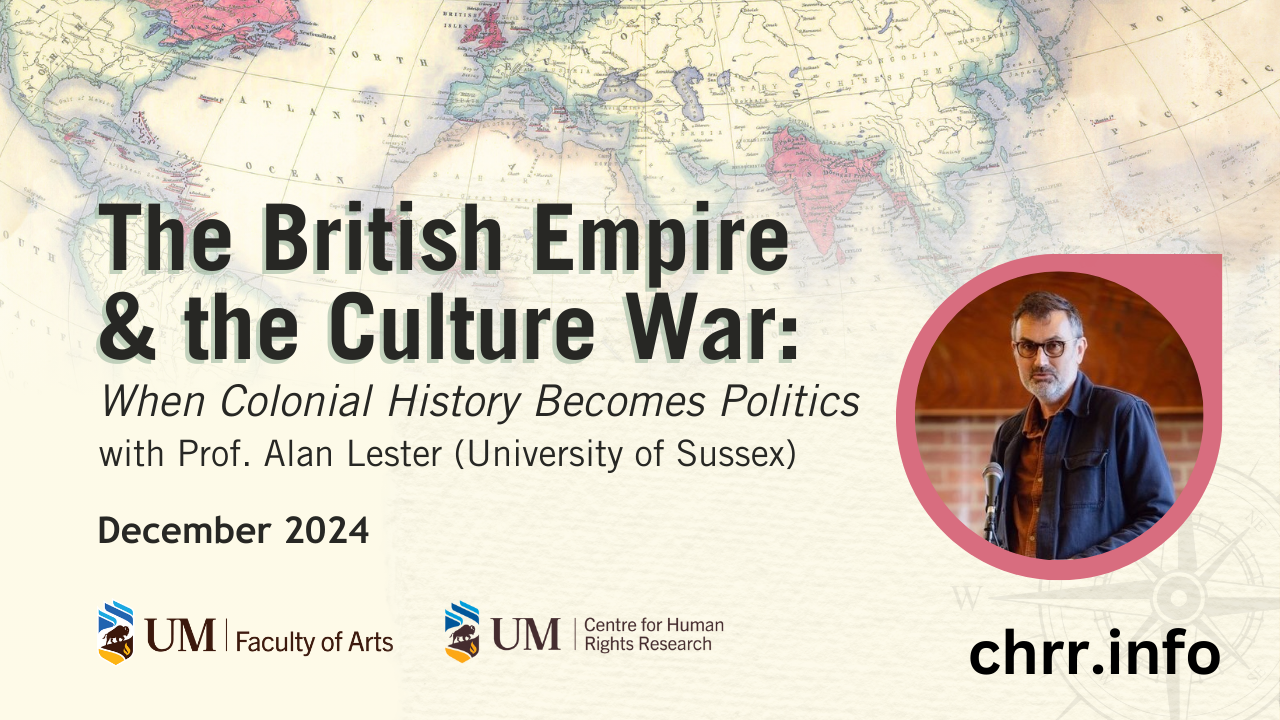
On Wednesday, December 11th at 2:00 pm, the Centre for Human Rights Research welcomed Prof. Alan Lester from the University of Sussex for a lecture on “The British Empire & The Culture War: When Colonial History Becomes Politics.”
Alan Lester is Professor of Historical Geography at the University of Sussex. He has held visiting lectureships at Rhodes University and the University of Fort Hare, an Erskine Fellowship at the University of Canterbury and an inaugural fellowship in humanities at La Trobe University. He has also been Research Professor (Historical Studies) at La Trobe. He is a Fellow of the Royal Historical Society and the co-editor of the Manchester University Press Studies in Imperialism series. Alan’s most recent edited collection The Truth About Empire: Real Histories of British Colonialism features a chapter by CHRR Director Dr. Adele Perry, CHRR Research Affiliate Dr. Sean Carleton, and CarletonU’s Dr. Omeasoo Wahpasiw titled “The Misuse of Indigenous and Canadian History in Colonialism.”
Pride in Health 2024 Drag Show – Graphic Recording
Pride in Health 2024 Drag Show - Graphic Recording
November 21, 2024
Miranda Maslany, Drawing Change
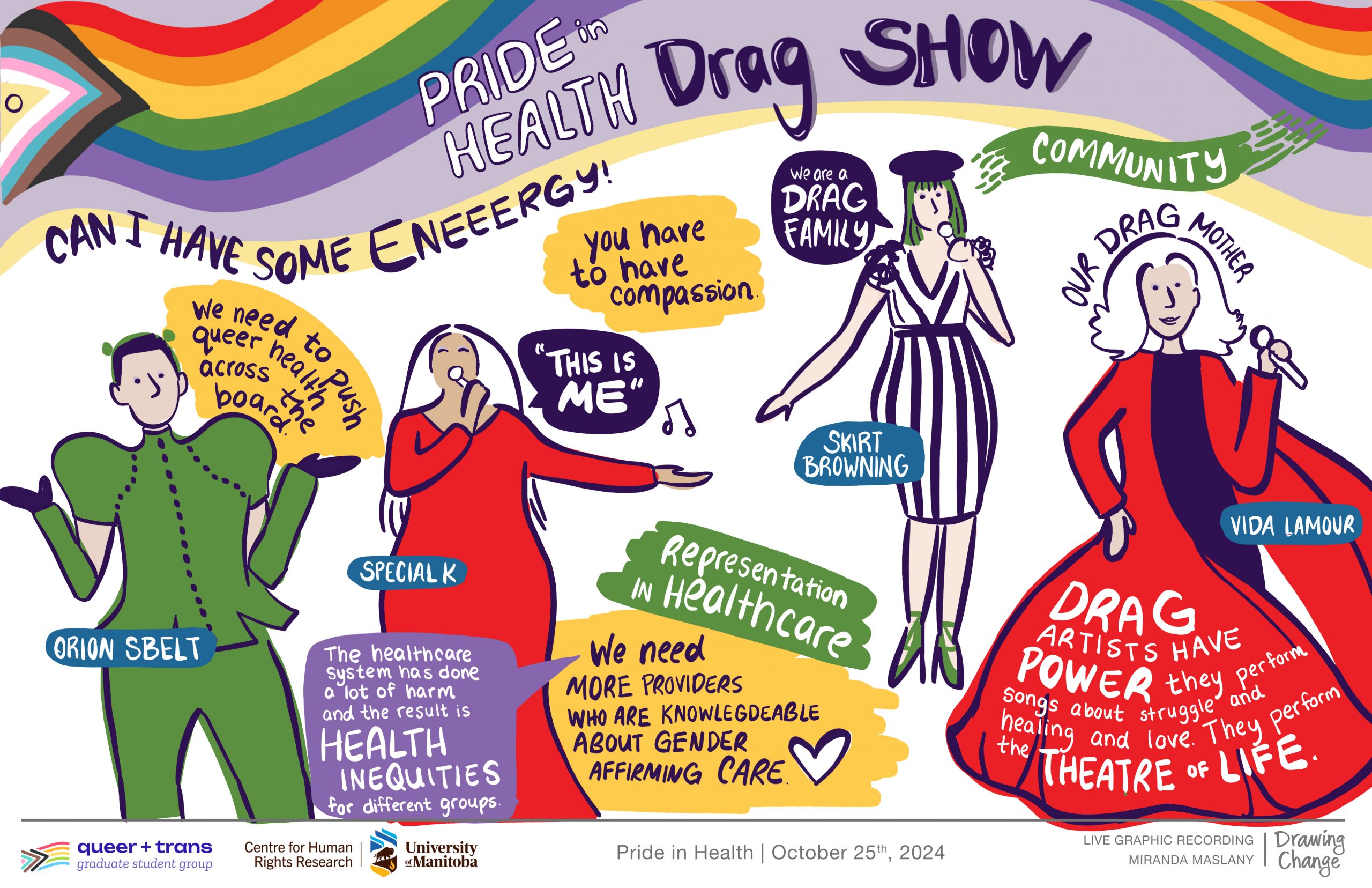
In October 2024, the Centre for Human Rights Research (CHRR) supported and co-coordinated the inaugural Pride in Health conference with the Queer and Trans Graduate Student Group (QTGSG). Pride in Health is an interdisciplinary health research conference focused on the 2SLGBTQIA+ community. This year, the conference was held on October 24 and 25. The first day of the conference was held on the Fort Garry Campus, and the second day was held on the Bannatyne campus.
On the second day of the conference, a drag show was held featuring Orion Sbelt, Special K, Skirt Browning, and Vida Lamour to celebrate the 2SLQBTQIA+ community in Manitoba and beyond. The drag show was coordinated with Synonym Art Consultation. A graphic recording of the drag show was created by Miranda Maslany from Drawing Change.
Resisting Anti-Queer and Anti-Trans Hate: Lessons from 1970s Toronto with Dr. Tom Hooper
Resisting Anti-Queer and Anti-Trans Hate: Lessons from 1970s Toronto with Dr. Tom Hooper
October 31, 2024
Angela Ciceron
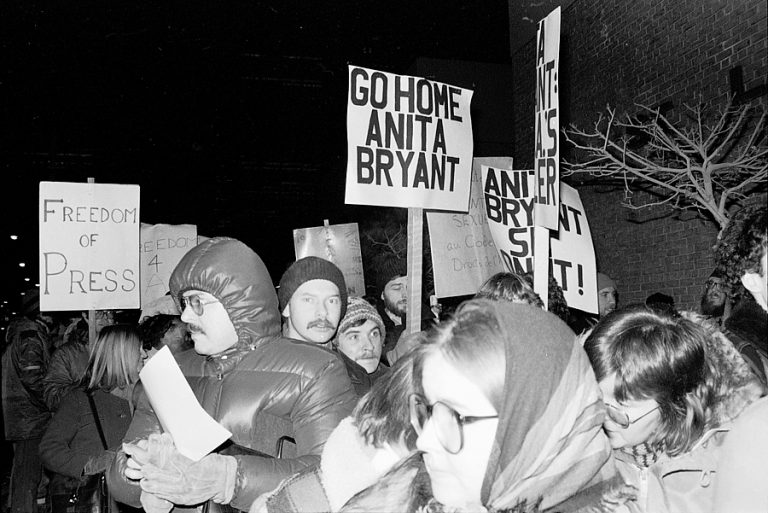
On Friday, October 11, 2024, the CHRR supported the 2SLGBTQ+ Histories Series at the University of Manitoba for a lecture with Dr. Tom Hooper from the Department of Equity Studies in York University who spoke on “Resisting Anti-Queer and Anti-Trans Hate: Lessons from 1970s Toronto”.
About the lecture:
In January 1978 anti-Queer and anti-Trans activist Anita Bryant brought her “Save Our Children” campaign to Toronto. The previous year Bryant had organized against a Miami-Dade, Florida ordinance that protected against discrimination based on sexual orientation. Bryant’s central argument was that this ordinance protected Queer and Trans people from discrimination in employment, including teachers and others who worked with children. The campaign to define Queer and Trans people as a threat to children worked, the Miami-Dade ordinance was repealed. Bryant was emboldened and embarked on a cross-continent campaign that also included a brief time Canada. Queer and Trans communities resisted these campaigns with various tactics. In this presentation I argue that studying our communities’ resistance to Anita Bryant could be useful as our communities rally to resist anti-Queer and anti-Trans hate today.
Indigenous Women, Girls, and Gender-Diverse People’s Human Right to Public Transportation – A Policy Brief
Indigenous Women, Girls, and Gender-Diverse People’s Human Right to Public Transportation - A Policy Brief
October 30, 2024
Trixie Maybituin
Content Warning:
This policy brief relates to missing and murdered Indigenous women and girls and Two-Spirit+ people and its content may be disturbing or triggering for readers. A reminder that the National Inquiry into Missing and Murdered Women and Girls has a free 24-hour Support Line available at: 1-844-413-6649.
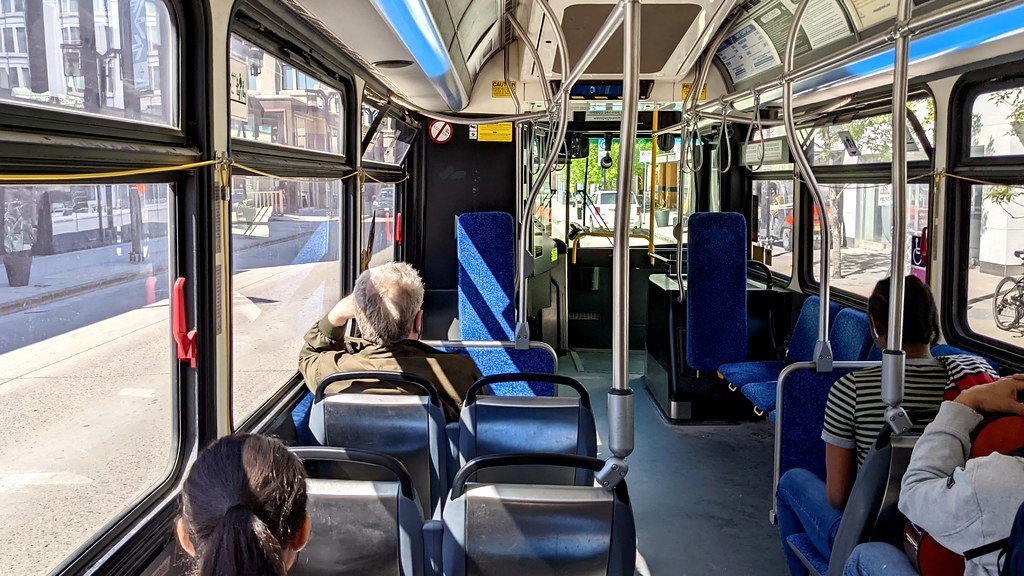
This policy brief expands upon and asserts the idea of public transportation as a human rights issue. Specifically, the current state of public transportation pushes Indigenous women and Two-Spirit Plus people to dangerous and unsafe situations. Fulfilling various modes of public transportation is thus a human rights obligation, and failure to facilitate rights holders’ access to public transportation prompts potential human rights violations.
This policy brief flows from work completed as part of the “Missing the Bus: Indigenous Women and Two-Spirit Plus People and Public Transit in Western Canada” project. “Missing the Bus” was funded by a Social Sciences & Humanities Research Council (SSHRC)-funded Knowledge Synthesis Grant (2020).
We would also like to acknowledge Jessica Paley (Indigenous Relations Division at the City of Winnipeg), who contributed her knowledge and guidance to this policy brief.
An Evening with Katsi’tsakwas Ellen Gabriel & Sean Carleton (When the Pine Needles Fall)
An Evening with Katsi'tsakwas Ellen Gabriel & Sean Carleton (When the Pine Needles Fall)
October 30, 2024
Katsi'tsakwas Ellen Gabriel, Sean Carleton, and Kiera Ladner
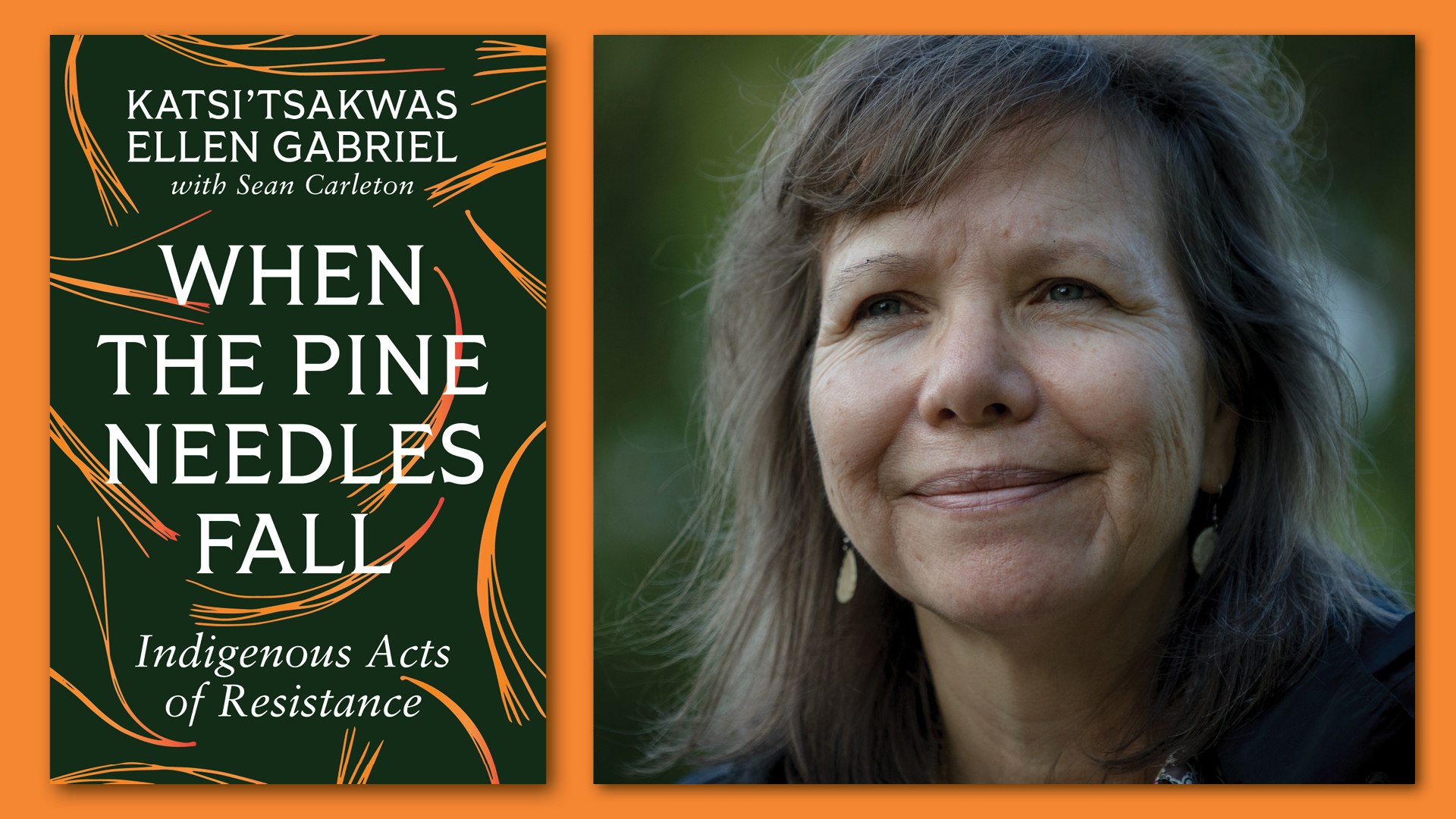
On Wednesday, October 2, 2024, the Centre for Human Rights Research (CHRR) and McNally Robinson Booksellers hosted Katsi’tsakwas Ellen Gabriel and Dr. Sean Carleton for a special evening to discuss their new book, When the Pine Needles Fall: Indigenous Acts of Resistance (Between the Lines). The event was hosted by CHRR Research Affiliate Dr. Kiera Ladner.
On When the Pine Needles Fall:
There have been many things written about Canada’s violent siege of Kanehsatà:ke and Kahnawà:ke in the summer of 1990, but When the Pine Needles Fall: Indigenous Acts of Resistance is the first book from the perspective of Katsi’tsakwas Ellen Gabriel, who was the Kanien’kehá:ka (Mohawk) spokesperson during the siege. When the Pine Needles Fall, written in a conversational style by Gabriel with historian Sean Carleton, offers an intimate look at Gabriel’s life leading up to the 1990 siege, her experiences as spokesperson for her community, and her work since then as an Indigenous land defender, human rights activist, and feminist leader. Gabriel’s hopes for a decolonial future make clear why protecting Indigenous homelands is vital not only for the survival of Indigenous peoples, but for all who live on this planet.
Pride in Health 2024: Abstract Book
Pride in Health 2024: Abstract Book
October 24, 2024
Pride in Health Organizing Committee
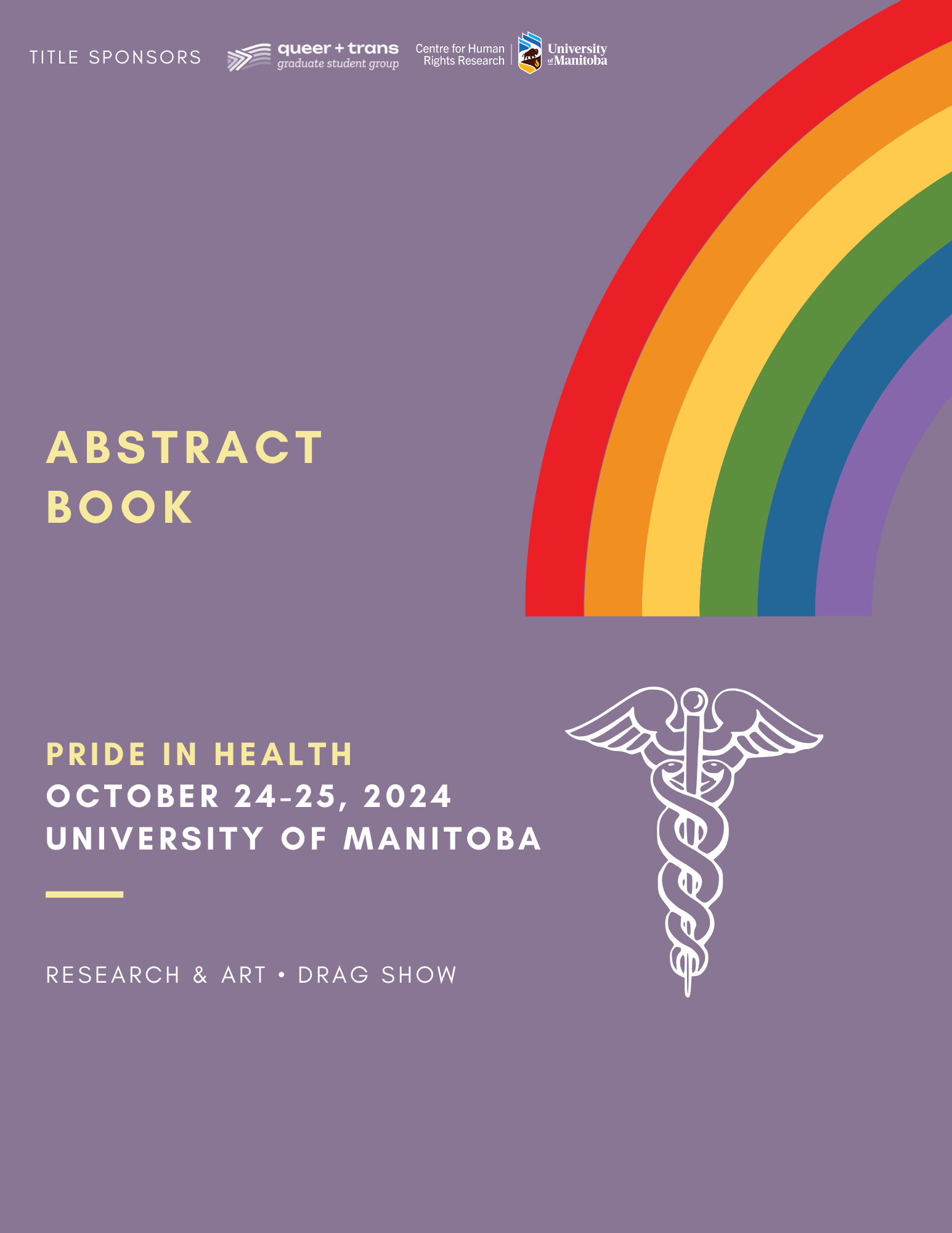
Pride in Health is an interdisciplinary research conference focused on the 2SLGBTQIA+ community. The conference was organized by the Queer & Trans Graduate Student Group and the Centre for Human Rights Research and held on October 24 and 25, 2024 in Winnipeg, Manitoba at the University of Manitoba.
The conference features work from students and early career researchers, on health, widely defined and highly inclusive, interpreted through the lenses of many different disciplines and includes oral presentations, scientific posters, and artwork.
Contact Us
We’d love to hear from you.
442 Robson Hall
University of Manitoba
Winnipeg, Manitoba
R3T 2N2 Canada
204-474-6453
Quick Links
Subscribe to our mailing list for periodic updates from the Centre for Human Rights Research, including human rights events listings and employment opportunities (Manitoba based and virtual).
Traditional Territories Acknowledgement
The University of Manitoba campuses are located on the original lands of the Anishinaabeg, Ininiwak, Anisininewuk, Dakota Oyate, Dene and Inuit, and on the National Homeland of the Red River Métis.

Centre for Human Rights Research 2023© · Privacy Policy