
• FOLLOW US


April 10, 2025

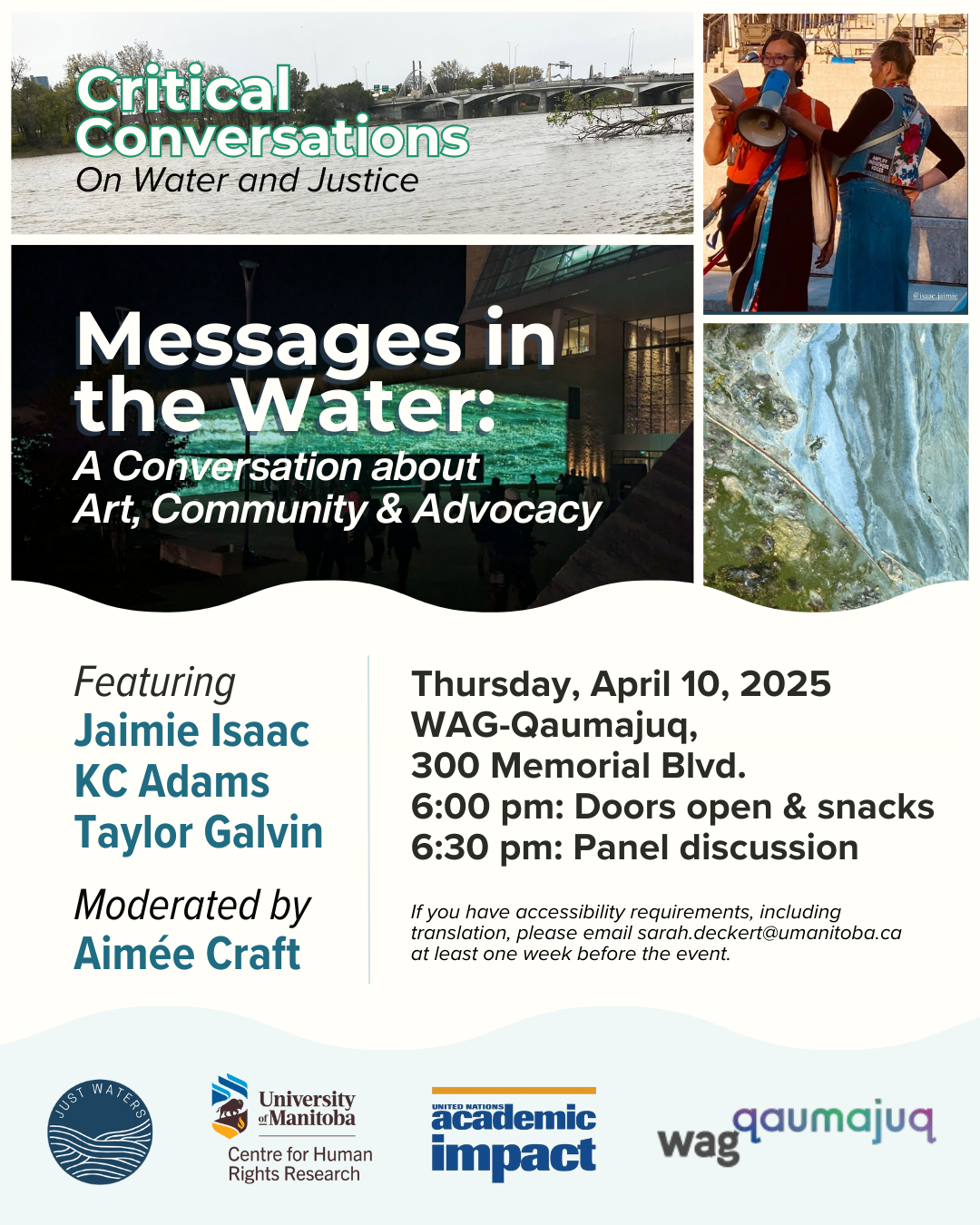
Messages in the Water: A Conversation About Art, Community and Advocacy

Event Date: April 10, 2025
Event Location: WAG-Qaumajuq, 300 Memorial Blvd.
Event Time: 6:00 pm

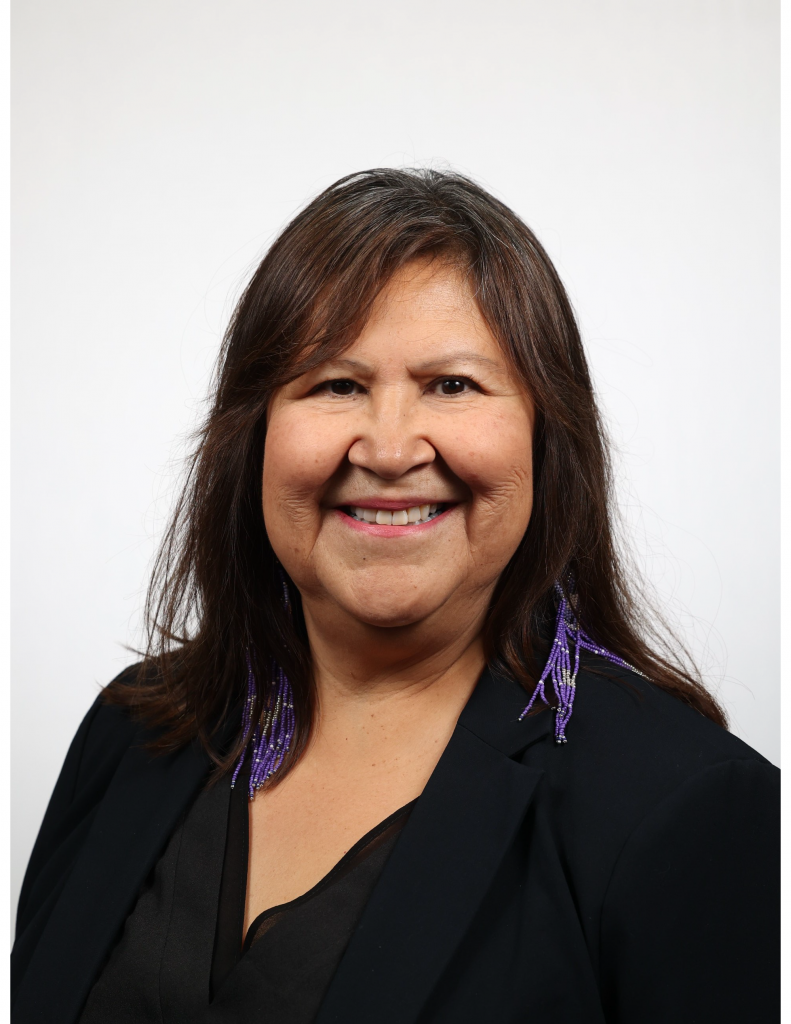
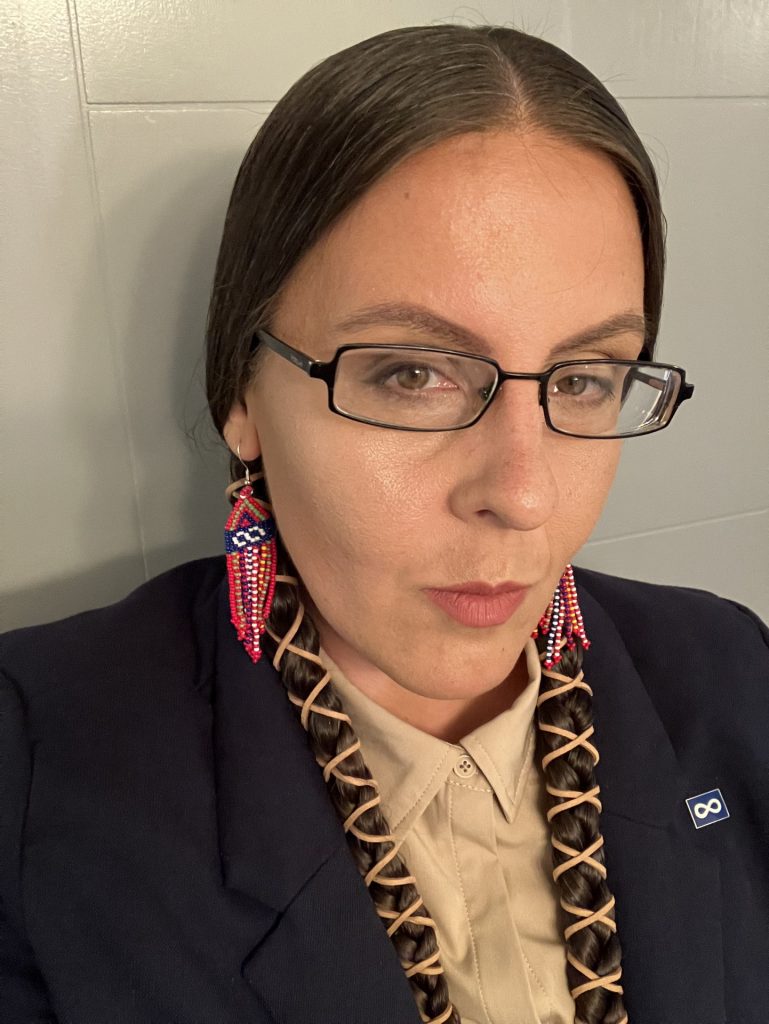
Join Jaimie Isaac (Just Waters Artist In Residence), Dr. Aimée Craft (Decolonizing Water, University of Ottawa), KC Adams (Artist) and Taylor Galvin (Mother Earth Protector, Scientist, Community Organizer) for a conversation about water and the role of art and community organization in a precarious time. Recognizing our relationship to water encourages a responsibility to protect what is sacred. As water carriers, the women carry a responsibility for water stewardship. Walking with community in support, how can we make change and live in reciprocity with the land and water? 

Many Indigenous peoples globally recognize that water is sacred, and countries have passed groundbreaking laws granting legal personhood status to their water systems, honoring the Indigenous peoples’ perspective of waters as relatives and ancestors. This discussion will focus on interdisciplinary perspectives on community advocacy for water, living in relation to water and seeing the messages in the water through art. 

6:00 pm Doors open + food

6:30 pm Panel

FREE

No registration required

Note: Use the entrance at the corner of Memorial Blvd and St. Mary Ave- the new part of WAG-Qaumajuq. The event takes place in Ilavut – Entrance Hall and Ilipvik – Learning Steps.

If you have accessibility requirements, including translation, please email sarah.deckert@umanitoba.ca at least one week before the event.

This event is the third and final installment in the CHRR’s 2025 Critical Conversations series. This year, the series of three public events is held in partnership with WAG-Qaumajuq and focuses on water and justice. Just Waters: Thinking with Hydro-Social Relations for a More Just and Sustainable World, the Centre for Human Rights Research, and the University of Manitoba’s United Nations Academic Impact Hub for Sustainable Development Goal 6 Last Drop speaker series, are collaborating to host these events. Funding is provided by the University of Manitoba’s IGNITE program, with in-kind contributions from WAG-Qaumajuq.

About the Speakers

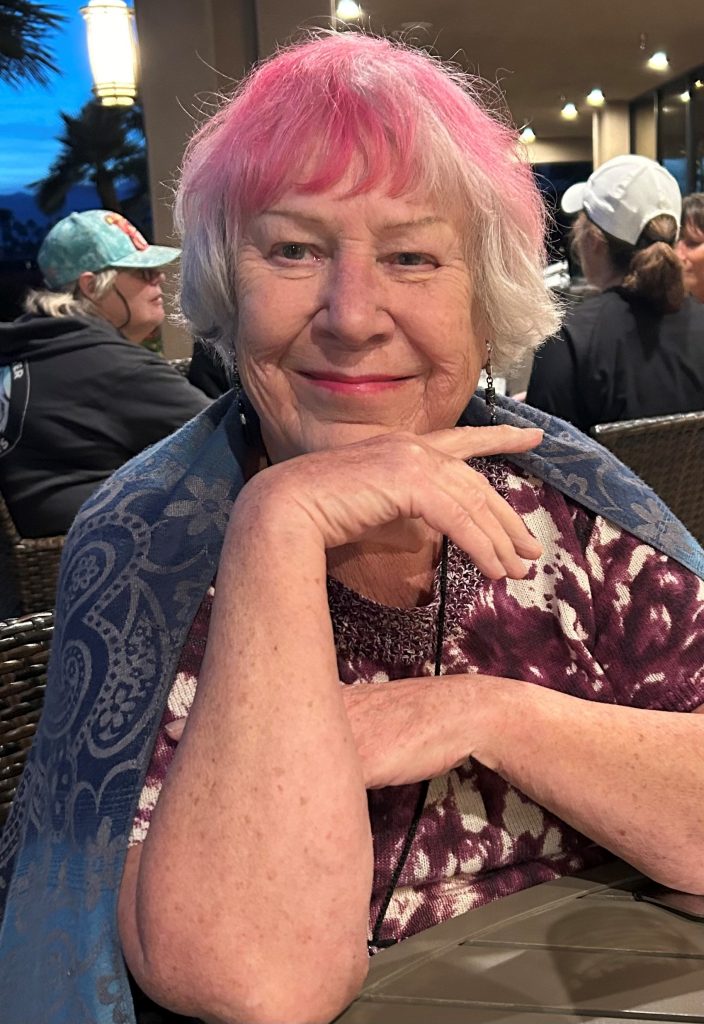
Jaimie Isaac (she/her/hers) is a curator and interdisciplinary artist, Anishinaabe member of Sagkeeng First Nation and is of British heritage. She was the Chief Curator at the Art Gallery of Greater Victoria from 2021-2023, and advisor 2023-2024.

As the Curator of Contemporary and Indigenous Arts at the Winnipeg Art Gallery 2015-2021, she was awarded the Canadian Museums Association outstanding achievement award in exhibitions category with the Boarder X exhibition. Isaac has a degree in Art History and a Masters of Arts from the University of British Columbia focused on decolonizing gallery/museum practices.

Through academic, curatorial, consulting/advisory, collaborative and artistic projects, Jaimie engages in areas of reconciliation, resistance, decolonization in art and in sport, Indigenous feminism, environmental justice, language and cultural resurgence. Isaac has lectured, curated internationally with research trips and residencies in Norway, Finland, Italy, Australia, New Zealand, Chicago, and New York. Bodies of art commissioned and exhibited take form in film, public art, installation and mixed media. With published work, Isaac has contributed to scholarly collections of writing within textbooks and journals.

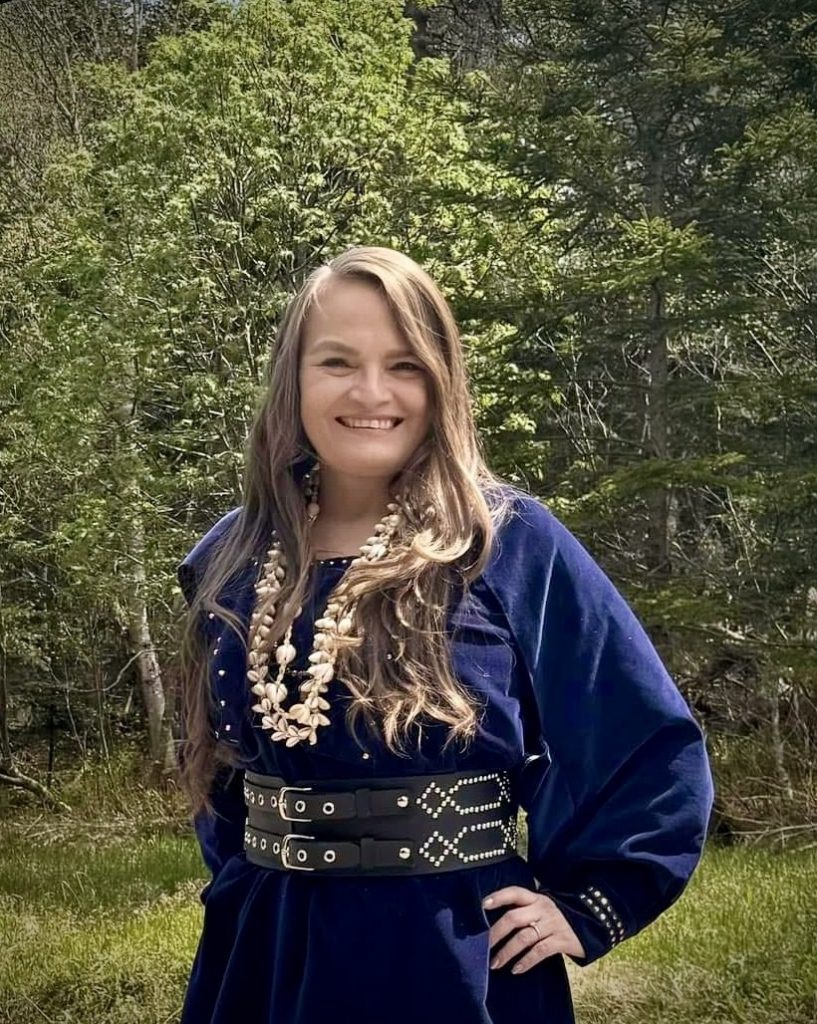
KC Adams (Anishinaabe/Ininnew/British) is a registered Fisher River Cree Nation member living in Winnipeg, Manitoba, with a B.F.A. from Concordia University and an M.A. in Cultural Studies, Curatorial Stream from the University of Winnipeg. She is a relational maker, a creator whose work connects to Indigenous knowledge systems and is also an educator, activist, community member and mentor. KC has had several solo and group exhibitions and residencies and has been in three biennales, including the PHOTOQUAI: Biennale des images du monde in Paris, France. Twenty pieces from the Cyborg Hybrid series are in the permanent collection of the National Art Gallery in Ottawa, and four trees from Birch Bark Ltd are in the Canadian Consulate of Australia, NSW collection. Adams was awarded the Winnipeg Arts Council’s Making A Mark Award, Canada’s Senate 150 medal, the Ohpinamake Award in Indigenous Art and the Quill & Quire’s 2019 Books of the Year.
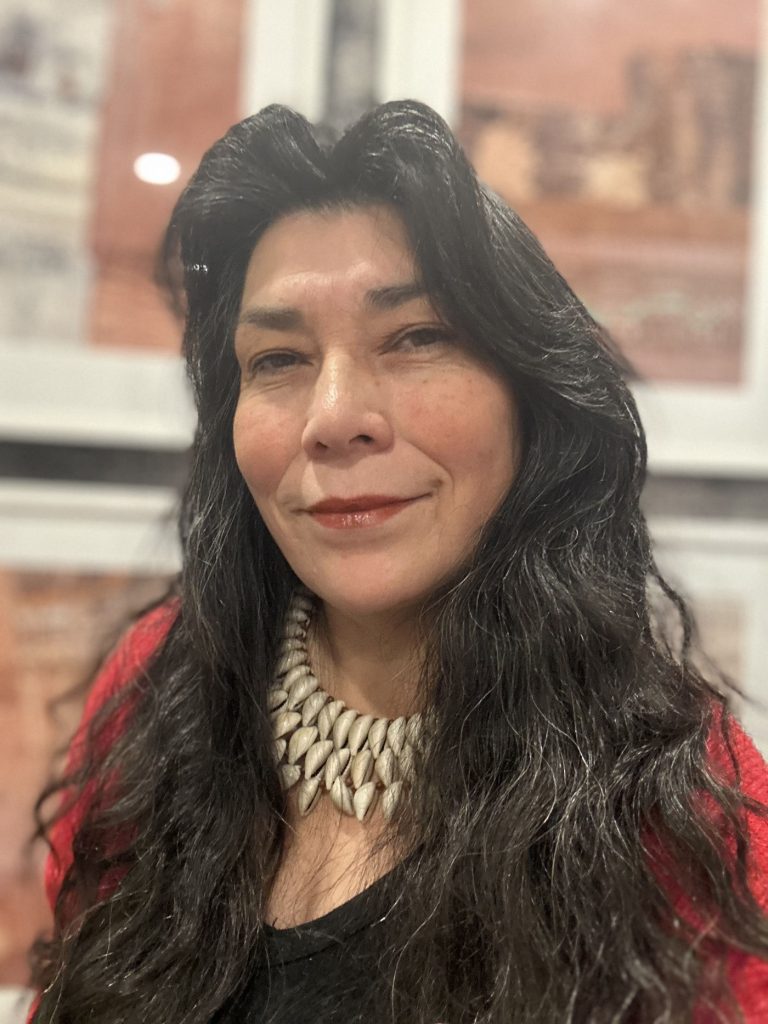
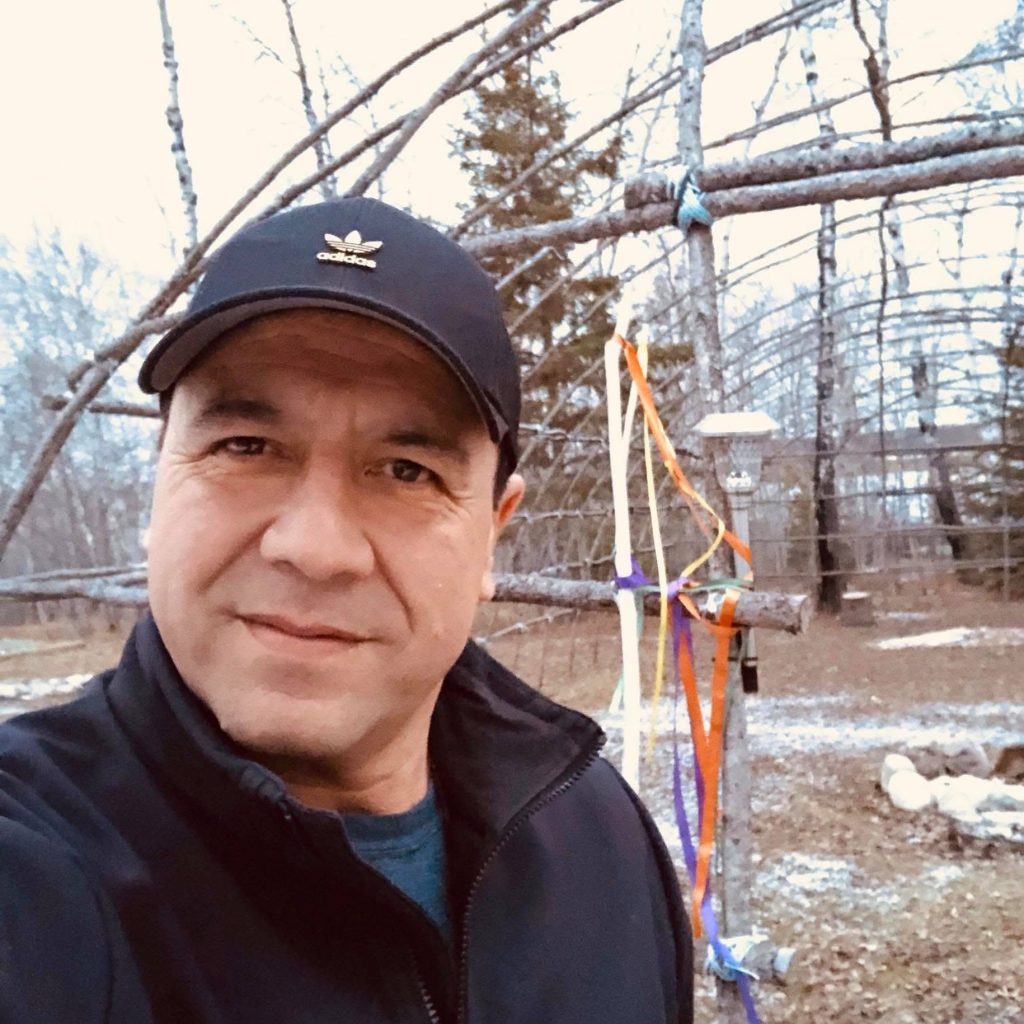
Aimée Craft is an award-winning teacher and researcher, recognized internationally as a leader in the area of Indigenous laws, treaties and water. She holds a University Research Chair Nibi miinawaa aki inaakonigewin: Indigenous governance in relationship with land and water.

An Associate Professor at the Faculty of Common law, University of Ottawa and an Indigenous (Anishinaabe-Métis) lawyer from Treaty 1 territory in Manitoba, she is the former Director of Research at the National Inquiry into Missing and Murdered Indigenous Women and Girls and the founding Director of Research at the National Centre for Truth and Reconciliation. She practiced at the Public Interest Law Centre for over a decade and in 2016 she was voted one of the top 25 most influential lawyers in
Canada. In 2021 she was awarded the prestigious Canadian Bar Association President’s Award.

Prof. Craft prioritizes Indigenous-lead and interdisciplinary research, including through visual arts and film, co-leads a series of major research grants on Decolonizing Water Governance and works with many Indigenous nations and communities on Indigenous relationships with and responsibilities to nibi (water). She plays an active role in international collaborations relating to transformative memory in colonial contexts and relating to the reclamation of Indigenous birthing practices as expressions of territorial sovereignty.

Breathing Life Into the Stone Fort Treaty, her award-winning book, focuses on understanding and interpreting treaties from an Anishinaabe inaakonigewin (legal) perspective. Treaty Words, her critically acclaimed children’s book, explains treaty philosophy and relationships.

She is past chair of the Aboriginal Law Section of the Canadian Bar Association and a current member of the Speaker’s Bureau of the Treaty Relations Commission of Manitoba.
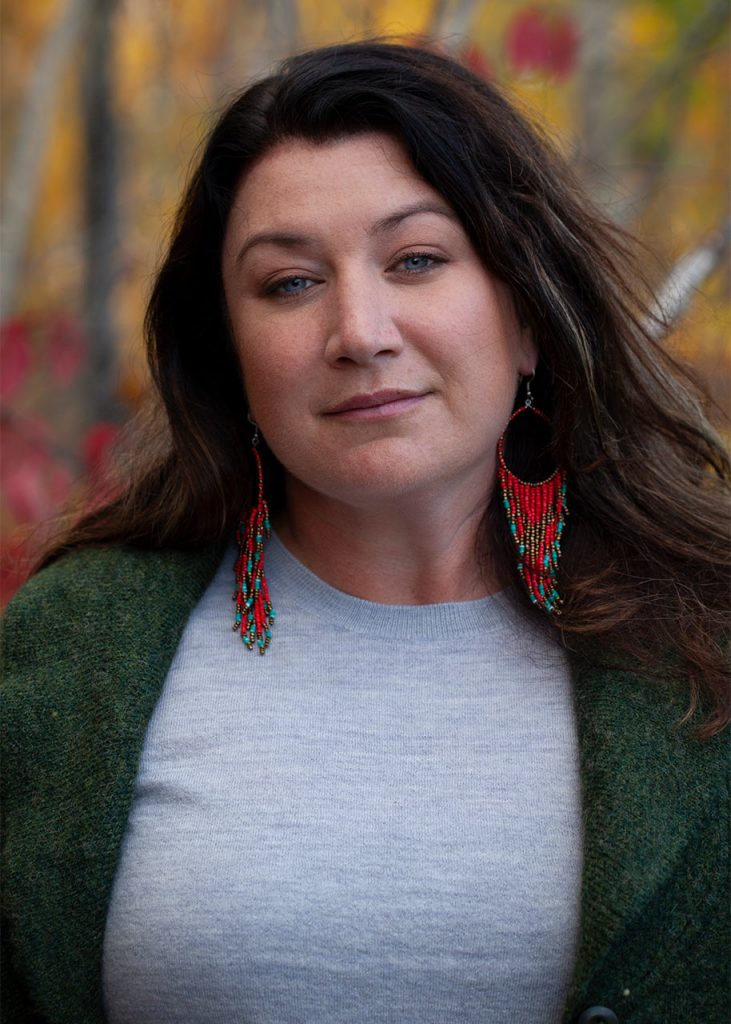
Taylor Galvin, an Anishinaabe-Kwe scientist from Baaskaandibewiiziibiing (Brokenhead Ojibway Nation), is a graduate student at the University of Manitoba. Her research centers on protecting Lake Sturgeon in Manitoba through the use of Indigenous science. She has made significant contributions across various fields, notably as a knowledge keeper in the Lake Winnipeg Personhood case in partnership with the Southern Chief’s Organization. On the international stage, she has worked with Maya youth in Belize to advance planetary wellness and food sovereignty initiatives. Additionally, she has provided counsel to the Canadian Ambassador in the Netherlands on the incorporation of Indigenous knowledge into sustainability projects. As a guest lecturer, she teaches First Nations ecology, Indigenous medicinal plants, and land-based healing practices. Taylor is currently the Host & Creator of the TeaPee Podcast, Director of the Brokenhead Wetland Ecological Reserve and holds positions on several boards that advocate for Indigenous perspectives.

Support Us

Whether you are passionate about interdisciplinary human rights research, social justice programming, or student training and mentorship, the University of Manitoba offers opportunities to support the opportunities most important to you. 

DONATE
  • FOLLOW US


March 26, 2025

Action through Art workshop: What if the river was a person?

Event Date: March 26, 2025
Event Location: 342 Education, 71 Curry Place, University of Manitoba Fort Garry Campus
Event Time: 10 am - 12 pm

What if the river was a person? If it held personhood status, what rights would that provide the river, if any? Nibi is an ongoing work that poses the concept of the Red River and Lake Winnipeg gaining personhood through supporting the work of others that have been advocating on behalf of these waterways. Embedded in the project is a collective worldview that water is sacred. 

Join Jaimie Isaac, Just Waters Artist-in-Residence in a workshop that promotes collective care through building resonant relationships and connections with water. Invited guest Daniel Gladu Kanu of the Lake Winnipeg Indigenous Collective will share a large-scale watershed map, offering an experience in geography, history and culture. Participants will also engage in a collective activity of mixed media art-making and advocacy for water protection. (No art skills required!)

Register here!

Support Us

Whether you are passionate about interdisciplinary human rights research, social justice programming, or student training and mentorship, the University of Manitoba offers opportunities to support the opportunities most important to you. 

DONATE
  • FOLLOW US


March 27, 2025

Critical Conversations on Water and Justice: Navigating Water Injustice Under Climate Colonialism

Event Date: March 27, 2025
Event Location: WAG-Qaumajuq, 300 Memorial Blvd.
Event Time: 6:00 pm

Join Dr. Jeffrey Ansloos (University of Toronto) and Rick Harp (Media Indigena) for a conversation about water and colonial injustice in a time of climate crisis.  From waterless reserves, to flooded homelands and weaponized water, water flows through Indigenous peoples’ experience of colonialism in what is now Canada and beyond. How can we navigate the politics of water and colonialism in a world being remade by climate change, especially considering the mental health implications for communities whose connections to water are disrupted? This discussion will center on the intersection of environmental justice and mental health, and the urgent need for healing and reclamation.

6:00 pm Doors open + food

6:30 pm Conversation

FREE

No registration required

If you have accessibility requirements, including translation, please email sarah.deckert@umanitoba.ca at least one week before the event.

This event is the second installment in the CHRR’s annual Critical Conversations series. This year, the series of three public events is held in partnership with WAG-Qaumajuq and will focus on water and justice. Just Waters: Thinking with Hydro-Social Relations for a More Just and Sustainable World, the Centre for Human Rights Research, and the University of Manitoba’s United Nations Academic Impact Hub for Sustainable Development Goal 6 Last Drop speaker series, are collaborating to host these events. Funding is provided by the University of Manitoba’s IGNITE program, with in-kind contributions from WAG-Qaumajuq.


About the Speakers

Jeffrey Ansloos, Ph.D., is Associate Professor of Indigenous Health and Social Policy and is the Tier II Canada Research Chair in Indigenous Studies of Health and Environmental Justice. His ongoing SSHRC Insight research project investigates the effects of extractivism, neoliberalism, and climate change on suicidal distress among First Nations and Inuit populations. As the founding director of the Critical Health and Social Action Lab, Ansloos oversees a Canada Foundation for Innovation-funded research center that supports community-based action research aimed at promoting health, social, and environmental justice. He is the theme lead for the Indigenous suicide prevention and complex crisis response stream within the Ontario Network Environment for Indigenous Health Research through CIHR. He is the author of The Medicine of Peace: Indigenous Youth Resisting Violence and Decolonizing Healing and Thunder and the Noise Storms, with forthcoming titles including Indigenous X: Networks of Relations and Resistance During and After Twitter and Against Annihilation: Indigenous Struggles for Inhabitable Worlds and Livable Lives. Ansloos is a Member of the College of New Scholars, Artists, and Scientists in the Royal Society of Canada. Dr. Ansloos is Cree and English and a citizen of the Fisher River Cree Nation (Ochekwi-Sipi; Treaty 5).

Jeffrey Ansloos. Photo taken by Christopher Katsarov Luna, 2024.

Born and raised in Winnipeg, Manitoba, Rick Harp is part of the Peter Ballantyne Cree Nation in what’s currently known as northern Saskatchewan. First bit hard in the 90s by the radio bug at campus/community station CKCU-FM in Ottawa, Harp’s 30-odd-years in media includes national and regional stints at CBC Radio, NCI-FM, and the Aboriginal Peoples Television Network (APTN), along with 350+ episodes as host/producer of the MEDIA INDIGENA podcast.

Support Us

Whether you are passionate about interdisciplinary human rights research, social justice programming, or student training and mentorship, the University of Manitoba offers opportunities to support the opportunities most important to you. 

DONATE
  • FOLLOW US


March 19, 2025

Open Hours with Artist-in-Residence Jaimie Isaac

Event Date: March 19, 2025
Event Location: 342 Education, University of Manitoba
Event Time: 11-2:30


Are you planning a multi-media artwork but want some feedback? Interested in what it’s like to be a curator? Have some ideas about combining art and advocacy?

Come meet with Just Waters Artist-in-Residence Jaimie Isaac on March 19 from 11 am to 2:30 pm in 342 Education! 

Set up a 30-minute appointment by emailing sarah.deckert@umanitoba.ca, or just stop by.

Stay tuned for more information about Jaimie’s Action through Art Workshop on March 26.

Support Us

Whether you are passionate about interdisciplinary human rights research, social justice programming, or student training and mentorship, the University of Manitoba offers opportunities to support the opportunities most important to you. 

DONATE
  • FOLLOW US


March 13, 2025

Critical Conversations on Water and Justice: Indigenous Water, Indigenous Science

Event Date: March 13, 2025
Event Location: WAG-Qaumajuq, 300 Memorial Blvd.
Event Time: 6:00 pm

Join Just Waters, the Centre for Human Rights Research, and The Last Drop at WAG-Qaumajuq for a panel on Indigenous Water, Indigenous Science with Dr. Myrle Ballard (University of Calgary), Dr. Az Klymiuk (University of Manitoba) and Dr. Miguel Uyaguari-Diaz (University of Manitoba).  The panelists will speak to the relationality of their work, the challenges and possibilities, and what keeps them going.

This panel is the first installment in the CHRR’s annual Critical Conversations series.  This year, the series of three public events is held in partnership with WAG-Qaumajuq and will focus on water and justice.  Just Waters: Thinking with Hydro-Social Relations for a More Just and Sustainable World, the Centre for Human Rights Research, and the University of Manitoba’s United Nations Academic Impact Hub for Sustainable Development Goal 6 Last Drop speaker series, are collaborating to host these events.  Funding is provided by the University of Manitoba’s IGNITE program, with in-kind contributions from WAG-Qaumajuq.

6:00 pm Doors open + food

6:30 pm Panel discussion

FREE

No registration required

If you have accessibility requirements, including translation, please email sarah.deckert@umanitoba.ca at least one week before the event.

About the Speakers

Dr. Myrle Ballard is a Canada Research Chair in Weaving Indigenous Science and Sustainability Science and Associate Professor in the Dept. of Earth, Energy, and Environment at the University of Calgary. She stood-up the new Indigenous Science Division at Environment and Climate Change Canada. Anishinaabe from Lake St. Martin First Nation, Dr. Ballard’s research explores Three-eyed seeing and how her fluency in Anishinaabe mowin can transform approaches to water resource management using Anishinaabe mowin baseline indicators.  Dr. Ballard also serves on a number of committees and working groups, with a recent appointment as Chair, World Water Quality Alliance. She was also appointed as a Scoping expert for the second IPBES global assessment of biodiversity and ecosystem services; and Expert for the IPBES task force on Indigenous and local knowledge. Her other research interests include but are not limited to, climate change, and sustainability of flooding/displacement. 

Dr. Az Klymiuk, an assistant professor and Indigenous Scholar in Science at the University of Manitoba, is an autistic, two-spirit, first-generation Cree Métis and Slavic citizen of the Métis Nation of Alberta.  Klymiuk grew up in subsistence-dominated lifeways in Treaty 8 Territory in northern Alberta, near the confluence of the Peace and Notikewin rivers.  They remain deeply connected to this land, and Indigenous ways of relating to other-than-human kin.  At the University of Manitoba, Klymiuk conducts research into plant mycobiomes, and is currently investigating how plant-fungal partnerships can be utilized to support Indigenous-led initiatives for manômin (wild rice) conservation, restoration, and food sovereignty.  Their work is supported by NSERC-CRSNG, SSHRC-CRSH’s New Frontiers in Research Foundation, and the University of Manitoba’s Collaborative Research and Fieldwork Support programs.

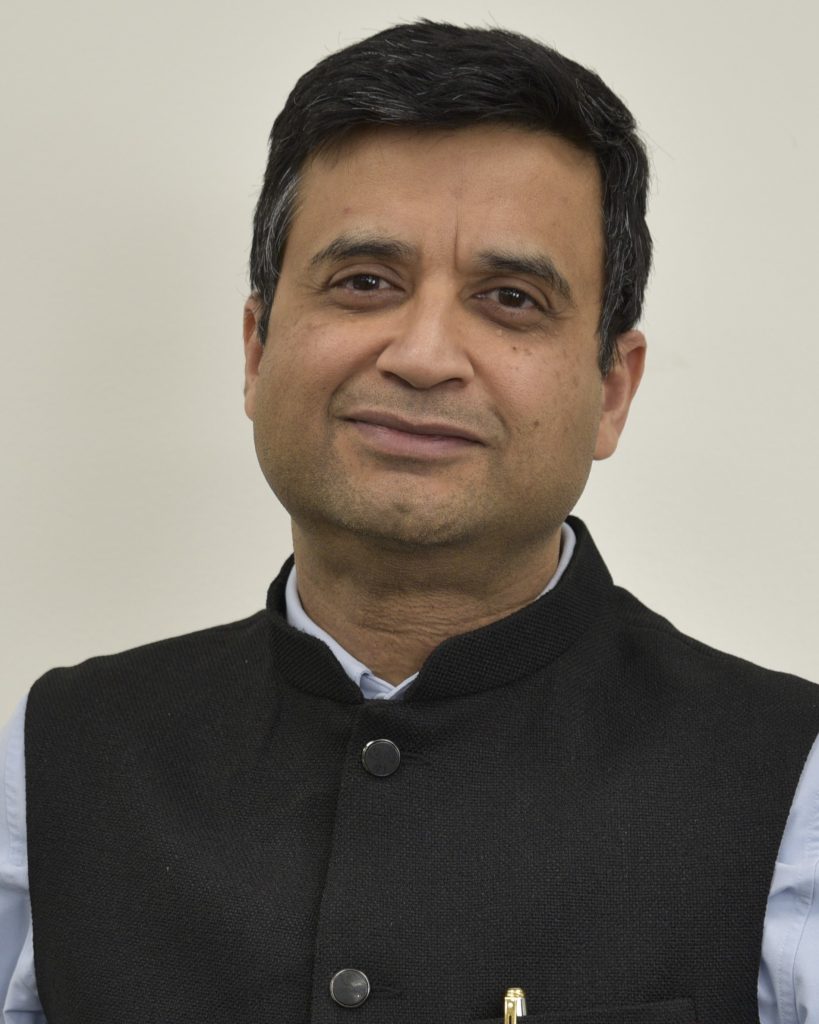
Ayush is a professor in the Department of Microbiology and Associate Dean-Strategic Initiatives in the Faculty of Science at the University of Manitoba. A Fellow of the Royal Society of Biology, he was President of the Canadian Society of Microbiologists (2021–22). His research focuses on multidrug resistance in Gram-negative bacteria, including antibiotic resistance mechanisms, environmental factors, and genetic tools. His group also studies water quality in First Nation communities in Manitoba.

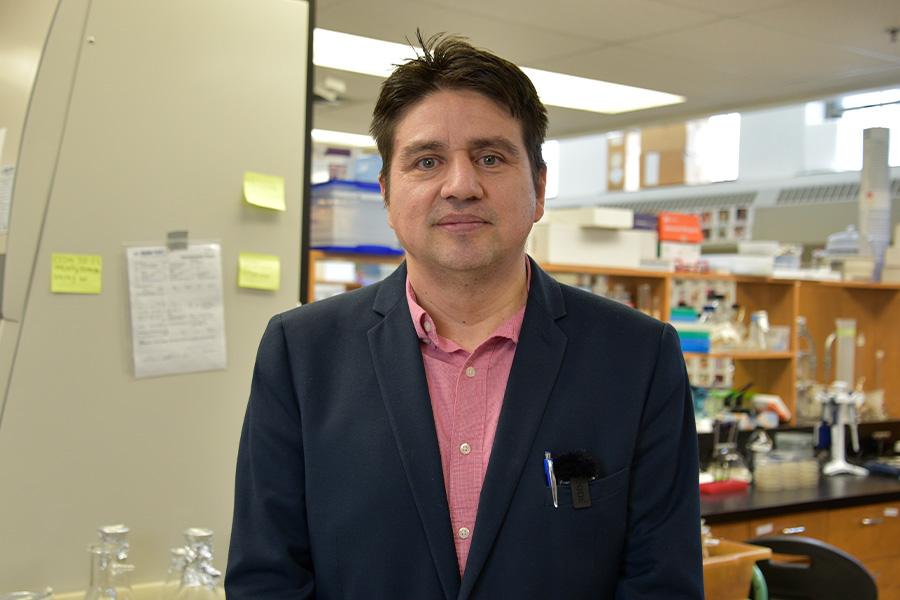
Assistant Professor/Indigenous Scholar at the University of Manitoba since July 2019. I hail from Naranjal, a small town in the countryside of Ecuador. I did my undergraduate in Ecuador in Marine Biology. I migrated to the USA in 2005 to pursue graduate studies in Aquatic Ecotoxicology and Molecular Microbial Ecology. I was a postdoctoral fellow and Senior Research Associate for ~8 years at the University of British Columbia and British Columbia Centre for Disease Control. My current research focuses on anthropogenic activities and their impact on water quality and aquatic ecosystems. I use culture independent approaches such as function and sequenced based metagenomics, quantitative PCR, bioinformatics and statistical tools to study diversity, abundance and dynamics/interactions of microbiomes particularly the resistome.

Support Us

Whether you are passionate about interdisciplinary human rights research, social justice programming, or student training and mentorship, the University of Manitoba offers opportunities to support the opportunities most important to you. 

DONATE
  • FOLLOW US


February 13, 2025

Everything is Connected: A Screening and Panel

Event Date: February 13, 2025
Event Location: The Event Space, located in the northwest corner on the second floor of The Forks Market
Event Time: 6:00 pm

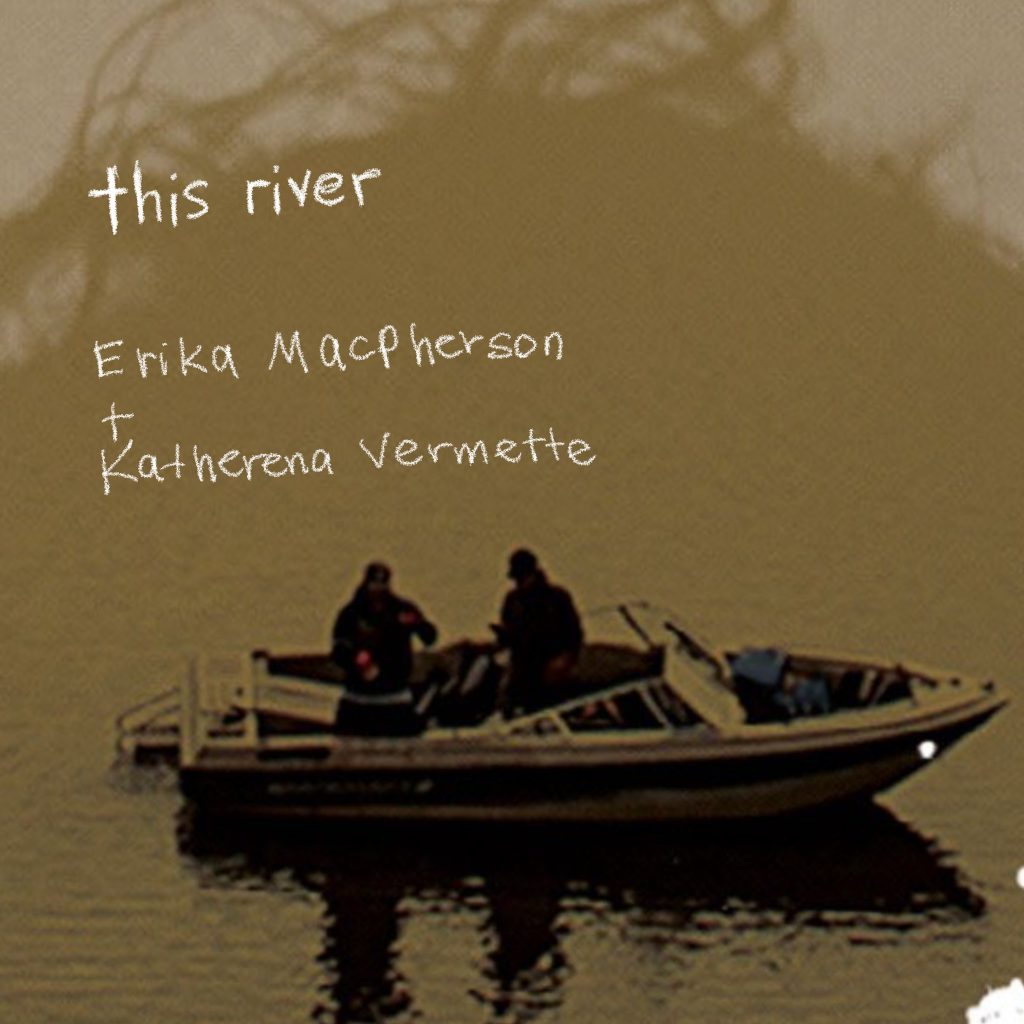
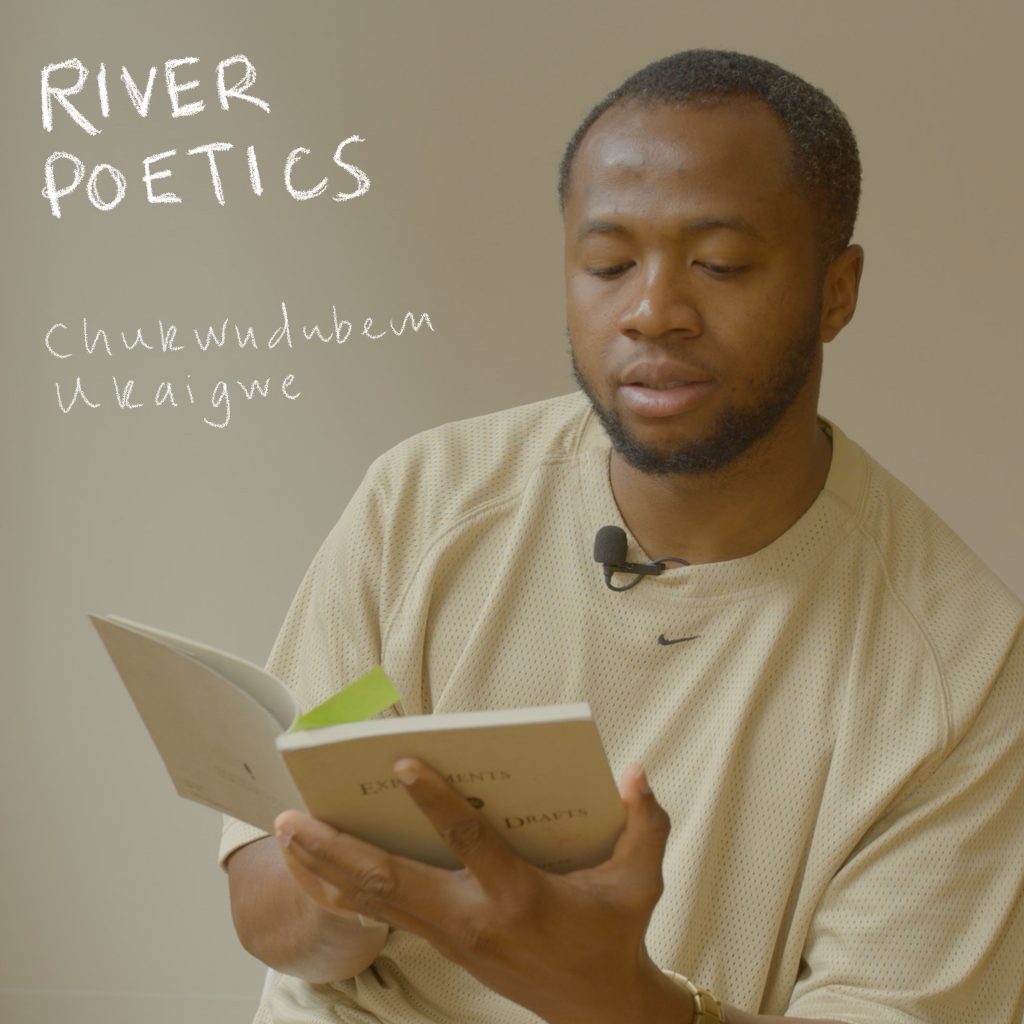
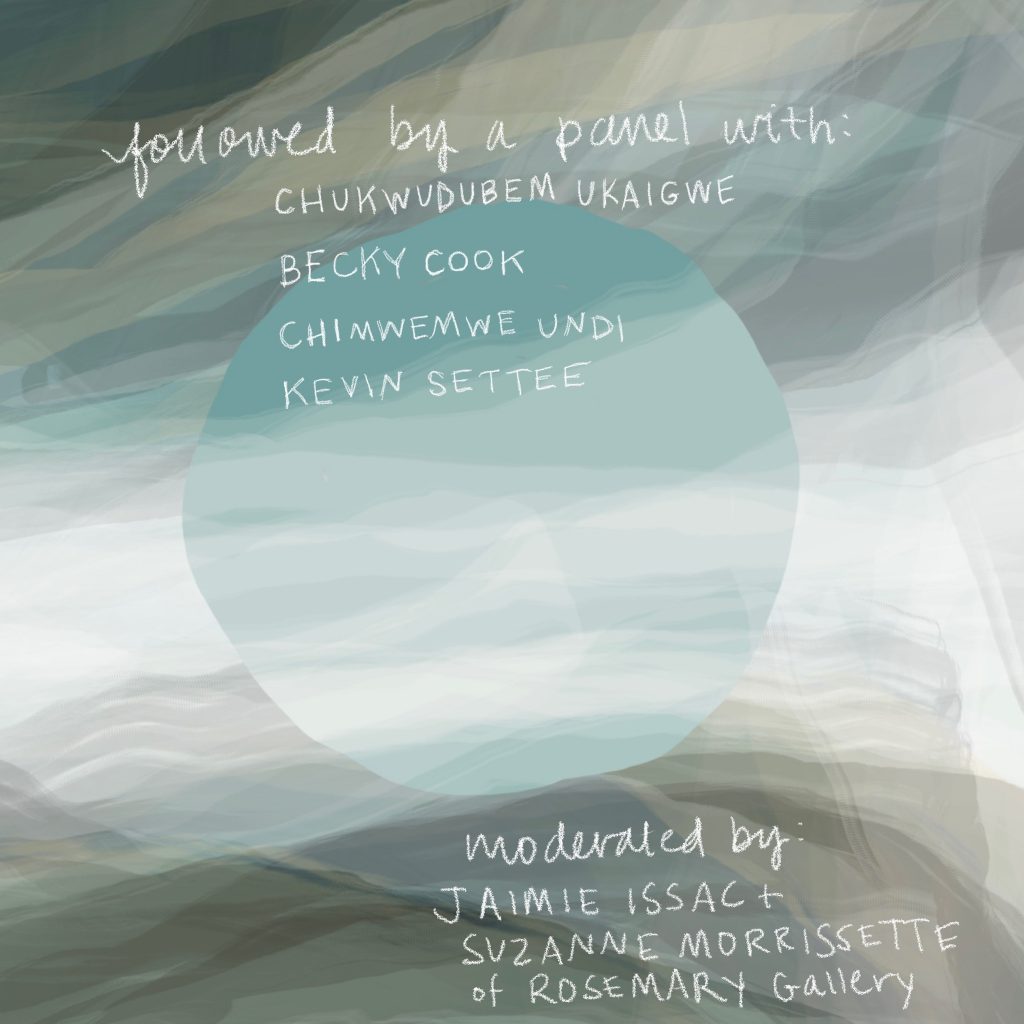
Join us next Thursday February 13 from 6-8:30 pm for a screening of Poplar River (Kevin Settee), River Poetics (Chukwudubem Ukaigwe), and This River (Erika MacPherson and Katherena Vermette) followed by a panel discussion about the interrelationships between environmental and social contexts related to rivers between panelists: Chukwudubem Ukaigwe, Becky Cook, Chimwemwe Undi, and Kevin Settee.

This event is a co-production of @rosemarythegallery The Decolonizing Lens, and Just Waters with support from @theforkswinnipeg!

The event will take place in The Event Space, located in the northwest corner on the second floor of The Forks Market.

Support Us

Whether you are passionate about interdisciplinary human rights research, social justice programming, or student training and mentorship, the University of Manitoba offers opportunities to support the opportunities most important to you. 

DONATE
  • FOLLOW US


February 13, 2025

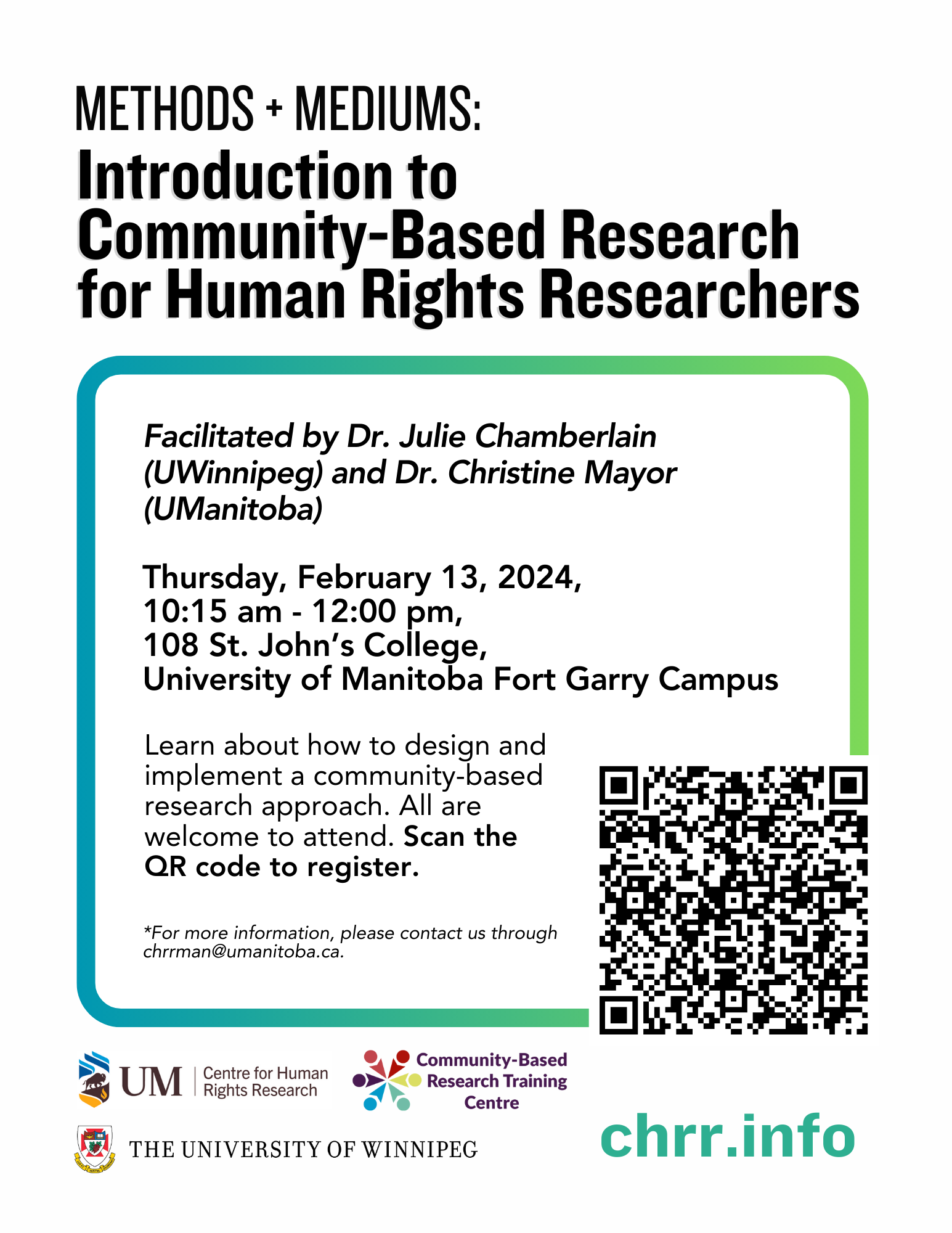
Methods + Mediums: Introduction to Community-Based Research for Human Rights Researchers

Event Date: February 13, 2025
Event Location: 108 St. John's College
Event Time: 10:15 am - 12:00 pm

On Thursday, February 13 at 10:15 am, please join the Centre for Human Rights Research (CHRR) and the Community-Based Research Training Centre (CBRTC) at the University of Winnipeg for a workshop with Dr. Julie Chamberlain (UWinnipeg) and Dr. Christine Mayor (UManitoba) introducing community-based research to human rights and social justice researchers. The workshop will be held in 108 St. John’s College. Light refreshments will be served. All are welcome to attend.

This workshop is a part of CHRR’s Methods and Mediums workshop series which explores different research methodologies and ways to publish research within human rights and social justice.

Register now: https://forms.office.com/r/wChANCDUym

About the facilitators:

Dr. Julie Chamberlain is Assistant Professor in Urban and Inner-City Studies at the University of Winnipeg, and co-lead of the Community-Based Research Training Centre, which is a joint initiative of the Manitoba Research Alliance and the University of Winnipeg. Her research and teaching focuses on anti-racist and anti-oppressive approaches to urban spaces and social relations, including community planning and development, and community-based research at the neighbourhood scale. Find out more about her work at https://juliechamberlain.org/

Dr. Christine Mayor is an Assistant Professor in the Faculty of Social Work at the University of Manitoba. She is the founder of Creative Community Change Research and a Research Affiliate at Centre for Human Rights Research, with a commitment to community-based scholarship on traumatizing conditions, racist and systemic oppression, and the advancement of liberatory and creative practices, policies, and education.

For more information, email us at chrrman@umanitoba.ca or h.scotland@uwinnipeg.ca

Support Us

Whether you are passionate about interdisciplinary human rights research, social justice programming, or student training and mentorship, the University of Manitoba offers opportunities to support the opportunities most important to you. 

DONATE
  • FOLLOW US


February 06, 2025

My Body, My Choice, Our Struggle: A Conversation on Reproductive Justice

Event Date: February 06, 2025
Event Location: Zoom Webinar
Event Time: 1:30 pm

On Thursday, February 6th 2025, at 1:30 pm, please join the Centre for Human Rights Research and the International Human Rights Clinic at the University of Manitoba for a webinar on “My Body, My Choice, Our Struggle: A Conversation on Reproductive Justice.”

We are honoured to host this panel discussion on the struggles and movements for reproductive justice featuring: Kemlin Nembhard (Women’s Health Clinic); Jacquie Nicholson (Feminist AF Marching Band), Harlie Pruder (Northern Reproductive Justice Network), and Linda Taylor (Founding Board of Directors of Women’s Health Clinic).

If you are interested in supporting reproductive justice in Winnipeg, please consider a donation to Women’s Health Clinic.

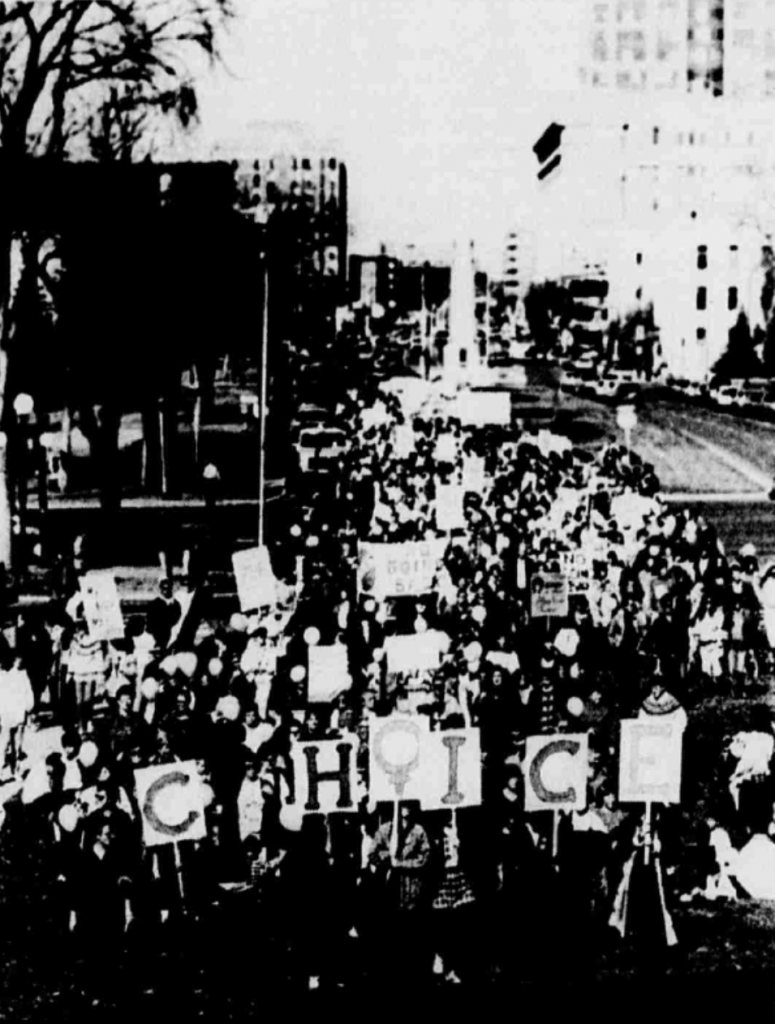
Black and white image of protest. Some protesters are holding posters spelling out the word CHOICE.
Tony Fernandes, The Manitoban, Oct 18 1989

About the Panelists

Kemlin Nembhard has been a passionate supporter of Women’s Health Clinic for many years. She was a member of the Board of Directors for two terms in the late 90’s and early 00’s.  

In October 2021, Kemlin became WHC Executive Director, after filling the role of Interim Executive Director for over a year. 

Kemlin is dedicated to equity, justice and building stronger communities. She’s been involved with the Canadian Federation of Students, Daniel McIntyre St. Matthews Community Organization and The Canadian Women’s Health Network, where she was the National Health Educator. Kemlin has also served on the boards of community organizations such as SEED, the Winnipeg Folk Festival, Herizons Magazine, and West End Cultural Centre. 

Kemlin uses her extensive experience as a community leader, organizer, facilitator and collaborator to guide WHC in its role as a unique, innovative and essential part of Manitoba’s health care network. She and WHC always focus on putting the client first – hearing and trusting people’s understanding of their own bodies and health and wellness needs  

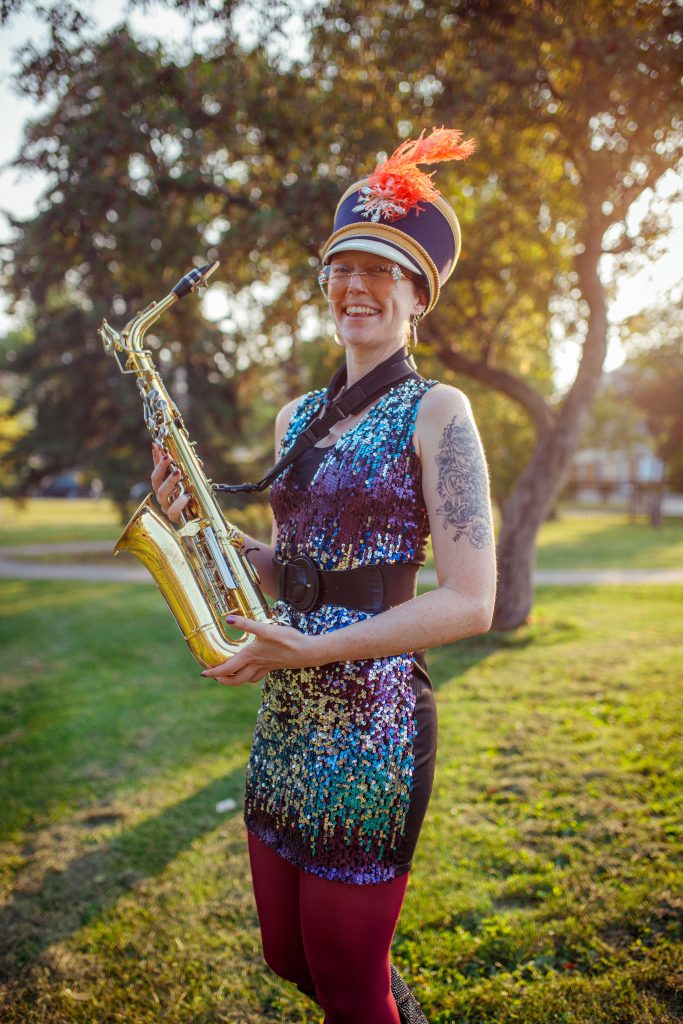
Jacquie Nicholson is a founding member of the Feminist as Fuck (FAF) Marching Band, a group of activist musicians devoted to promoting reproductive justice in Winnipeg and beyond. The band was originally formed in 2018 to confront anti-choice activists harassing people outside the Health Sciences centre but has since evolved into a more all-purpose feminist musical presence at picket lines, Pride parades, pro-choice rallies, and other community events. They are always welcoming new members of all skill levels, so if you’re feminist af and play an instrument, or want to learn one, feel free to get in touch!    

Harlie Pruder (she/they) is a Two-Spirit Métis activist, community organizer, and researcher based in Northern Manitoba. With a deep commitment to reproductive justice and 2SLGBTQIA+ rights, Harlie works at the intersections of gender, Indigeneity, and Northern realities to advocate for equitable access to healthcare and safe, affirming spaces. Harlie’s activism is grounded in a vision of self-determined, community-led solutions that center the voices of those most impacted by systemic injustice. Through research, advocacy, and grassroots organizing, they continue to push for policies and initiatives that reflect the needs and realities of Northern and Indigenous communities. 

Linda Taylor has been involved in the women’s movement since 1969, with a focus on women’s liberation, reproductive justice, and abortion rights. In 1981, she was a Founding Board member of the Women’s Health Clinic. She also developed and managed Resources for Adolescent Parents to provide supports for young sole parents. She was co-Chair of the Coalition for Reproductive Choice which worked to establish the abortion clinic now part of Women’s Health Clinic.  

Resources

My Body, My Choice, Our Struggle: A Conversation on Reproductive Justice – Video Recording

My Body, My Choice, Our Struggle – Primer

Reflecting on a Decade of Pro-Choice Student Activism at the University of Manitoba’s Fort Garry Campus

Fighting for Reproductive Rights: Resource Guide

Support Us

Whether you are passionate about interdisciplinary human rights research, social justice programming, or student training and mentorship, the University of Manitoba offers opportunities to support the opportunities most important to you. 

DONATE
  • FOLLOW US


February 20, 2025

Water Justice is Menstruation Justice: A Conversation with Co-Resistors

Event Date: February 20, 2025
Event Location: 108 St. John's College, University of Manitoba
Event Time: 1:00 - 3:30pm

On Thursday, February 20th at 1:00pm, we welcome you to join the Centre for Human Rights Research and Moon Time Connections (MTC) for an event exploring the interconnections of water justice and menstruation justice. The event takes place in Room 108 St. John’s College at the University of Manitoba.

We are honored to open the event with a Water & Tobacco Ceremony with Knowledge Keepers Ramona Milliea and Bill Milliea. If you have a copper cup, please bring it for the ceremony.

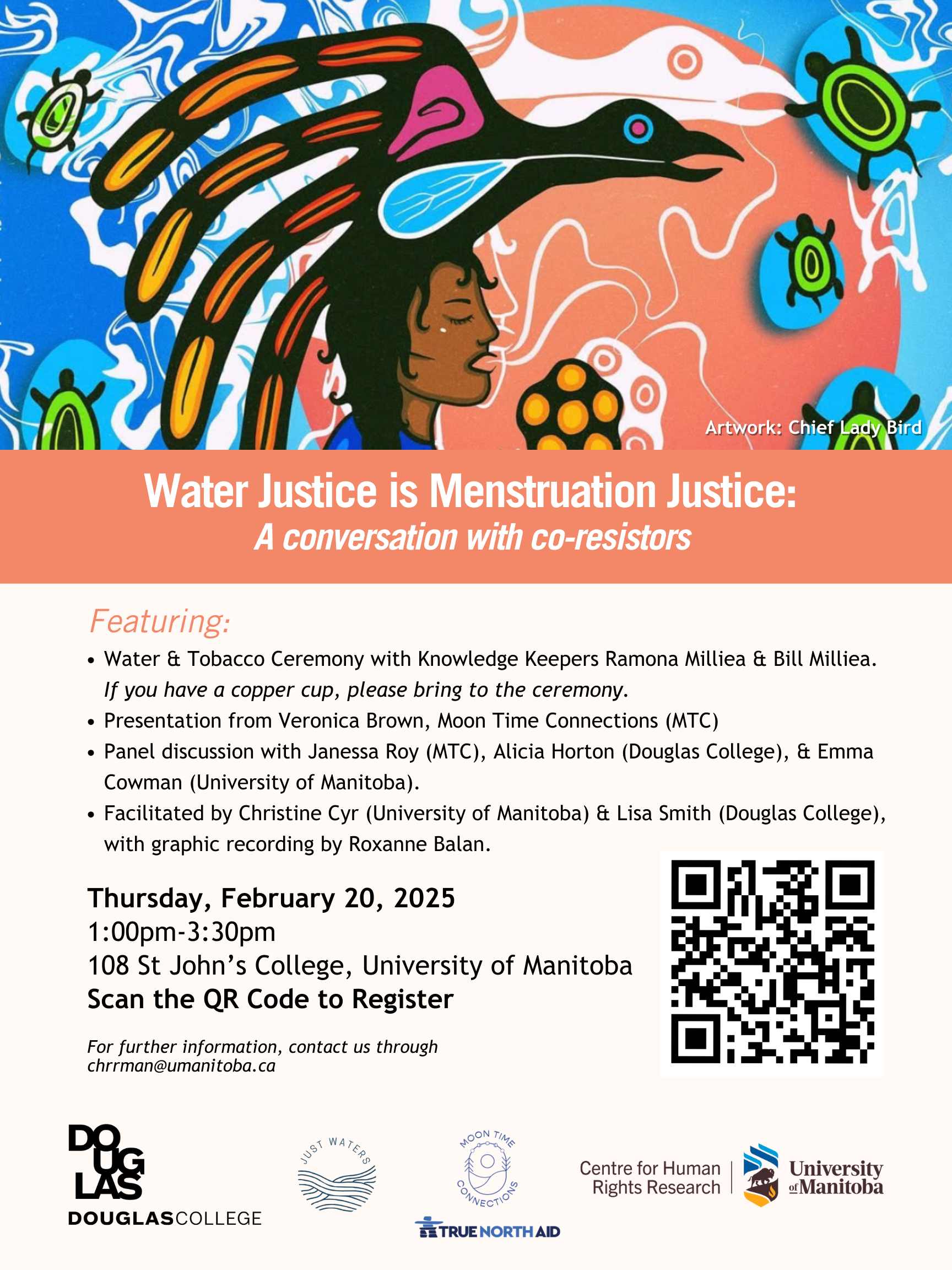
The free event will feature a presentation from Veronica Brown (MTC), followed by a panel discussion. Panelists include Emma Cowman (University of Manitoba), Alicia Horton (Douglas College), and Janessa Roy (MTC). The event will be moderated by Chrstine Cyr (University of Manitoba) and Dr. Lisa Smith (Douglas College), with graphic recording by Roxanne Balan. We are grateful to Chief Lady Bird, whose artwork is featured on our poster.

Light refreshments will be provided. In order to ensure we have enough space, we request registration. 

For information on getting to the University of Manitoba, see: https://umanitoba.ca/about-um/our-campuses/getting-here

About the Speakers

Bill Milliea is first degree Midewiwin and is from the Giwnig (Otter) Clan. He is Mi’kmaq from Elsipogtog First Nation in New Brunswick. Bill has spent over 30 years working with Correctional Services Canada in various capacities – an Elder’s Helper, Indigenous Liaison Officer, Indigenous Correctional Program Facilitator, 5 years as Kikeway Wig Director – a Section 84 Healing House, and now as an Elder. Kikeway Wig was a healing house where up to six (6) Indigenous offenders would stay as they reintegrated into society after prison. Bill is dedicated to learning and working with traditional medicines, attending ceremonies, and he is an avid hiker.

Roxanne Balan is a Anishinaabe from Shoal Lake No. 40 First Nation. She is a long time advocate and is a consultant who specializes in project management, community engagement and graphic illustration. Her goal is to help communities flourish through her various methods of facilitation.

Veronica Brown is the Ontario Chapter Lead and Education Director for Moon Time Connections, an Indigenous-led, Indigenous-focused period equity organization in Canada that works alongside northern Indigenous Communities to gain access to free menstrual products and Moon Time Education from a cultural perspective. Veronica is a settler on Treaty 13. She is an Indigenous Knowledge Professor at Centennial College, and a co-resister in many forms. She not only advocates for Indigenous rights, but also advocates for the truth to be shared about colonization and the impacts it has had on Indigenous Nations. 

Emma Cowman (she/they) is a Research Assistant with the Just Waters project at the Centre for Human Rights Research, where she is exploring the intersections of menstrual justice and water justice through an in-depth literature review and critical analysis.

Currently pursuing a Master of Social Work at the University of Manitoba, Emma holds an Honours Bachelor of Arts in Psychology and a Bachelor of Arts in Women’s and Gender Studies from the University of Regina. Their research interests span reproductive justice, 2SLGBTQIA+ rights, and gender-based violence. Emma’s thesis focuses on the abortion experiences of 2SLGBTQIA+ individuals in Manitoba, addressing gaps in inclusive reproductive healthcare.

Emma is also involved in several other research projects, including the Abortion in Manitoba project, various gender-based violence research projects with RESOLVE, and the UBC Youth Sexual & Reproductive Justice project. Beyond academia, she serves on the National Youth Advisory Board for Action Canada for Sexual Health and Rights, where she advocates for equitable and inclusive sexual health policies.

Christine Cyr is a proud Red River Métis woman. She grew up in the north end of Winnipeg in a large family. She is an alumnus of the UM (1999) and is now a graduate student in the Master of Education program. As the Associate Vice-President (Indigenous) responsible for students, community, and cultural integration, Christine is actively involved in strategic planning, cultural education, and advocating for the disruption of anti-Indigenous racism. She has worked in leadership roles at the University of Manitoba for 24 years first in Indigenous Student Recruitment and then as Director of the Indigenous Student Centre. During her time at UM, Christine co-founded the Indigenous Circle of Empowerment (ICE) leadership program, she designed and created the post-secondary club program, and she established the Métis inclusion portfolio – all of which have grown and expanded to be successfully established programs. She also brought Full Moon ceremonies to the Fort Garry campus to create space for celebrating and empowering women, and most recently she led the university community in building a new Sweatlodge on campus.  

Christine has received the Future Leaders of Manitoba Award as well as the Service Award from the University of Manitoba for her outstanding work in the field of Indigenous education and for her commitment to the community. In 2023, Christine was recognized for a lifetime commitment to Indigenous education at the Honouring Our Indigenous Campus Community celebration. Christine is a traditional woman who attends, participates in, and leads ceremonies. She lives in Winnipeg surrounded by her husband, four children, seven grandchildren, and a loving circle of family and friends. 

Alicia Horton, PhD, is a faculty member of the Department of Criminology, at Douglas College in British Columbia, Canada. Her primary academic research areas include prison culture, prison violence, prison education, social control and bodies as a resource. She is particularly interested in people’s lived experiences with prisoning, criminalization, and resistance. She loves social constructionist theories, masculinities theories and qualitative methods. Dr. Horton is an Inside-Out Prison Exchange Program certified instructor. Her most recent co-authored book Connecting Criminology and Criminal Justice: People, Places and Processes presents integrated criminology/criminal justice content from a sociological perspective.

Janessa Roy is the Manitoba Chapter Lead and Education Coordinator for Moon Time Connections. Janessa holds both settler & Mi’kmaq roots and resides on Treaty 1 Territory. She is a cultural dancer and dedicated holistic health advocate. Having stepped back from classroom teaching, she’s now focusing on her advocacy work with Moon Time Connections while expanding her dance and fitness initiatives. She’s very committed to sharing the transformative power of dance, fitness & Moon Time with others.

Dr. Lisa Smith is a member of the Department of Sociology and Coordinator of the Menstrual Cycle Research Group at Douglas College. Her research interests include: the social and political aspects of menstruation, gender-based violence and post-secondary campuses, and intersectional feminism and technology. She is particularly interested in research approaches that are community engaged, creative and informed by an applied sociology lens. Lisa is a devoted and passionate educator and scholar, who remains actively engaged within her community and many of her projects involve collaborations with grassroots community groups, as well as government and not-for-profit organizations engaged in advocacy. Her work has appeared in a variety of peer-reviewed publications, including journals and edited collections. In addition to publishing in academic venues, Lisa works on an ongoing basis to support knowledge dissemination and public engagement through open-access outputs (e.g. publicly accessible reports, podcasts, zines), as well as collaborative events, workshops and outreach. She is an active member of the menstrual equity activist community in Canada and internationally and serves on a number of community action groups and societies related to menstruation. In her downtime, Lisa loves a good long walk in the forest or strumming away on the ukulele.  
Resources

Water Justice is Menstruation Justice: A Conversation with Co-Resistors– Graphic Recording

The Interconnections of Water and Menstrual Justice in Canada – Primer

Connecting Gender and Water Justice: A Zine

World Water Day: Why Menstrual Justice Matters Too

Poster reads Water Justice is Menstruation Justice. Feb 20 at 1:00pm

Support Us

Whether you are passionate about interdisciplinary human rights research, social justice programming, or student training and mentorship, the University of Manitoba offers opportunities to support the opportunities most important to you. 

DONATE
  • FOLLOW US


December 12, 2024

Christmas Colloquia on Colonialism... or, how I learned to talk about the British Empire without ahistorical hogwash

Event Date: December 12, 2024
Event Location: Whodunit? Bookshop | 163 Lilac Street
Event Time: Doors Open: 6:30

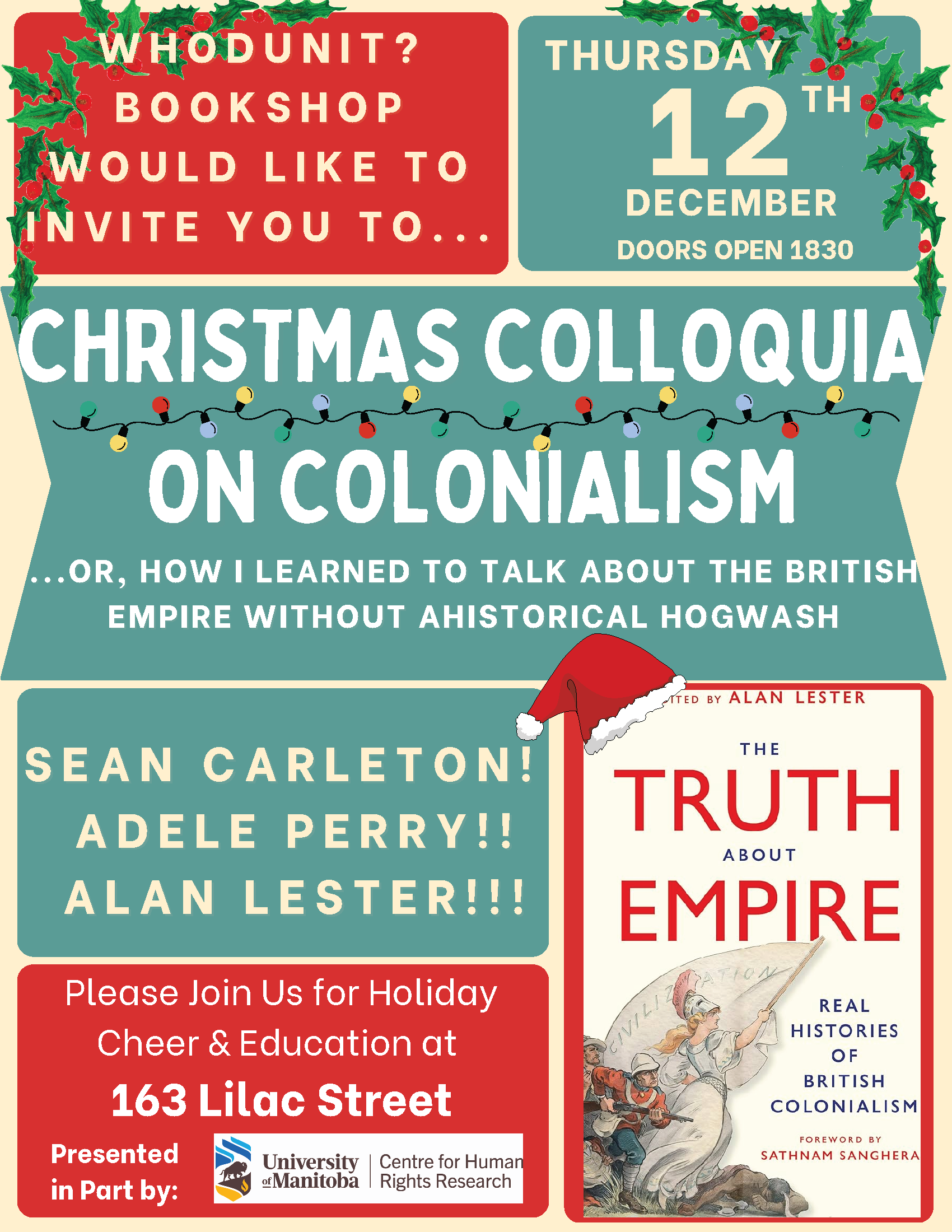
Whodunit? Bookshop would like to invite you to a Christmas Colloquia on Colonialism…. or, how I learned to talk about the British empire without ahistorical hogwash. The evenings event features Prof. Alan Lester, alongside CHRR Director Dr. Adele Perry and CHRR Research Affiliate Dr. Sean Carleton, who will discuss their work in The Truth About Empire: Real Histories of British Colonialism (2024).

Please join us on Thursday, December 12th at Whodunit? Bookshop, located at 163 Lilac Street. Doors open at 6:30 pm. No registration is required.

Brightly coloured poster with Christmas lights and holly.

Support Us

Whether you are passionate about interdisciplinary human rights research, social justice programming, or student training and mentorship, the University of Manitoba offers opportunities to support the opportunities most important to you. 

DONATE