
An Event in Honour of Red Dress Day with Cambria Harris
May 2, 2024
Cambria Harris
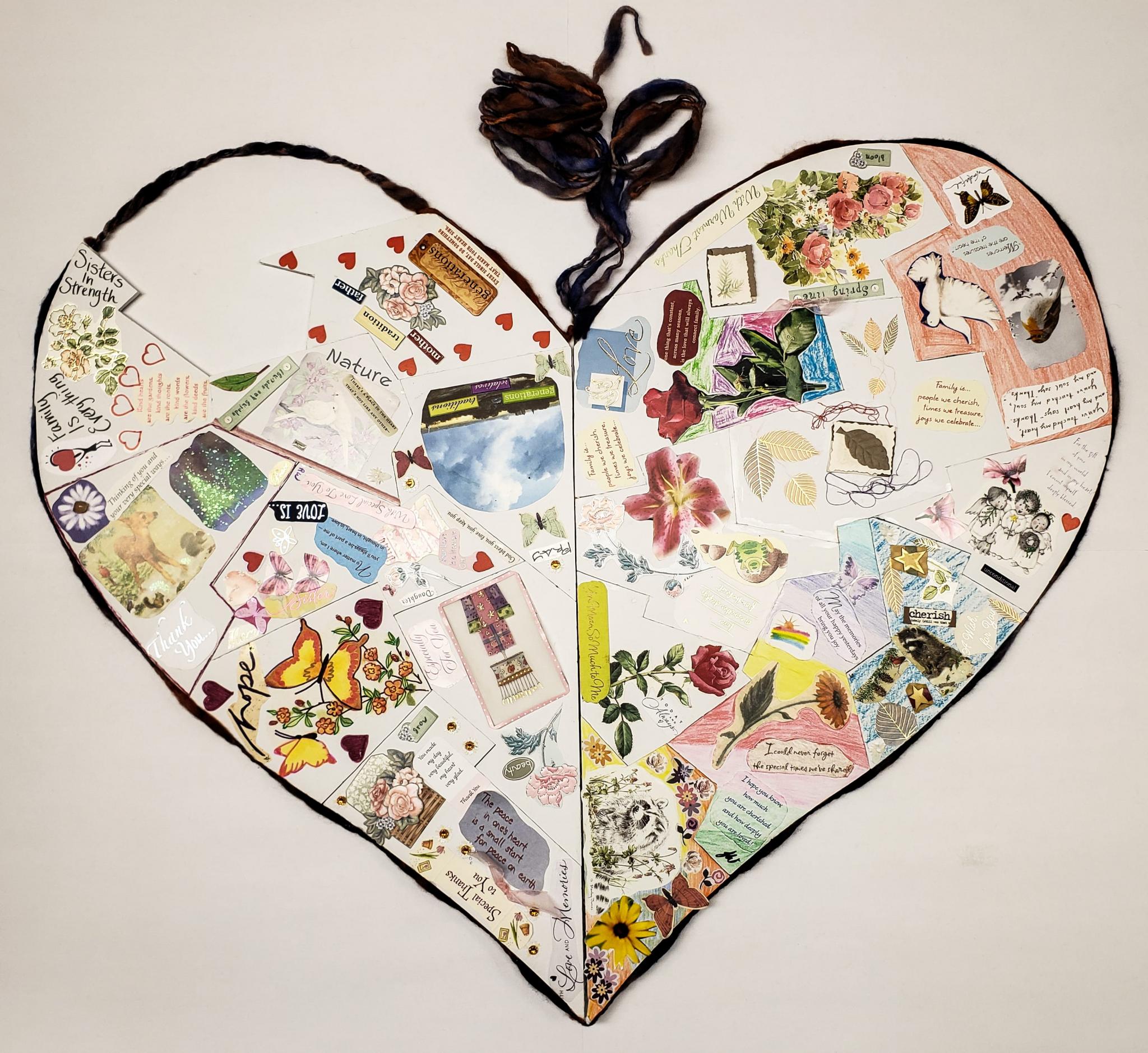
The content in this video may be difficult and/or triggering. If you or someone you know needs emotional assistance related to this topic or the information in this article, help is available 24/7 through the MMIWG Support Line, 1-866-413-6649.
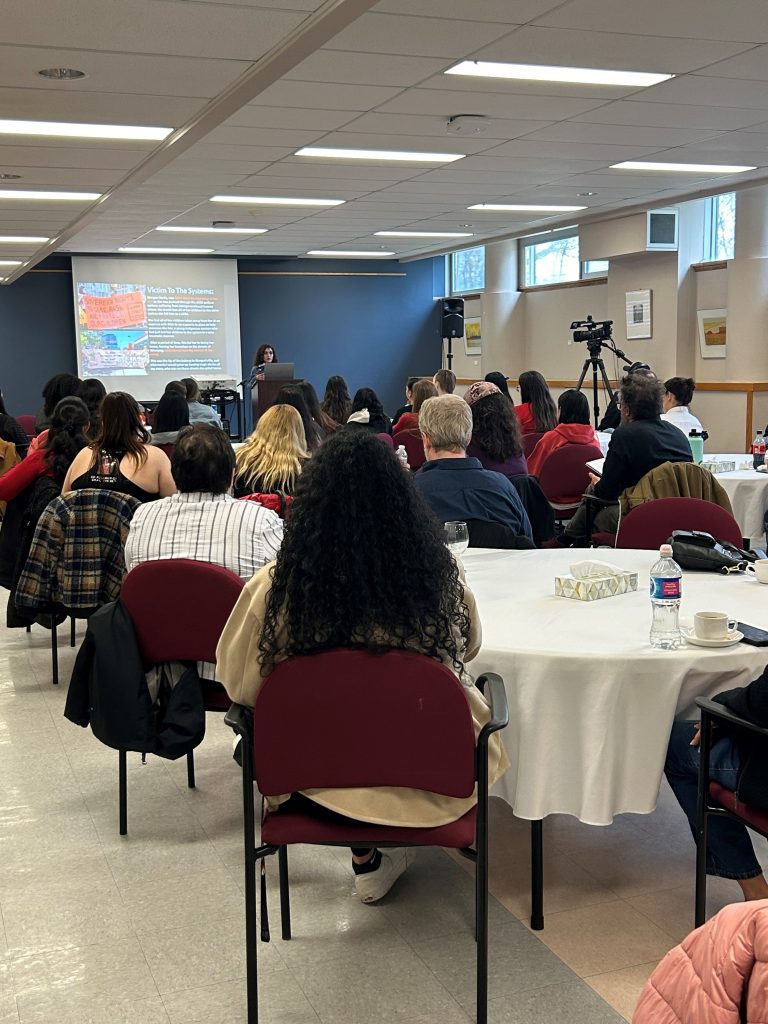
On Thursday, May 2nd, 2024, Indigenous Engagement and Communications, the Department of Indigenous Studies, the Margaret Laurence Endowment Fund (Women’s and Gender Studies) and the Centre for Human Rights Research at the University of Manitoba were honoured to host Cambria Harris for an event in honour of the National MMIWG2S+ Awareness Day, or Red Dress Day.
The name ‘Red Dress Day’ is inspired by the work of Métis artist Jamie Black who began The REDress Project in 2010 to raises awareness about the thousands of missing and murdered Indigenous Women, Girls, and 2SLGBTQQIA+ Peoples. It began as an art installation that hung hundreds of empty red dresses in public spaces to remind people of the First Nations, Métis, and Inuit women and girls lost because of gender-based violence.
Read more about the Calls to Justice.


Migrant Reproductive Justice: Perinatal and abortion care with precarious immigration status with Dr. Lindsay Larios
Migrant Reproductive Justice: Perinatal and abortion care with precarious immigration status with Dr. Lindsay Larios
April 2, 2024
Dr. Lindsay Larios
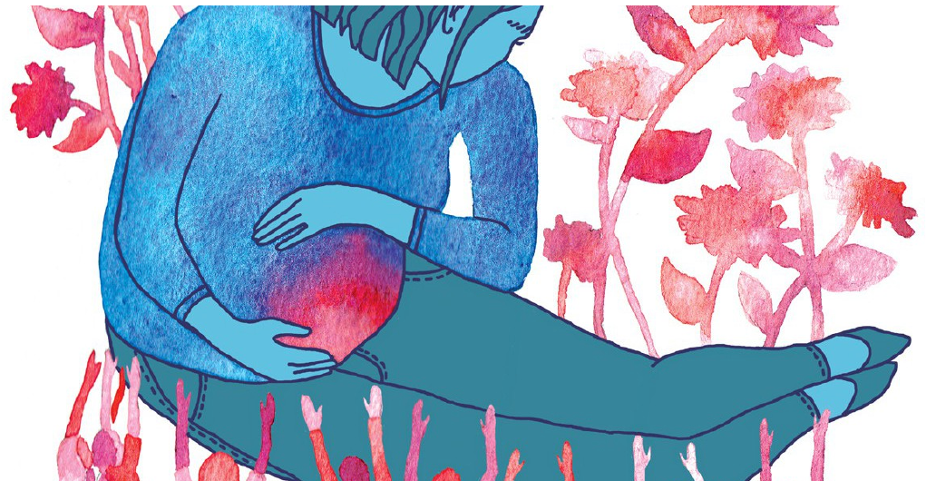
On April 2, 2024, the Centre for Human Rights Research (CHRR) hosted Dr. Lindsay Larios (UManitoba) for a seminar titled “Migrant Reproductive Justice: Perinatal and abortion care with precarious immigration status.”
Dr. Lindsay Larios is an interdisciplinary critical policy researcher and assistant professor of social work at the University of Manitoba. She studies citizenship and immigration in the Canadian context, in particular, as it intersects with family and reproductive politics and policies. Her most recent work focuses on the politics of pregnancy and childbirth and precarious migration as an issue of reproductive justice.
This seminar is a part of our annual Critical Conversations seminar series. This year, the seminar series focused on the CHRR’s research theme Reproductive and Bodily Justice and explored histories of the body, reproduction, and care in Canada and beyond.
The Right to Clean Water in First Nations: The Photovoice Project (2nd Edition)
The Right to Clean Water in First Nations: The Photovoice Project (2nd Edition)
April 2, 2024
Colin Bonnycastle
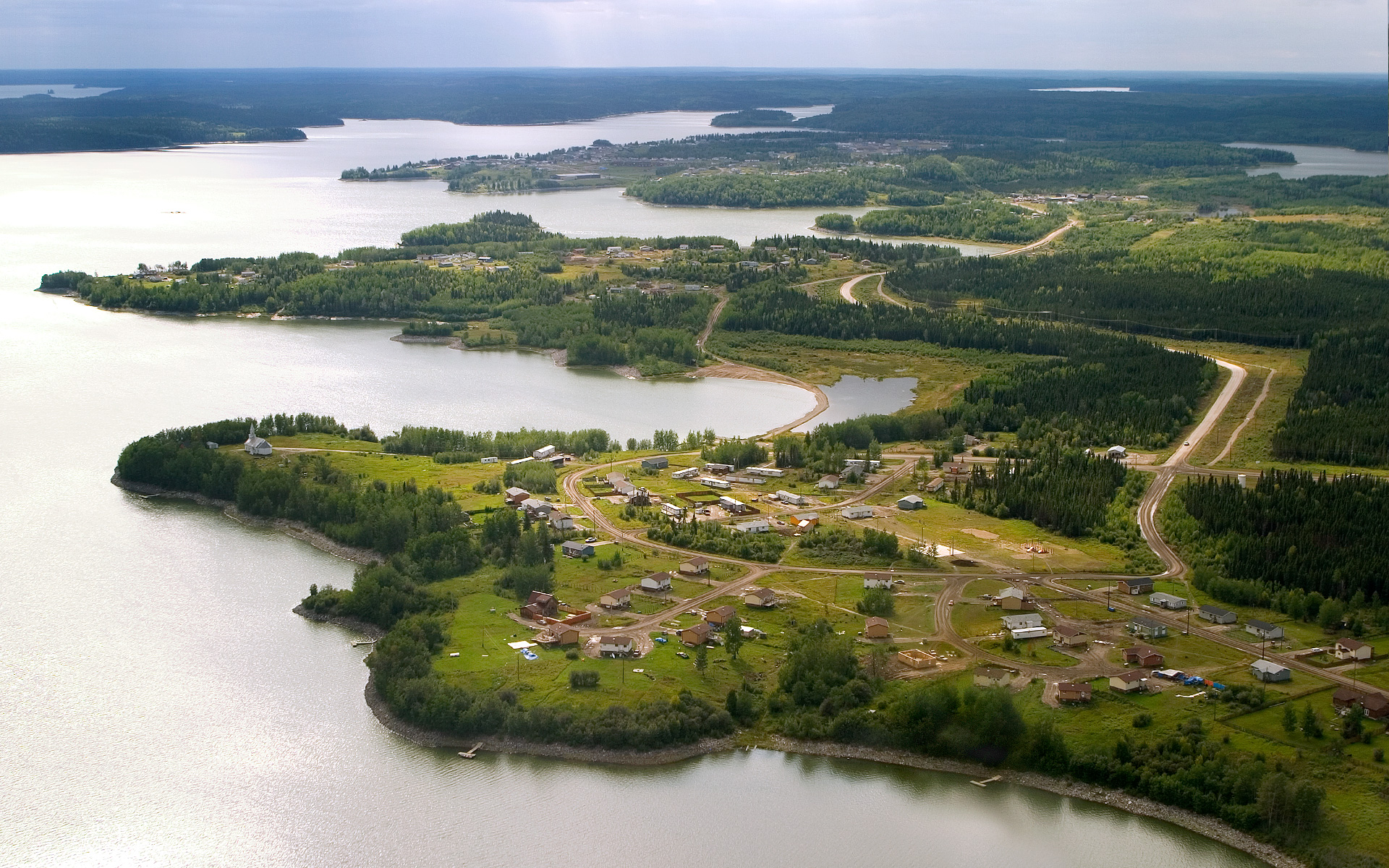
The right to water and sanitation remains a key focus and modern day human rights issue in Canada. Indigenous communities in Canada are overrepresented with respect to poor water quality and water advisories. Protecting Indigenous rights to water and sanitation is best done by community grassroots approach.
This Photovoice project stems from a 2011 SSHRC Partnership Development Grant led by Prof. Karen Busby (Principal Investigator) and Colin Bonnycastle (Co-Investigator). Nisichawayasihk Cree Nation and the students and staff at Atoskiwin Training & Employment Centre of Excellence Centre (ATEC) created a Photovoice Project to bring awareness to the impacts of unsafe drinking water and sanitation practices in Indigenous communities.
The research remains crucial today as communities continue to advocate for access to clean drinking water.

Related Resources
Support Us
Whether you are passionate about interdisciplinary human rights research, social justice programming, or student training and mentorship, the University of Manitoba offers opportunities to support the opportunities most important to you.
Migrant Justice and Human Rights: A Resource Guide
Migrant Justice and Human Rights: A Resource Guide
April 2024
Angela Ciceron
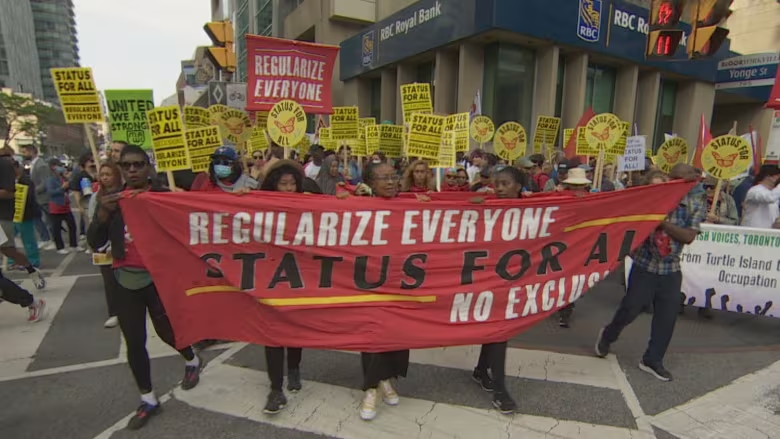
In March 2024, the Centre for Human Rights Research hosted Mostafa Henaway, a long-time community organizer with Immigrant Workers Centre in Montreal. Henaway’s work emphasized the structural and transnational issues propelling migrant workers to undertake precarious work under neoliberal capitalism, as well as efforts made by migrants to resist these structures. This resource guide aims to expand on this conversation by providing resources on the experiences of migrant workers under neoliberalism and their role in Canadian society more broadly.
Related Resources
Support Us
Whether you are passionate about interdisciplinary human rights research, social justice programming, or student training and mentorship, the University of Manitoba offers opportunities to support the opportunities most important to you.
Thinking with the Ocean: Twelve questions and a meditation to accompany the International Day of Remembrance of the Victims of Slavery and the Transatlantic Slave Trade
Thinking with the Ocean: Twelve questions and a meditation to accompany the International Day of Remembrance of the Victims of Slavery and the Transatlantic Slave Trade
March 10, 2024
Sonja Boon
“Water,” writes Dionne Brand in A Map to the Door of No Return: Notes to Belonging, “is the first thing in my memory. The sea sounded like a thousand secrets, all whispered at the same time.”[1] What might it mean to read the ocean as whispers and secrets – as an archive? What pasts might float ashore, what new stories might be carried on the currents, what materials might be washed away, eroding into unknowable and irretrievable memories?
As Derek Walcott reminds us, “The sea is History.”[2] The ocean is a repository of human memory, both metaphorical and material. Polluted with the debris of the Atlantic slave trade and histories of indenture, as well as the muck of penal ships, refugee journeys, and other detainments, these seas are not the “timeless, unchanging, unmarked, deeply unhistoric” waters of our imagination.[3] Rather, the ocean – whose histories are shaped by imperial quests for wealth, domination and control – is unknowable. Too vast, it is overwhelming. Too mobile, it challenges desires for fixity, solidity, and control.[4] Time, here, is not linear; rather, it is relational, experienced through the interaction of different forces – terrestrial, aqueous, and lunar.

If the ocean is unbounded, how might this unboundedness also allow us to imagine the archives of enslavement differently: What happens when archives of containment, capture, violence, and indeed erasure, flood?[5] When stories exceed their banks? When identities rupture, surge, spill, overflow, escape?[6] Alternatively, following Carolyn Steedman, if archives are places of dreams,[7] then what might it mean to imagine lost, silenced, and forgotten dreams through oceanic swells, currents, sprays, and saltings?
Scholars and poets of the Black Atlantic figure water – here understood primarily as the Atlantic of the Middle Passage – as a site of haunting that is both life giving and life destroying. In the words of Guyanese poet Grace Nichols, “Yes, I rippling to the music / I slipping pass the ghost ships / Watching old mast turn flowering tree / Even in the heart of all this bacchanal / The Sea returns to haunt this carnival.”[8]Thinking about oceans as archives asks us to honour not only those for whom the ocean has been a grave, but also those who have journeyed across its waves, journeys that transformed people into chattel, erasing names for numbers, journeys haunted by violent erasures and unfinished dreams.[9]

Thinking about oceans as archives asks us also to think about time in relation to memory. In the words of Janine McLeod, the sea might be imagined as “an infinite water in which everything is retained, and where all times mingle together.”[10] Oceanic time cannot be contained in an endless march forward: it cycles forward and back with the tides, washing with the waves, eroding land and memories.[11]
Oceanic archival thinking requires us to interrogate notions of boundaries and borders, the ways that water erodes shorelines, remapping territory and undermining claims to land, and to think about time and geography in relation to memory — “an infinite water in which everything is retained, and where all times mingle together.”[12] Along the shores in Suriname, for example, entire plantations have eroded, their histories – and their violences – claimed by the sea. And yet, in the process, erosion – as a form of oceanic time – has also revealed submerged truths, with lost slave cemeteries rising to the surface.
There is both a softness and a brittleness to oceanic time. Tumbling rocks soften in ocean waves; rough edges become smooth. But we also need to attend to the salting that both hardens and burns, preserves and destroys. We might consider, here, the essential role of salted, preserved fish. Salt fish was fed to the enslaved and remains an essential part of contemporary Caribbean diets, culture, and identity, but also, and simultaneously, is destructive in relation to broader questions of health. But we can also look to the material conditions of enslaved labour. In The History Mary Prince, A West Indian Slave, Mary Prince recounts her time working in the salt ponds on Grand Turk, Turks and Caicos Islands, and the sores, boils, and blisters that ate right down to the bone.[13]

In the haunted space-time of oceans as archives, past, present, and impossible-but-hoped-for futures collide with one another. How can we make sense of histories of ruination? How can we, following M. NourbeSe Philip, tell impossible stories that must be told?[14] But also, how can we live well in what Christina Sharpe calls the wake, a mode of reckoning and a reminder of a “past that is not yet past,”[15] in the ongoing afterlives of the transatlantic slave trade? What stories might the ocean be able to tell us, and what might we learn? What might it mean, following Alexis Pauline Gumbs, to breathe with the ocean?[16]
The work of artist and scholar Camille Turner offers one way forward. In 2019, when interviewed about an art installation that considered Newfoundland and Labrador’s imbrication in the transatlantic slave trade, she underscored the importance of understanding these pasts. “We didn’t create this history,” she said. “None of us did. We weren’t here, but it is what shaped us. By not dealing with it, we can never move on from here. We can’t really move into a future where things are equitable. So I think it’s really important to acknowledge these stories.”
This blog post draws on an essay I wrote for Daze Jefferies: Stay Here Stay How Stay (St. John’s: The Rooms Provincial Art Gallery, 2024), as well as on “Thinking with Oceans,” a blog post I wrote for the Social Sciences and Humanities Ocean Research and Education (SSHORE) network (https://sshoresite.wordpress.com/2019/05/27/thinking-with-oceans/). My thanks to The Rooms Provincial Art Gallery for permission to quote from the essay.
[1] Dionne Brand, A Map to the Door of No Return: Notes to Belonging, Toronto: Penguin Random House, 2001, 8.
[2] Derek Walcott, “The Sea is History,” in Collected Poems, 1948-1984. New York: Farrar, Strauss & Giroux, 364. https://www.theparisreview.org/poetry/7020/the-sea-is-history-derek-walcott
[3] Suvendrini Perera, “Oceanic Corpo-Graphies, Refugee Bodies and the Making and Unmaking of Waters.” Feminist Review 103 (2013): 58-79, 62.
[4] See, for example, Renisa Mawani’s oceanic methodology in Across Oceans of Law (Durham: Duke University Press, 2018), which relies on currents layering over and against one another.
[5] For more on flooding and memory, see Toni Morrison, “The Site of Memory,” where she writes: “You know, they straightened out the Mississippi River in places, to make room for houses and livable acreage. Occasionally the river floods these places. ‘Floods’ is the word they use, but in fact it is not flooding; it is remembering. Remembering where it used to be. All water has a perfect memory and is forever trying to get back to where it was” (“The site of memory.” In Inventing the Truth: The Art and Craft of Memoir, ed. William Zinsser, 83-102. Boston and New York: Houghton Mifflin, 1995, 98-99.
[6] See, for example, Alexis Pauline Gumbs, Spill: Scenes of Black Feminist Fugitivity (Durham, NC: Duke University Press, 2016).
[7] Carolyn Steedman, Dust: The Archive and Cultural History (New Brunswick, NJ: Rutgers University Press, 2002).
[8] Grace Nichols, I Have Crossed an Ocean, Newcastle-upon-Tyne: Bloodaxe Books, 2010, 103.
[9] For one powerful example of restorying the Middle Passage, see M. NourbeSe Philip, Zong!, Westeyan University Press, 2008.
[10] Janine McLeod. “Water and the Material Imagination: Reading the Sea of Memory against the Flows of Capital.” In Thinking With Water, eds. Cecilia Chen, Janine McLeod, and Astrida Neimanis, 40-60 (Montreal and Kingston: McGill-Queen’s University Press, 2013), 40.
[11] Stefanie Hessler, “Tidalectics: Imagining an Oceanic Worldview through Art and Science.” In Tidalectics: Imagining an Oceanic Worldview Through Art and Science, ed. Stefanie Hessler, 31-81 (Boston: MIT Press, 2018); Mawani, Across Oceans of Law; and McLeod. “Water and the Material Imagination.”
[12] McLeod, “Water and the Material Imagination,” 40.
[13] Mary Prince, The History of Mary Prince, A West Indian Slave. London: F. Westley and A.H. Davis, 1831)
[14] M. NourbeSe Philip, Zong!, Wesleyan University Press, 2008.
[15] In the Wake: On Blackness and Being (Durham, NC: Duke University Press, 2016), 13.
[16] Gumbs, Undrowned: Black Feminist Lessons from Marine Mammals (Chico, CA: AK Press, 2020).
Care Activism in Canada: Migrant Domestic Workers, Dissident Friendships and Decolonial Care
Care Activism in Canada: Migrant Domestic Workers, Dissident Friendships and Decolonial Care
March 19, 2024
Dr. Ethel Tungohan and Diwa Marcelino
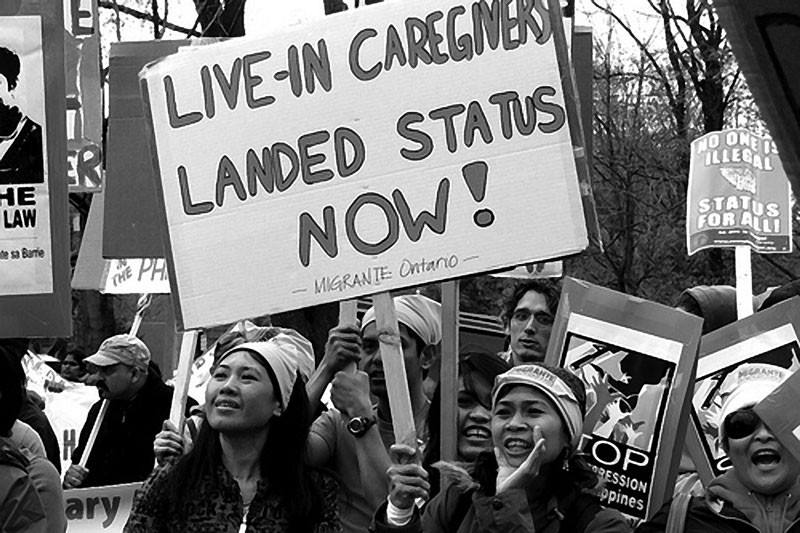
Dr. Ethel Tungohan in conversation with Diwa Marcelino, Migrante Manitoba
In collaboration with the Global College – University of Winnipeg, the Centre for Human Rights Research (CHRR) at the University of Manitoba hosted Dr. Ethel Tungohan (York University) for a seminar titled Care Activism in Canada: Migrant Domestic Workers, Dissident Friendships and Decolonial Care. Dr. Tungohan was in conversation with Migrante Manitoba representative and community organizer Diwa Marcelino.
Ethel Tungohan is a Canada Research Chair in Canadian Migration Policy, Impacts and Activism and an Associate Professor of Politics at York University in Toronto, Canada. Her book, “Care Activism: Migrant Domestic Workers, Communities of Care, and Movement Building,”, won the National Women’s Studies Association First Book Prize. Her research looks at social movements, immigration policy, social and public policy, and Canadian and comparative politics.
Diwa Marcelino is a community organizer with Migrante Manitoba, a grassroots organization advancing the rights and welfare of overseas Filipinos within the framework of peoples’ struggle for democracy, justice & peace in the Philippines. Migrante Manitoba is a founding member of Health Care for All Manitoba, an alliance advocating for expanded public health care coverage to include all residents of Manitoba regardless of status. During the Freedom Convoy occupations in 2022, he became the national project manager for the Community Solidarity Project, a civil society response to rise of the politics of division and hate. He is also a founding member of Community Solidarity Manitoba. He is also the vice-chairperson of the Council of Canadians, a grassroots organization challenging corporate power and advocating for people, the planet and our democracy. He is also a steering committee member of KAIROS, an ecumenical organization promoting ecological justice and human rights.
This seminar is a part of our annual Critical Conversations seminar series. This year, the seminar series focused on the CHRR’s research theme Reproductive and Bodily Justice and explored histories of the body, reproduction, and care in Canada and beyond.
“The Crying Need For Indian Foster Homes”: Indigenous Women Challenge State Child Welfare Practices With Sarah Nickel, PhD.
"The Crying Need For Indian Foster Homes": Indigenous Women Challenge State Child Welfare Practices With Sarah Nickel, PhD.
March 12, 2024
Dr. Sarah Nickel
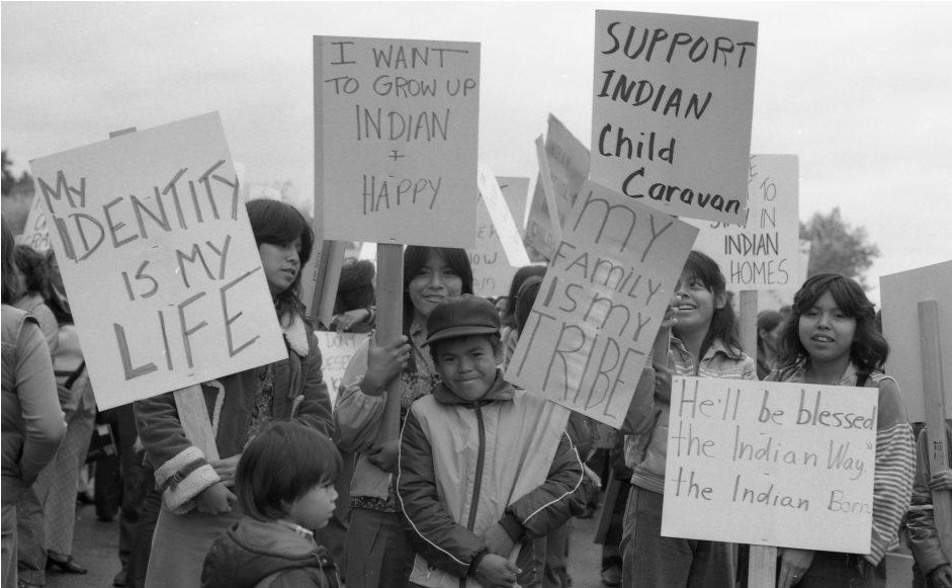
The Centre for Human Rights Research (CHRR) hosted a seminar titled “The crying need for Indian foster homes”: Indigenous Women Challenge State Child Welfare Practices with Dr. Sarah Nickel (UAlberta) on Tuesday, March 12, 2024, at 2:30 pm in 543-544 UMSU University Centre.
Sarah Nickel is Tk’emlúpsemc, French Canadian, and Ukrainian, and an associate professor of History at the University of Alberta. Her work focuses on twentieth century Indigenous politics and the gendered nature of political work drawing on community- engaged methodologies. Her first book, Assembling Unity: Indigenous Politics, Gender, and the Union of BC Indian Chiefs was published in 2019 with UBC Press and won the Canadian Historical Association’s prize for Best Book in Indigenous History in 2020. Sarah’s second monograph, Active Women: Indigenous Women’s Social and Political Work in Kanata’s West will be published with the University of Toronto Press in late 2024.
This seminar is a part of our annual Critical Conversations seminar series. This year, the seminar series focused on the CHRR’s research theme Reproductive and Bodily Justice and explored histories of the body, reproduction, and care in Canada and beyond.
Article in The Manitoban: Shortfalls in menstrual equity at U of M, audit reveals
Article in The Manitoban: Shortfalls in menstrual equity at U of M, audit reveals
August 24, 30
Kyra Campbell
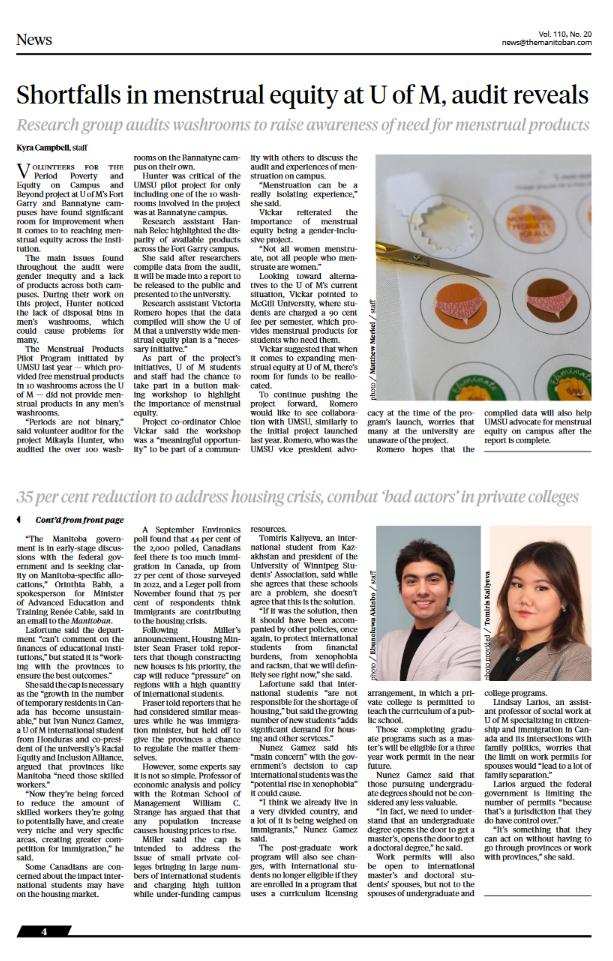
Kyra Campbell, reporter for The Manitoban, covered the work of the “Period Poverty & Equity, On Campus and Beyond” project, including the campus audit and the button-making event. Read more at The Manitoban!
Related Resources
Support Us
Whether you are passionate about interdisciplinary human rights research, social justice programming, or student training and mentorship, the University of Manitoba offers opportunities to support the opportunities most important to you.
Innocents Behind Bars: Systemic Racism and Wrongful Convictions
Innocents Behind Bars: Systemic Racism and Wrongful Convictions
November 28, 2023
Kara Sievewright
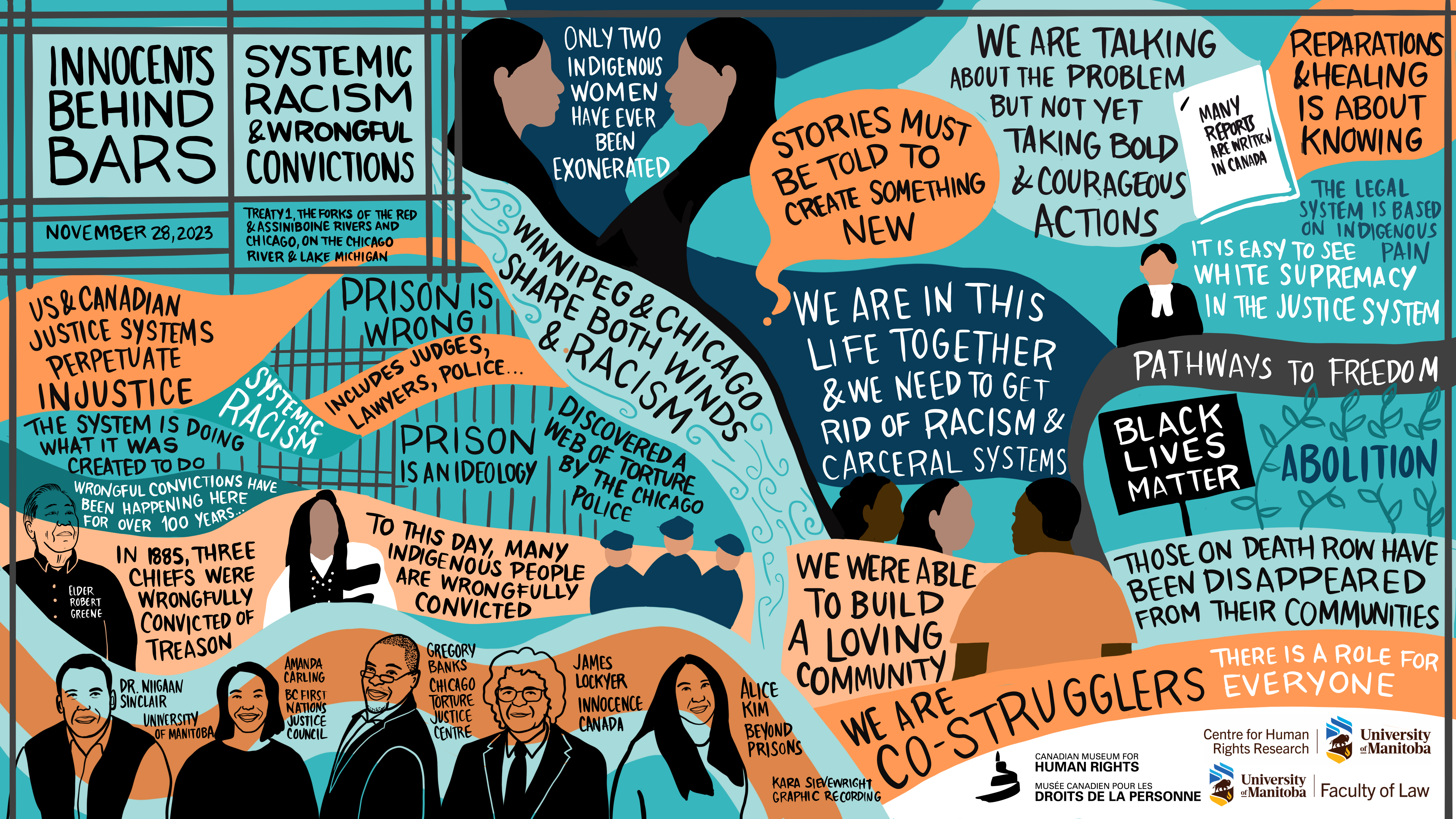
The Canadian Museum for Human Rights, the Centre for Human Rights Research (University of Manitoba), and the Faculty of Law (University of Manitoba) co-organized and sponsored a public event on November 28, 2023 “Innocents Behind Bars: Systemic Racism and Wrongful Convictions.” There were over 125 people in attendance, as well as 25 people joining online.
The panel brought together leaders of the police torture justice/reparations movement in Chicago, into conversation with those working on demanding justice for Indigenous and racialized peoples wrongly imprisoned here in Canada.This event is inspired by the July 2023 release of Allan Woodhouse and Brian Anderson who were wrongfully imprisoned for a murder they did not commit and spent almost fifty years fighting to clear their names. Brian Anderson and members of his family were in attendance and Allan Woodhouse was able to join virtually.
Artist Kara Sievewright, Maker of Nets captured highlights of the event with a graphic recording.
Related Resources
Support Us
Whether you are passionate about interdisciplinary human rights research, social justice programming, or student training and mentorship, the University of Manitoba offers opportunities to support the opportunities most important to you.
Innocents Behind Bars: Systemic Racism and Wrongful Convictions
Innocents Behind Bars: Systemic Racism and Wrongful Convictions
November 28, 2023
Amanda Carling, James Lockyer, Alice Kim, Gregory Banks, Niigaan Sinclair, Elder Robert Greene
On November 28, 2023, the Canadian Museum for Human Rights, the Centre for Human Rights Research (University of Manitoba), and the Faculty of Law (University of Manitoba) co-organized and sponsored a public event “Innocents Behind Bars: Systemic Racism and Wrongful Convictions.”
We were honoured to welcome:
- Amanda Carling, CEO, BC First Nations Justice Council
- James Lockyer, Founding Director, Innocence Canada
- Alice Kim, Director of Human Rights Practice, Centre for the Study of Race, Politics and Culture
- Gregory Banks, Torture Survivor and Learning Fellow, Chicago Torture Justice Center (joining virtually)
- Facilitated by Dr. Niigaan Sinclair, Indigenous Studies, University of Manitoba
- Opening remarks from Elder Robert Greene, Canadian Museum for Human Rights
Contact Us
We’d love to hear from you.
442 Robson Hall
University of Manitoba
Winnipeg, Manitoba
R3T 2N2 Canada
204-474-6453
Quick Links
Subscribe to our mailing list for periodic updates from the Centre for Human Rights Research, including human rights events listings and employment opportunities (Manitoba based and virtual).
Traditional Territories Acknowledgement
The University of Manitoba campuses are located on the original lands of the Anishinaabeg, Ininiwak, Anisininewuk, Dakota Oyate, Dene and Inuit, and on the National Homeland of the Red River Métis.

Centre for Human Rights Research 2023© · Privacy Policy