
Violence Against Women Migrants and Refugees: A Podcast
February 23, 2026
GBV-MIG Canada Research Program
This podcast explores the experiences of gender-based violence (GBV) by migrant and refugee women in Canada. As a part of the GBV-MIG Canada Research Program, it aims to show how structural and systemic factors such as policies and legislation shape the violence that migrant and refugee women and girls are likely to experience in Canada.
Episode 1: Migration and Gender-Based Violence (GBV) in Canada with Dr. Lori Wilkinson and Dr. Evie Tastsoglou
In this episode, host Dr. Pauline Tennent speaks with Dr. Lori Wilkinson (University of Manitoba) and Dr. Evie Tastsoglou (Saint Mary’s University) about the GBV-MIG Canada Research Program. In particular, they talk about how the project came to be, and provide important background information about gender-based violence (GBV) experienced by migrant and refugee women in Canada.
Listen now:
Episode 2: Systemic Factors of Gender-Based Violence with Dr. Evie Tastsoglou and Dr. Cathy Holtmann
In the second episode of the podcast, host Dr. Pauline Tennent discusses with Dr. Evie Tastsoglou (Saint Mary’s University) and Dr. Cathy Holtmann (University of New Brunswick) about the underlying systemic factors which shape gender-based violence (GBV) for migrant and refugee women (MRW). Using intersectional feminist and social ecological approaches, this episode explores how inequalities and identities shape the social determinants of health and well-being of MRW..
Listen now:
- Yalcinoz-Ucan, B., Tastsoglou, E., Dawson, M. (2025). Tracing Individual Experiences to Systemic Challenges: The (Re)Production of GBV in Migrant Women’s Experiences in Canada, Frontiers in Sociology, Special Research Topic on Gender and the Continuum of Violence in Migration, edited by Tastsoglou E., Dawson, M., Freedman, J., Holtmann, C. Vol. 10 (Open Access).
- Tastsoglou, E. (2025). Gender-Based Violence in a Migration Context: Health Impacts and Barriers to Healthcare Access and Help Seeking for Migrant and Refugee Women in Canada. Societies, 15(3), 68. https://doi.org/10.3390/soc15030068
- Sisic, M., Tastsoglou, E., Wilkinson, L., Dawson, M., Holtmann, C., Falconer, C. (2024). The Continuum of Gender-Based Violence Experienced by Migrant and Refugee Women in Canada: Perspectives from Key Informants. In Special Topic on “Gender and the Continuum of Violence in Migration,” guest-edited by Tastsoglou, E., Dawson, M., Freedman, J., Holtmann. C. In the journal Sociology, Frontiers
- Holtmann, C., Tastsoglou, E., Dawson, M. Wilkinson, L. (2023). Surviving Gender-Based Violence: A Social Ecological Approach to Migrant and Refugee Women’s Settlement. Canadian Ethnic Studies, Special Issue on Gender and Violence in a Migration and Refugee Context: Agency, Resilience and Resistance, edited by Tastsoglou, E. 55(3), 57-77
About the Project
This podcast is a knowledge mobilization initiative from the project, Violence Against Women Migrants and Refugees: Analyzing Causes and Effective Policy Response from the GBV-MIG Canada Research Program. The project is a partnership of four academics and four academic institutions, including Saint Mary’s University, University of Guelph, University of Manitoba, University of New Brunswick.
Funded by the Canada Institutes of Health Research as one of the international partners in the GBV-MIG Project, a winning project of the Gender-Net Plus Consortium.
Connect with us
- Email: gbv-mig@smu.ca
- Website: https://www.smu.ca/gendernet/welcome.html
- Twitter/X: https://x.com/GBV_MIGCanada
- Bluesky: https://bsky.app/profile/gbv-mig-canada.bsky.social




Bordering on Age Discrimination: A social age analysis of Canada immigration policy
Bordering on Age Discrimination: A social age analysis of Canada immigration policy
December 1, 2025
Angela Ciceron
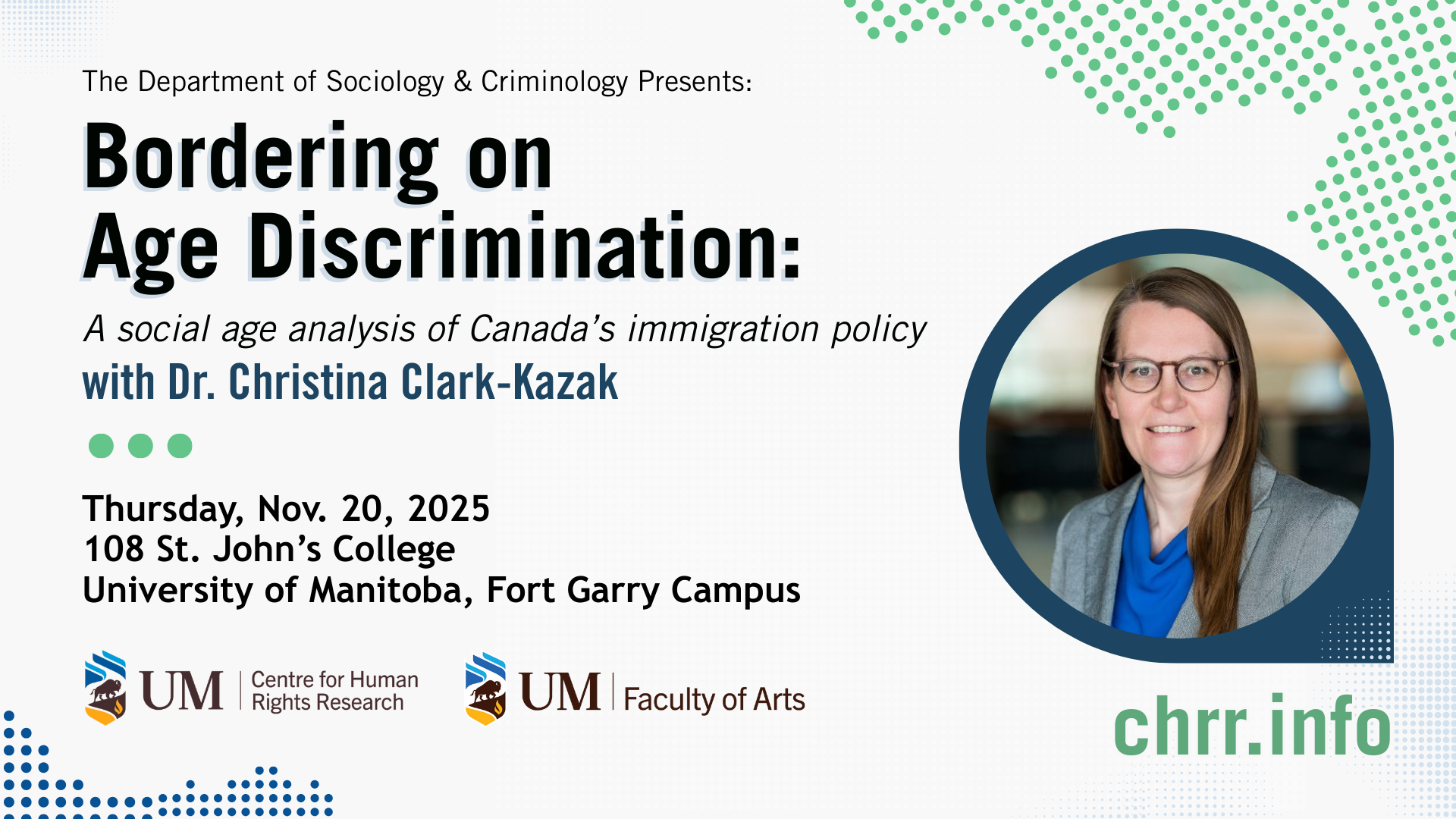
On November 20, 2025, the Centre for Human Rights Research and the Department of Sociology and Criminology (Faculty of Arts) at the University of Manitoba hosted Dr. Christina Clark-Kazak for a lecture titled “Bordering on Age Discrimination: A Social Age Analysis of Canada’s Immigration Policy.”
In this lecture, Clark-Kazak draws from her forthcoming work on Age and Immigration Policy in Canada: Toward an Equitable Approach (UBC Press, 2026) where she uses a social age analysis to understand how Canadian immigration policies can discriminate on the basis of social age. Her analysis covers a broad range of immigration policies, from the points system to refugee settlement, as well as related areas such as immigration detention.
Watch the lecture below.
An Evening on Cuban-Canadian encounters through music, art, politics and more with Karen Dubinsky and Jorge Nállim
An Evening on Cuban-Canadian encounters through music, art, politics and more with Karen Dubinsky and Jorge Nállim
October 29, 2025
Centre for Human Rights Research

On October 24, 2025, the CHRR, in collaboration with McNally Robinson Booksellers and the UM Institute for the Humanities hosted historians Karen Dubinsky and Jorge Nállim for an evening on Cuban-Canadian encounters through music, art, politics and more at the Atrium in McNally Robsinson Booksellers – Grant Park. This evening included a reading from Dubinsky’s latest book, Strangely, Friends: A History of Cuban-Canadian Encounters (Between the Lines Books) and a Q&A with the audience, followed by a book signing. Watch a recording of the book launch below.
Just Research: A Podcast – Season 1
Just Research: A Podcast - Season 1
October 6, 2025
Angela Ciceron
Just Research is a podcast series from the Centre for Human Rights Research at the University of Manitoba. Hosted by Dr. Pauline Tennent and Dr. Adele Perry, the podcast highlights researchers from the UM community and beyond doing work in human rights and social justice in a variety of disciplines.
This season focuses on researchers whose work engages with each of the CHRR’s research themes: Borders and Human Rights, Indigenous Peoples and Human Rights, Reproductive and Bodily Justice, and Water Rights and Justice.
Episode 1: Looking Back on the CHRR and Water Research with Helen Fallding
In the first episode of Just Research, CHRR director Dr. Adele Perry and former CHRR manager Helen Fallding look back to the CHRR’s longstanding work in water rights and justice. In this conversation, they talked about the CREATE H2O program, its interdisciplinary, foundational work in water and sanitation in First Nations communities, and its legacy through the Just Waters project.
Listen now:
Episode 2: On Borders and Human Rights with Dr. Lori Wilkinson
In this episode of Just Reseach, CHRR manager Dr. Pauline Tennent speaks with Dr. Lori Wilkinson, a professor in Sociology at University of Manitoba, about her research on borders and human rights. Dr. Wilkinson’s research has touched on a wide variety of topics surrounding the lived experiences of migrants, refugees, and newcomers in Canada, including their experiences with sexual and gender-based violence.
Listen now:
- Sisic, Mia, Evangelia. Tastsoglou, Lori Wilkinson, Myrna Dawson, Catherine Holtmann, Chantelle Falconer, “The Continuum of Gender-Based Violence Experienced by Migrant and Refugee Women in Canada: Perspectives from Key Informants.” In Special Topic on “Gender and the Continuum of Violence in Migration,” guest-edited by E. Tastsoglou, M. Dawson, J. Freedman, C. Holtmann. In the journal Sociology, Frontiers, 2024
- Luo, Yazhi and Lori Wilkinson (2023) “Asian international students in a mid-sized Canadian City: A Case study of the University of Manitoba” Chapter 14, pp. 202-216 in Asian international students in Canadian universities: Internationalization, racialization and inclusion. Ann H. Kim, Elizabeth Buckner, and Jean Michel Montsion eds. Milton Park, UK: Routledge Press.
- Wilkinson, Lori and Sally Ogoe (2020) “Friendly Manitoba? An Examination of Racism and Xenophobia during the COVID-19 Pandemic” COVID-19 in Manitoba: Public Policy Responses to the First Wave Andrea Rounce, Karine Levasseur, and Shannon Furness eds. Winnipeg: University of Manitoba Press.
Episode 3: On Reproductive and Bodily Justice with Dr. Lindsay Larios
In this episode of Just Research, CHRR manager Dr. Pauline Tennent talks to Dr. Lindsay Larios, an assistant professor in the Faculty of Social Work at the University of Manitoba, about her research in reproductive justice. Dr. Larios’ work explores access to reproductive justice and care for migrants in Manitoba through community-based research approaches.
Listen now:
- https://chrr.info/research-themes/research-themes/reproductive-and-bodily-justice/
- https://chrr.info/person/people-_network/lindsay-_larios/
- https://lindsaylarios.com/
- https://www.instagram.com/reprojusticeresearchmb/
- https://chrr.info/current-projects-2/past-projects/period-poverty-and-equity-on-campus-and-beyond/
- Tennent, P., Alemaio, B., Belec, H., Hunter, M., Larios, L., Perry, A., Romero, V., Smith, J., & Vickar, C. (2024). A Report on Period Poverty and Equity, on Campus and Beyond. Winnipeg, MB: Centre for Human Rights Research, University of Manitoba.
- Larios, L., Larsen, P., Olanubi, O., & Oviosun, J. (2023) “Healthcare is a human right”: International student speak out on healthcare inaccessibility in Manitoba. Winnipeg, MB: Canadian Centre for Policy Alternatives — Manitoba.
- Larios, L. (2023). Precarious reproductive citizenship: Employment protections for pregnant precarious status migrants in Canada. Citizenship Studies. DOI: 10.1080/13621025.2022.2073970
- Larios, L. and Cowman, E. (2025). Working toward reproductive justice in Manitoba. Winnipeg, MB: Canadian Centre for Policy Alternatives — Manitoba.
Episode 4: On Indigenous Peoples and Human Rights with Brenda Gunn
On the last episode of Just Research, CHRR director Dr. Adele Perry speaks to Brenda Gunn, a professor in Robson Hall – Faculty of Law at the University of Manitoba, about her research on Indigenous peoples and human rights. Professor Gunn’s work has encompassed a wide variety of topics in this area, including Indigenous and treaty rights in Manitoba, and international law and Indigenous rights.
Listen now:
- https://chrr.info/research-themes/research-themes/reproductive-and-bodily-justice/
- https://chrr.info/person/people-_network/lindsay-_larios/
- https://lindsaylarios.com/
- https://www.instagram.com/reprojusticeresearchmb/
- https://chrr.info/current-projects-2/past-projects/period-poverty-and-equity-on-campus-and-beyond/
- Tennent, P., Alemaio, B., Belec, H., Hunter, M., Larios, L., Perry, A., Romero, V., Smith, J., & Vickar, C. (2024). A Report on Period Poverty and Equity, on Campus and Beyond. Winnipeg, MB: Centre for Human Rights Research, University of Manitoba.
- Larios, L., Larsen, P., Olanubi, O., & Oviosun, J. (2023) “Healthcare is a human right”: International student speak out on healthcare inaccessibility in Manitoba. Winnipeg, MB: Canadian Centre for Policy Alternatives — Manitoba.
- Larios, L. (2023). Precarious reproductive citizenship: Employment protections for pregnant precarious status migrants in Canada. Citizenship Studies. DOI: 10.1080/13621025.2022.2073970
- Larios, L. and Cowman, E. (2025). Working toward reproductive justice in Manitoba. Winnipeg, MB: Canadian Centre for Policy Alternatives — Manitoba.
“Dancing with fire in limbo”: The consequences of Myanmar migrants’ ambiguous legal status in Thailand
"Dancing with fire in limbo": The consequences of Myanmar migrants' ambiguous legal status in Thailand
May 20, 2024
Dr. Sai Kyi Zin Soe
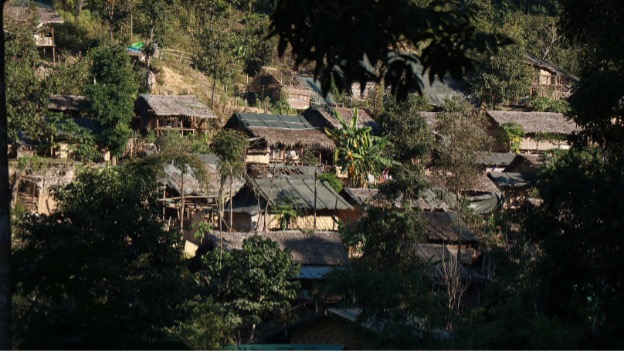
The Department of Anthropology and the Centre for Human Rights Research hosted a lecture with Dr. Sai Kyi Zin Soe on May 30, 2024. Dr. Soe’s presentation “”Dancing with fire in limbo”: The consequences of Myanmar migrants’ ambiguous legal status in Thailand” explores the challenges faced by Burmese refugees in Thailand, who navigate the precarious circumstances of displacement and legal ambiguity. Drawing on social science research, it examines the drivers of forced migration from Myanmar, including the intensified civil war, persecution of ethnic minorities, and economic hardship. In Thailand, these refugees are officially classified as “illegal migrants,” leaving them in a state of limbo without access to essential services and vulnerable to arrest and deportation. Simultaneously, Burmese nationals face pressure to conform to their communities’ expectations regarding political activism and in-country revolution. The presentation emphasizes the importance of understanding these complex realities through a social science lens to inform holistic, rights -based approaches to development policy and practice. By advocating for legal recognition, refugee empowerment, and research-informed strategies, this presentation highlights the transformative potential of social science in shaping policies that bridge the gap between displacement and belonging, positioning refugees as agents of change.
Dr. Sai Kyi Zin Soe is a Research Affiliate at the Centre for Disability Research and Policy, Faculty of Medicine and Health at the University of Sydney. Currently, he serves as a Senior Consultant at the Foundation for Education and Development (FED), dedicated to assisting Myanmar migrants in Thailand. Additionally, he provides support to the Karenni State Interim Parliament (KSIP) in the capacity of a Technical Advisor.
“No One is Disposable” with Mostafa Henaway
"No One is Disposable" with Mostafa Henaway
March 2024
Mostafa Henaway
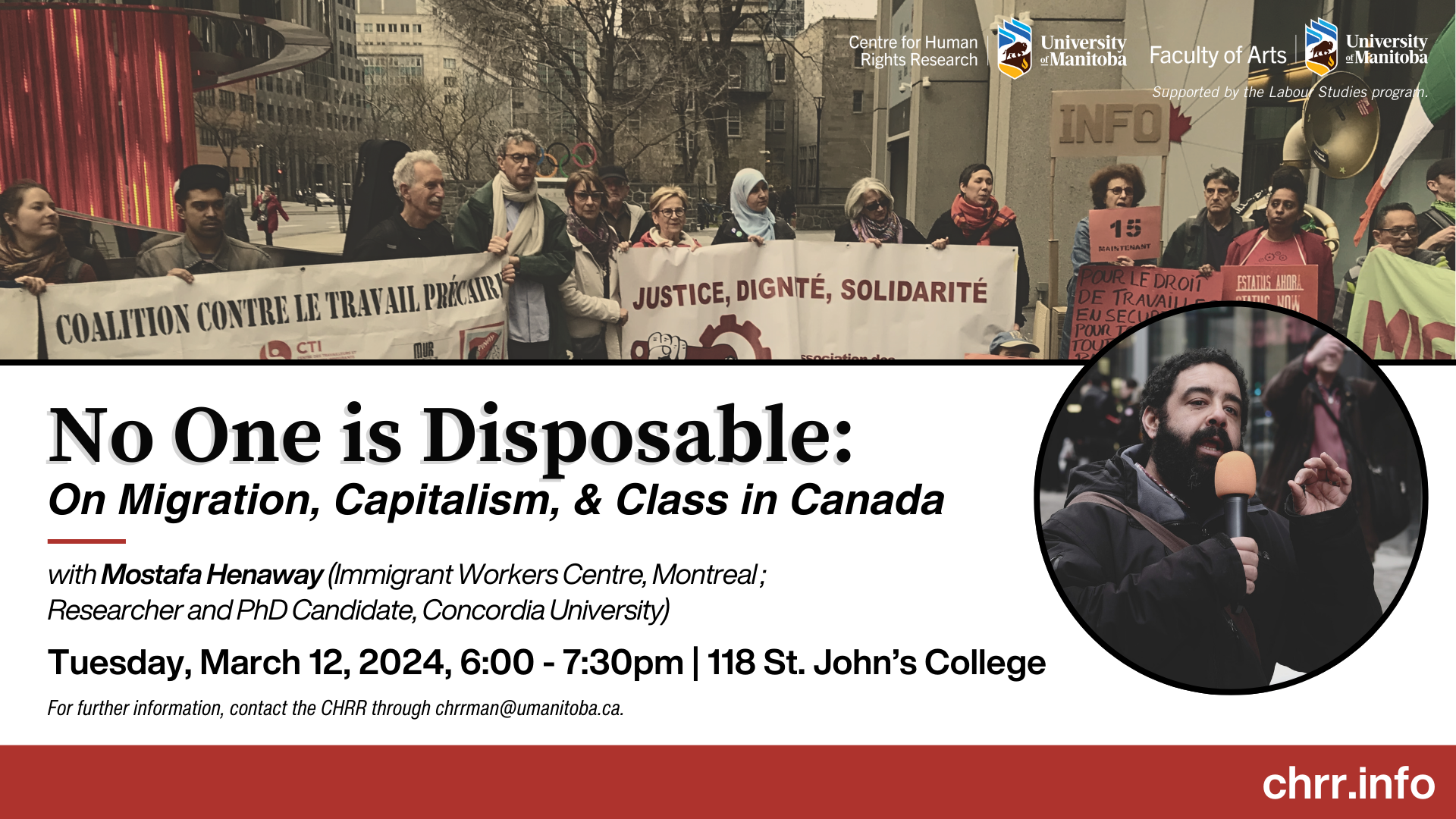
The Centre for Human Rights Research (CHRR) and the Faculty of Arts at the University of Manitoba, hosted Mostafa Henaway (Immigrant Workers Centre – Montreal) for a lecture titled “No One is Disposable: On Migration, Capitalism, and Class in Canada” on March 12, 2024 at the University of Manitoba.
Henaway, a Canadian-born Egyptian, is a long-time community organizer at the Immigrant Workers Centre in Montreal, where he has been organizing for justice for immigrant/migrant workers for over two decades. He is also a researcher and PhD candidate at Concordia University. In his new book, Essential Work, Disposable Workers: Migration, Capitalism and Class, he examines “the massive expansion of precarious work under neoliberalism and how migrant workers are challenging the conditions of their hyper-exploitation through struggles for worker rights and justice.”

Related Resources
Support Us
Whether you are passionate about interdisciplinary human rights research, social justice programming, or student training and mentorship, the University of Manitoba offers opportunities to support the opportunities most important to you.
Migrant Justice and Human Rights: A Resource Guide
Migrant Justice and Human Rights: A Resource Guide
April 2024
Angela Ciceron
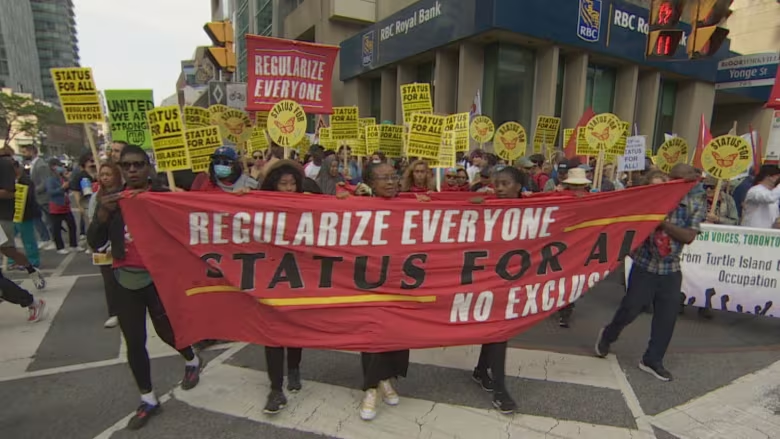
In March 2024, the Centre for Human Rights Research hosted Mostafa Henaway, a long-time community organizer with Immigrant Workers Centre in Montreal. Henaway’s work emphasized the structural and transnational issues propelling migrant workers to undertake precarious work under neoliberal capitalism, as well as efforts made by migrants to resist these structures. This resource guide aims to expand on this conversation by providing resources on the experiences of migrant workers under neoliberalism and their role in Canadian society more broadly.
Related Resources
Support Us
Whether you are passionate about interdisciplinary human rights research, social justice programming, or student training and mentorship, the University of Manitoba offers opportunities to support the opportunities most important to you.
Resource Hub
Rethinking Borders: A panel on Transnational Movements, Resistance, Identity, and Gender
April 3, 2023
Dr. Lorena Fontaine, Dr. Shauna Labman, Dr. Rob Lorway, Dr. Shayna Plaut, Dr. Lori Wilkinson

In collaboration with Global College at the University of Winnipeg, our third critical conversation took place on Apr. 3, 2023 and featured Drs. Lorena Fontaine, Shauna Labman, Rob Lorway, Shayna Plaut, and Lori Wilkinson.
The conversation was wide-ranging and touched on a variety of topics. Panelists identified – based on their research and expertise – the borders that matter, how they matter, who made them and why, as well as what they cross, both literally and metaphorically. They also discussed the limits and power of borders, the ways in which their research (or the subjects of their research) cross borders, the research and/or activism that has most guided or inspired them, and the kind of research that is most needed to meet the challenges of the present.
Water and Borders - A Roundtable
February 28, 2023
Dr. Cary Miller, Dr. Teresa Montoya, Dr. Emma Norman, Dr. Nicole J. Wilson
Does water have a border? When do the politics of water cut across borders, and when are they shaped, or even determined, by them? How does water challenge our conventional understanding of borders, including geopolitical ones, and how does it alert us to histories that pre-date the power of the colonial state? Can struggles around water – whether for decent drinking water, or against mega-projects and their impact on Indigenous communities – on different sides of North America’s settler borders be understood in common, or as discrete and different?
In collaboration with the University of Manitoba’s United Nations Sustainable Development Goal 6 (Water and Sanitation) Group, on Feb. 28, 2023 the CHRR welcomed Drs. Cary Miller, Teresa Montoya, Emma Norman, Adele Perry, and Nicole J. Wilson for an exploration of borders and the politics of water.
Borders and Human Rights: A Resource Guide
2022
Sara Gibson
This is a short list of resources compiled by Research Assistant Sara Gibson, of books, articles, poems, videos etc. that provide a critical look at borders and human rights. It is only a starting point for “Questioning Borders” and we look forward to adding to it. Please email chrrman@umanitoba.ca if you have suggestions.
Contact Us
We’d love to hear from you.
442 Robson Hall
University of Manitoba
Winnipeg, Manitoba
R3T 2N2 Canada
204-474-6453
Quick Links
Subscribe to our mailing list for periodic updates from the Centre for Human Rights Research, including human rights events listings and employment opportunities (Manitoba based and virtual).
Traditional Territories Acknowledgement
The University of Manitoba campuses are located on the original lands of the Anishinaabeg, Ininiwak, Anisininewuk, Dakota Oyate, Dene and Inuit, and on the National Homeland of the Red River Métis.

Centre for Human Rights Research 2023© · Privacy Policy