
Indigenous Feminism & Critical Approaches to Relationality with Dr. Gina Starblanket
June 22, 2026
Dr. Gina Starblanket
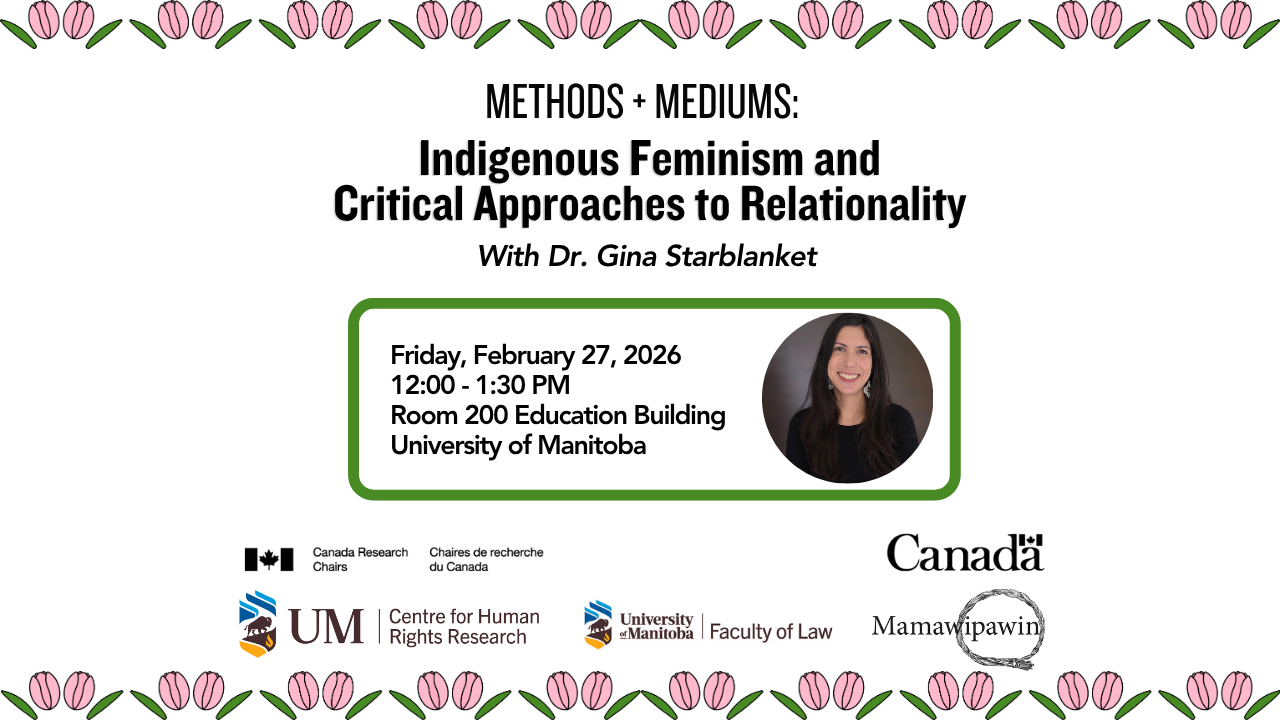
The Centre for Human Rights Research was honoured to host Dr. Gina Starblanket for a talk on Indigenous feminism and critical approaches to relationality. The talk was held on Friday, February 27th, 2026 on the University of Manitoba – Fort Garry Campus. This talk explored Indigenous feminist and other critical approaches to relationality in academic research and writing. It provided examples of applied practices and reviews the implications of Indigenous feminist approaches across diverse sites and scales.


Creating Systemic Change through the Red Dress Alert with Sandra Delaronde
Creating Systemic Change through the Red Dress Alert with Sandra Delaronde
May 26, 2026
Sandra Delaronde

On Thursday, May 7th, 2026, Giganawenimaanaanig and the Centre for Human Rights Research at the University of Manitoba hosted an event in honour of National Day of Awareness for Missing and Murdered Indigenous Women and Girls and 2SLGBTQIA+ (MMIWG2S+) people, also known as Red Dress Day. In 2026, we were honoured to host Sandra Delaronde to speak on “Creating Systemic Change through the Red Dress Alert”.
Calling for Justice and Re-Imagining Governance: A Zotero Library
Calling for Justice and Re-Imagining Governance: A Zotero Library
May 26, 2026
Hope Ace, Kyra Campbell, and Ashley Daniels

The Calling for Justice and Re-imagining Governance project aims to bring together knowledge on the interconnected historical and contemporary factors contributing to the systemic marginalization of Indigenous women to outline actionable steps towards rematriation – to restoring Indigenous women’s human rights and leadership roles. This Zotero library compiles various journal articles, books, reports, and other resources used within the project.
Access the Zotero library here.
Artwork by Micaela Gilbert, 2025.
Gender-Based Violence and Displacement: The Human Cost of War, Colonialism and the Climate Crisis
Gender-Based Violence and Displacement: The Human Cost of War, Colonialism and the Climate Crisis
May 4, 2026
Joy Chadya, Brenda Gunn, Helga Hamilton, Olga Khamedova, Shirley Robinson, and Alex Wilson
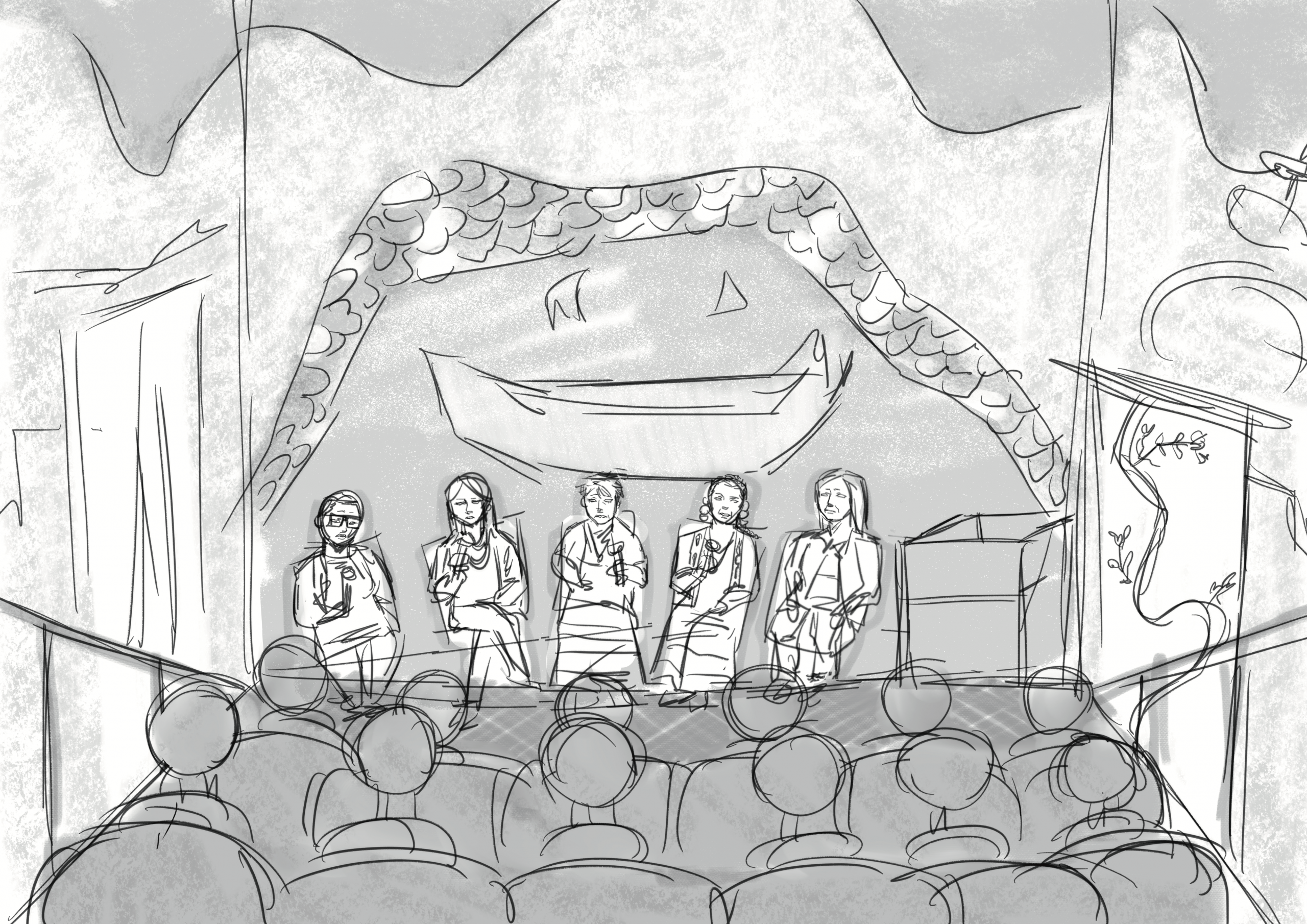
In honour of International Women’s Day, the Centre for Human Rights Research and Giganwenimaanaanig hosted a panel discussion titled “Gender-Based Violence and Displacement: The Human Cost of War, Colonialism, and the Climate Crisis” on Thursday, March 5th. This discussion explored gender-based violence in the context of conflict, structural violence, and displacement, and the ways in which love — for the lands, waters, and for all our relations — can sustain us.
Watch a recording of the panel below.
Artwork by Aubrey Yuol.
Calling for Justice and Re-Imagining Governance – A Final Report
Calling for Justice and Re-Imagining Governance - A Final Report
May 1, 2026
Hope Ace, Sandra DeLaronde, Adele Perry, Pauline Tennent, Kiera Ladner, Shawna Ferris, Ashley Daniels, Kyra Campbell, and Brenda Gunn
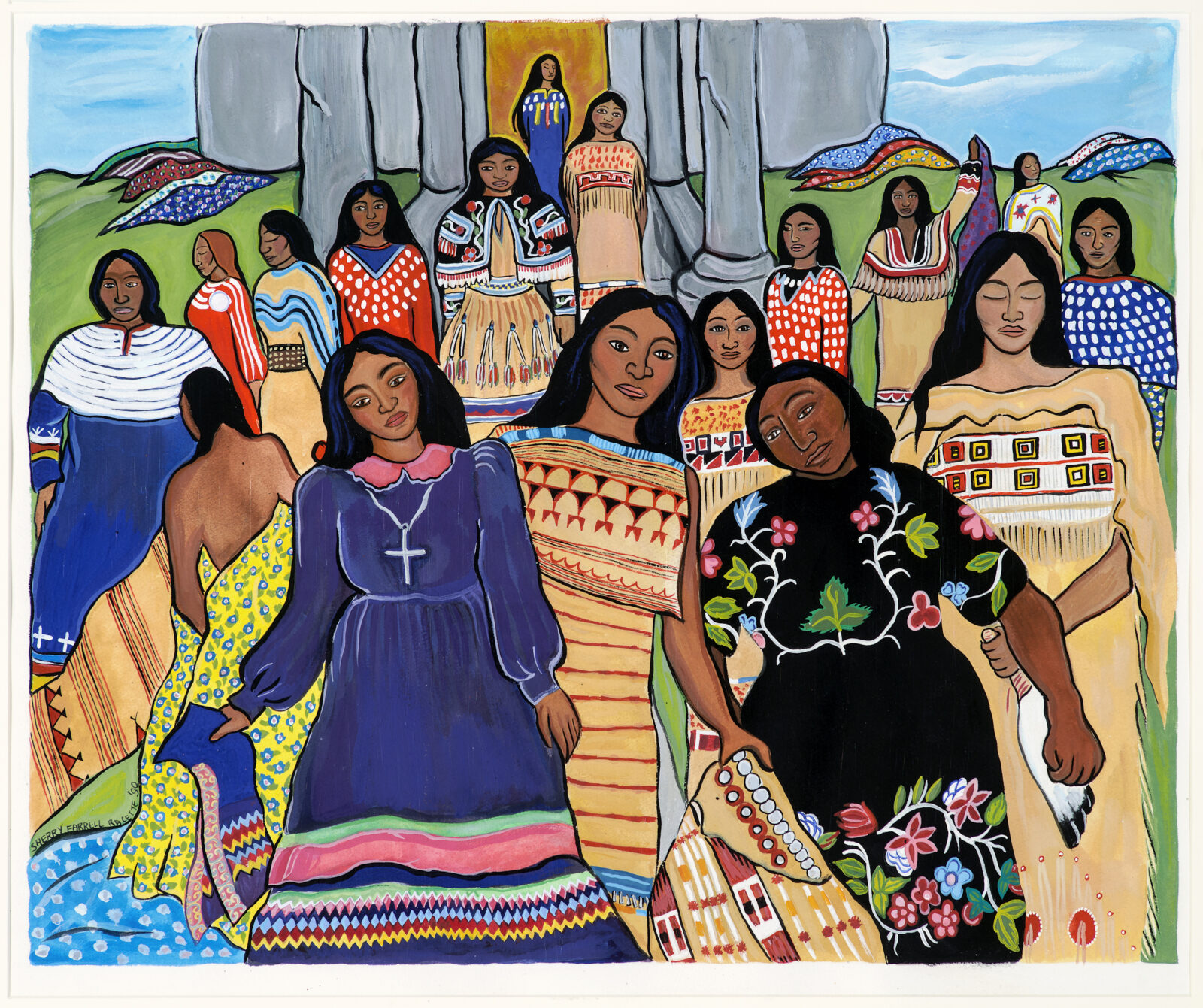
Inspired by and responding directly to the Calls for Justice offered in the National Inquiry on Murdered and Missing Indigenous Women and Girls Final Report, in particular Call 1.4 which demands “urgent and special measures to ensure that Indigenous women, girls and 2SLGBTQQIA people are represented in… governance and leadership,” the “Calling for Justice and Re-Imagining Governance” project contributes to the ongoing work of Indigenous women, girls, Two-Spirit, and gender-diverse kin who are actively working to stop a genocide through their leadership and governance. The aim of this project is to propose new systems of governance and expressions of self determination which centre gendered realities. This report synthesizes the key findings from the project.
Just Research: A Podcast – Episode 1
Just Research: A Podcast - Episode 1
October 6, 2025
Angela Ciceron
If you’re interested in water justice, you’ll be interested in the first episode of Just Research. Just Research is a podcast series from the Centre for Human Rights Research at the University of Manitoba. Hosted by Dr. Pauline Tennent and Dr. Adele Perry, the podcast highlights researchers from the UM community and beyond doing work in human rights and social justice in a variety of disciplines.
This season focuses on researchers whose work engages with each of the CHRR’s research themes: Borders and Human Rights, Indigenous Peoples and Human Rights, Reproductive and Bodily Justice, and Water Rights and Justice.
Episode 1: Looking Back on the CHRR and Water Research with Helen Fallding
In the first episode of Just Research, CHRR director Dr. Adele Perry and former CHRR manager Helen Fallding look back to the CHRR’s longstanding work in water rights and justice. In this conversation, they talked about the CREATE H2O program, its interdisciplinary, foundational work in water and sanitation in First Nations communities, and its legacy through the Just Waters project.
Listen now:
Becoming Kin: A Discussion with Patty Krawec
Becoming Kin: A Discussion with Patty Krawec
October 4, 2024
Patty Krawec

On October 4th, 2024, the Centre for Human Rights Research (CHRR) and Centre for Creative Writing and Oral Culture (CCWOC) welcomed Anishinaabe-Ukrainian writer Patty Krawec to discuss her book Becoming Kin: An Indigenous Call to Unforgetting the Past and Reimagining Our Future (Broadleaf Books).
Patty weaves her story with broader themes of settler colonialism, Indigenous survival, and Indigenous thriving in Canada and the United States. She argues that Indigenous kinship systems can help everyone imagine and move toward a just, livable future for all. She examines the idea that we live in relationships and considers how we might live as good relatives by taking the lead from Indigenous peoples and philosophies.
This event was funded through CHRR’s Outreach and Events Support Initiative, which was made possible by the University of Manitoba’s Strategic Initiative Fund.
Debunking the “Mass Grave Hoax”: A Report on Media Coverage and Residential School Denialism in Canada
Debunking the “Mass Grave Hoax”: A Report on Media Coverage and Residential School Denialism in Canada
October 2023
Reid Gerbrandt, Dr. Sean Carleton
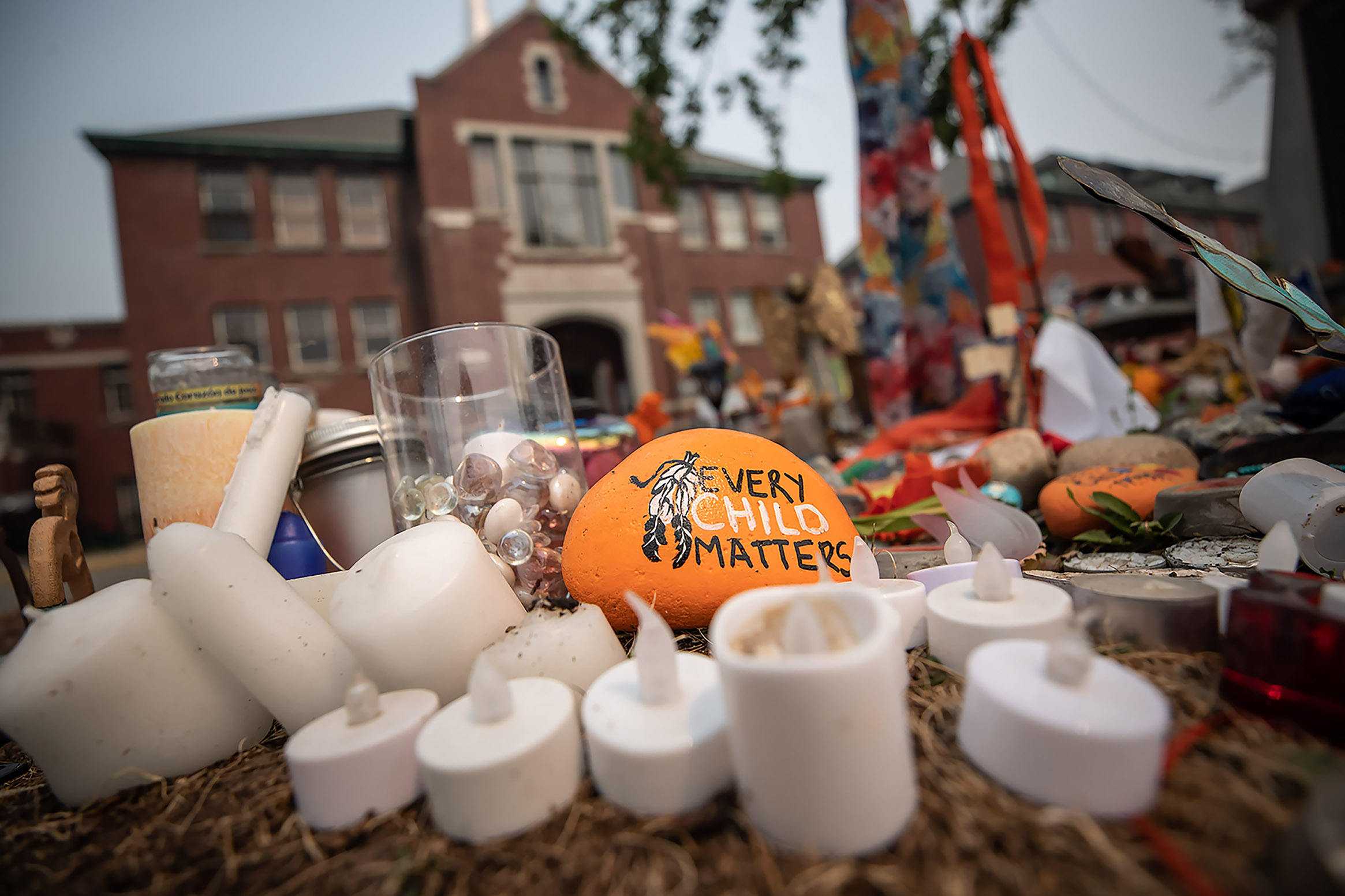
In the two years since the Tk’emlúps te Secwépemc First Nation’s 2021 announcement about the location of 215 potential unmarked graves at the former Kamloops Indian Residential School, a number of priests, pundits, and politicians have downplayed and questioned the validity of the findings. Some have declared the news of potential unmarked graves at many former residential school sites across Canada to be a “huge lie”. Others insist that mainstream media, the federal government, and First Nations have conspired to created a “hoax” by misrepresenting the news of potential unmarked burials sites as a “mass grave” to shock and guilt Canadians into caring about Indigenous Peoples and reconciliation.
Given the growing popularity of the “mass grave hoax” narrative, especially on the far-right in Canada and the United States, and recent calls for Canadians to take responsibility for countering such harmful misinformation, Reid Gerbrandt and Dr. Sean Carleton, assistant professor in history and Indigenous studies at the University of Manitoba, decided to investigate the claims of a media conspiracy and fact-check them against the evidence of what was actually reported in Canada. This report outlines their findings and recommendations.
Debunking the “Mass Grave Hoax”: A Report on Media Coverage and Residential School Denialism in Canada was released in October 2023.

Related Resources
Support Us
Whether you are passionate about interdisciplinary human rights research, social justice programming, or student training and mentorship, the University of Manitoba offers opportunities to support the opportunities most important to you.
Contact Us
We’d love to hear from you.
442 Robson Hall
University of Manitoba
Winnipeg, Manitoba
R3T 2N2 Canada
204-474-6453
Quick Links
Subscribe to our mailing list for periodic updates from the Centre for Human Rights Research, including human rights events listings and employment opportunities (Manitoba based and virtual).
Traditional Territories Acknowledgement
The University of Manitoba campuses are located on the original lands of the Anishinaabeg, Ininiwak, Anisininewuk, Dakota Oyate, Dene and Inuit, and on the National Homeland of the Red River Métis.

Centre for Human Rights Research 2023© · Privacy Policy