
Creating Systemic Change through the Red Dress Alert with Sandra Delaronde
May 26, 2026
Sandra Delaronde

On Thursday, May 7th, 2026, Giganawenimaanaanig and the Centre for Human Rights Research at the University of Manitoba hosted an event in honour of National Day of Awareness for Missing and Murdered Indigenous Women and Girls and 2SLGBTQIA+ (MMIWG2S+) people, also known as Red Dress Day. In 2026, we were honoured to host Sandra Delaronde to speak on “Creating Systemic Change through the Red Dress Alert”.


Calling for Justice and Re-Imagining Governance: A Zotero Library
Calling for Justice and Re-Imagining Governance: A Zotero Library
May 26, 2026
Hope Ace, Kyra Campbell, and Ashley Daniels

The Calling for Justice and Re-imagining Governance project aims to bring together knowledge on the interconnected historical and contemporary factors contributing to the systemic marginalization of Indigenous women to outline actionable steps towards rematriation – to restoring Indigenous women’s human rights and leadership roles. This Zotero library compiles various journal articles, books, reports, and other resources used within the project.
Access the Zotero library here.
Artwork by Micaela Gilbert, 2025.
Gender-Based Violence and Displacement: The Human Cost of War, Colonialism and the Climate Crisis
Gender-Based Violence and Displacement: The Human Cost of War, Colonialism and the Climate Crisis
May 4, 2026
Joy Chadya, Brenda Gunn, Helga Hamilton, Olga Khamedova, Shirley Robinson, and Alex Wilson
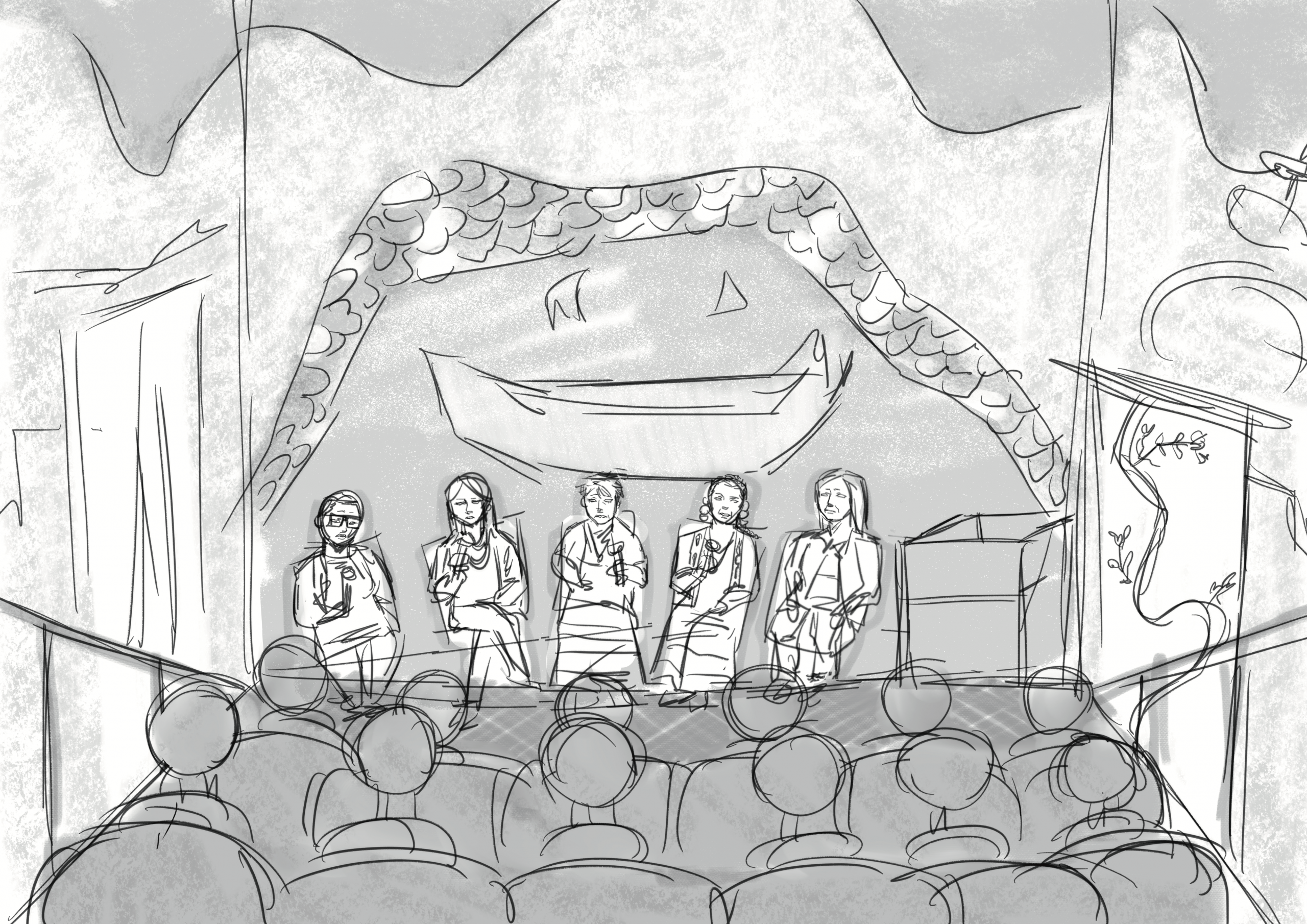
In honour of International Women’s Day, the Centre for Human Rights Research and Giganwenimaanaanig hosted a panel discussion titled “Gender-Based Violence and Displacement: The Human Cost of War, Colonialism, and the Climate Crisis” on Thursday, March 5th. This discussion explored gender-based violence in the context of conflict, structural violence, and displacement, and the ways in which love — for the lands, waters, and for all our relations — can sustain us.
Watch a recording of the panel below.
Artwork by Aubrey Yuol.
Calling for Justice and Re-Imagining Governance – A Final Report
Calling for Justice and Re-Imagining Governance - A Final Report
May 1, 2026
Hope Ace, Sandra DeLaronde, Adele Perry, Pauline Tennent, Kiera Ladner, Shawna Ferris, Ashley Daniels, Kyra Campbell, and Brenda Gunn
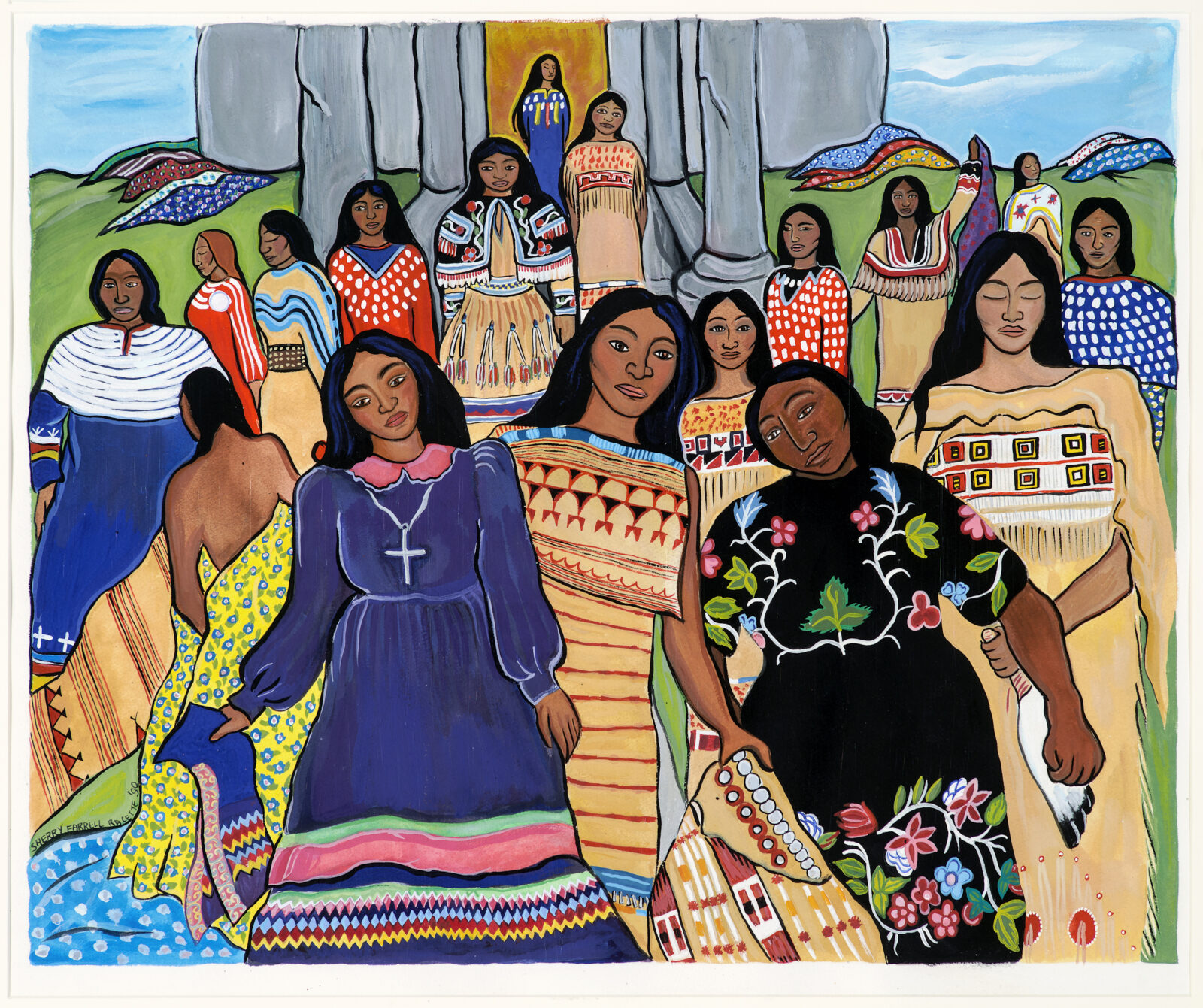
Inspired by and responding directly to the Calls for Justice offered in the National Inquiry on Murdered and Missing Indigenous Women and Girls Final Report, in particular Call 1.4 which demands “urgent and special measures to ensure that Indigenous women, girls and 2SLGBTQQIA people are represented in… governance and leadership,” the “Calling for Justice and Re-Imagining Governance” project contributes to the ongoing work of Indigenous women, girls, Two-Spirit, and gender-diverse kin who are actively working to stop a genocide through their leadership and governance. The aim of this project is to propose new systems of governance and expressions of self determination which centre gendered realities. This report synthesizes the key findings from the project.
Just Research: A Podcast – Season 1
Just Research: A Podcast - Season 1
October 6, 2025
Angela Ciceron
Just Research is a podcast series from the Centre for Human Rights Research at the University of Manitoba. Hosted by Dr. Pauline Tennent and Dr. Adele Perry, the podcast highlights researchers from the UM community and beyond doing work in human rights and social justice in a variety of disciplines.
This season focuses on researchers whose work engages with each of the CHRR’s research themes: Borders and Human Rights, Indigenous Peoples and Human Rights, Reproductive and Bodily Justice, and Water Rights and Justice.
Episode 1: Looking Back on the CHRR and Water Research with Helen Fallding
In the first episode of Just Research, CHRR director Dr. Adele Perry and former CHRR manager Helen Fallding look back to the CHRR’s longstanding work in water rights and justice. In this conversation, they talked about the CREATE H2O program, its interdisciplinary, foundational work in water and sanitation in First Nations communities, and its legacy through the Just Waters project.
Listen now:
Episode 2: On Borders and Human Rights with Dr. Lori Wilkinson
In this episode of Just Reseach, CHRR manager Dr. Pauline Tennent speaks with Dr. Lori Wilkinson, a professor in Sociology at University of Manitoba, about her research on borders and human rights. Dr. Wilkinson’s research has touched on a wide variety of topics surrounding the lived experiences of migrants, refugees, and newcomers in Canada, including their experiences with sexual and gender-based violence.
Listen now:
- Sisic, Mia, Evangelia. Tastsoglou, Lori Wilkinson, Myrna Dawson, Catherine Holtmann, Chantelle Falconer, “The Continuum of Gender-Based Violence Experienced by Migrant and Refugee Women in Canada: Perspectives from Key Informants.” In Special Topic on “Gender and the Continuum of Violence in Migration,” guest-edited by E. Tastsoglou, M. Dawson, J. Freedman, C. Holtmann. In the journal Sociology, Frontiers, 2024
- Luo, Yazhi and Lori Wilkinson (2023) “Asian international students in a mid-sized Canadian City: A Case study of the University of Manitoba” Chapter 14, pp. 202-216 in Asian international students in Canadian universities: Internationalization, racialization and inclusion. Ann H. Kim, Elizabeth Buckner, and Jean Michel Montsion eds. Milton Park, UK: Routledge Press.
- Wilkinson, Lori and Sally Ogoe (2020) “Friendly Manitoba? An Examination of Racism and Xenophobia during the COVID-19 Pandemic” COVID-19 in Manitoba: Public Policy Responses to the First Wave Andrea Rounce, Karine Levasseur, and Shannon Furness eds. Winnipeg: University of Manitoba Press.
Episode 3: On Reproductive and Bodily Justice with Dr. Lindsay Larios
In this episode of Just Research, CHRR manager Dr. Pauline Tennent talks to Dr. Lindsay Larios, an assistant professor in the Faculty of Social Work at the University of Manitoba, about her research in reproductive justice. Dr. Larios’ work explores access to reproductive justice and care for migrants in Manitoba through community-based research approaches.
Listen now:
- https://chrr.info/research-themes/research-themes/reproductive-and-bodily-justice/
- https://chrr.info/person/people-_network/lindsay-_larios/
- https://lindsaylarios.com/
- https://www.instagram.com/reprojusticeresearchmb/
- https://chrr.info/current-projects-2/past-projects/period-poverty-and-equity-on-campus-and-beyond/
- Tennent, P., Alemaio, B., Belec, H., Hunter, M., Larios, L., Perry, A., Romero, V., Smith, J., & Vickar, C. (2024). A Report on Period Poverty and Equity, on Campus and Beyond. Winnipeg, MB: Centre for Human Rights Research, University of Manitoba.
- Larios, L., Larsen, P., Olanubi, O., & Oviosun, J. (2023) “Healthcare is a human right”: International student speak out on healthcare inaccessibility in Manitoba. Winnipeg, MB: Canadian Centre for Policy Alternatives — Manitoba.
- Larios, L. (2023). Precarious reproductive citizenship: Employment protections for pregnant precarious status migrants in Canada. Citizenship Studies. DOI: 10.1080/13621025.2022.2073970
- Larios, L. and Cowman, E. (2025). Working toward reproductive justice in Manitoba. Winnipeg, MB: Canadian Centre for Policy Alternatives — Manitoba.
Episode 4: On Indigenous Peoples and Human Rights with Brenda Gunn
On the last episode of Just Research, CHRR director Dr. Adele Perry speaks to Brenda Gunn, a professor in Robson Hall – Faculty of Law at the University of Manitoba, about her research on Indigenous peoples and human rights. Professor Gunn’s work has encompassed a wide variety of topics in this area, including Indigenous and treaty rights in Manitoba, and international law and Indigenous rights.
Listen now:
- https://chrr.info/research-themes/research-themes/reproductive-and-bodily-justice/
- https://chrr.info/person/people-_network/lindsay-_larios/
- https://lindsaylarios.com/
- https://www.instagram.com/reprojusticeresearchmb/
- https://chrr.info/current-projects-2/past-projects/period-poverty-and-equity-on-campus-and-beyond/
- Tennent, P., Alemaio, B., Belec, H., Hunter, M., Larios, L., Perry, A., Romero, V., Smith, J., & Vickar, C. (2024). A Report on Period Poverty and Equity, on Campus and Beyond. Winnipeg, MB: Centre for Human Rights Research, University of Manitoba.
- Larios, L., Larsen, P., Olanubi, O., & Oviosun, J. (2023) “Healthcare is a human right”: International student speak out on healthcare inaccessibility in Manitoba. Winnipeg, MB: Canadian Centre for Policy Alternatives — Manitoba.
- Larios, L. (2023). Precarious reproductive citizenship: Employment protections for pregnant precarious status migrants in Canada. Citizenship Studies. DOI: 10.1080/13621025.2022.2073970
- Larios, L. and Cowman, E. (2025). Working toward reproductive justice in Manitoba. Winnipeg, MB: Canadian Centre for Policy Alternatives — Manitoba.
Fighting Denialism and Standing Up for the Truth About Residential Schooling
Fighting Denialism and Standing Up for the Truth About Residential Schooling
September 24, 2025
Kimberly Murray and Sean Carleton
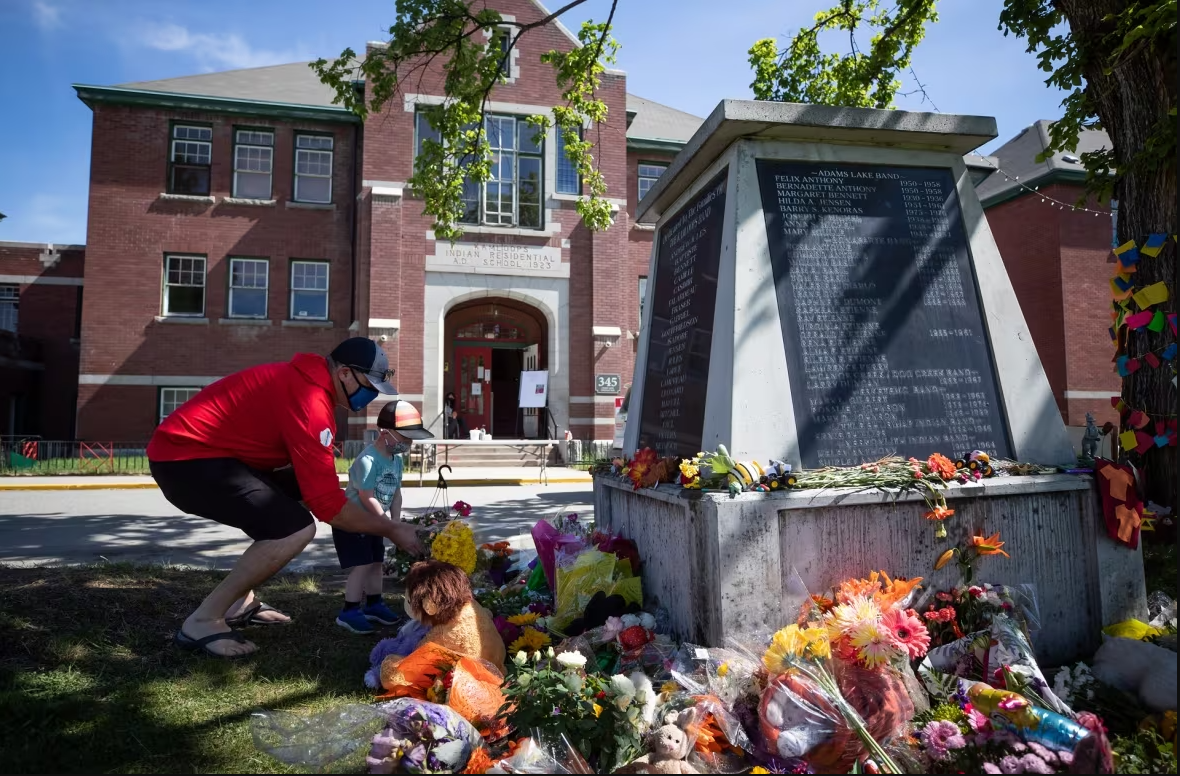
Residential school denialism is on the rise. Niigaan Sinclair and Sean Carleton, University of Manitoba professors and CHRR Research Affiliates, are working on a new book collection that will help people learn how to identify and confront residential school denialism to help put truth before reconciliation. The following is an abridged version of a chapter, based on a conversation with lawyer and professor Kimberly Murray, that will appear in the new volume.
Becoming Kin: A Discussion with Patty Krawec
Becoming Kin: A Discussion with Patty Krawec
October 4, 2024
Patty Krawec

On October 4th, 2024, the Centre for Human Rights Research (CHRR) and Centre for Creative Writing and Oral Culture (CCWOC) welcomed Anishinaabe-Ukrainian writer Patty Krawec to discuss her book Becoming Kin: An Indigenous Call to Unforgetting the Past and Reimagining Our Future (Broadleaf Books).
Patty weaves her story with broader themes of settler colonialism, Indigenous survival, and Indigenous thriving in Canada and the United States. She argues that Indigenous kinship systems can help everyone imagine and move toward a just, livable future for all. She examines the idea that we live in relationships and considers how we might live as good relatives by taking the lead from Indigenous peoples and philosophies.
This event was funded through CHRR’s Outreach and Events Support Initiative, which was made possible by the University of Manitoba’s Strategic Initiative Fund.
A Discussion on Indigenous Water (In)Security – HWISE-RCN
A Discussion on Indigenous Water (In)Security - HWISE-RCN
April 2022
HWISE-RCN
With the Household Water Insecurity Experiences (HWISE) – Research Coordination Network (RCN), Dr. Nicole Wilson chaired a panel discussion in April 2022 on the many complexities of water (in)security for Indigenous peoples. Panelists engaged with the ways that water (in)security is (re)produced by jurisdictional and regulatory injustices and the broader political and economic asymmetries created by settler-colonial water governance. They also explored the distinct understandings of security and well-being that flow from Indigenous relationships to water as a living entity and the ways they shape desirable water futures. View the discussion below.
The Lake St. Martin Story
March 12, 2025
Cameron Armstrong
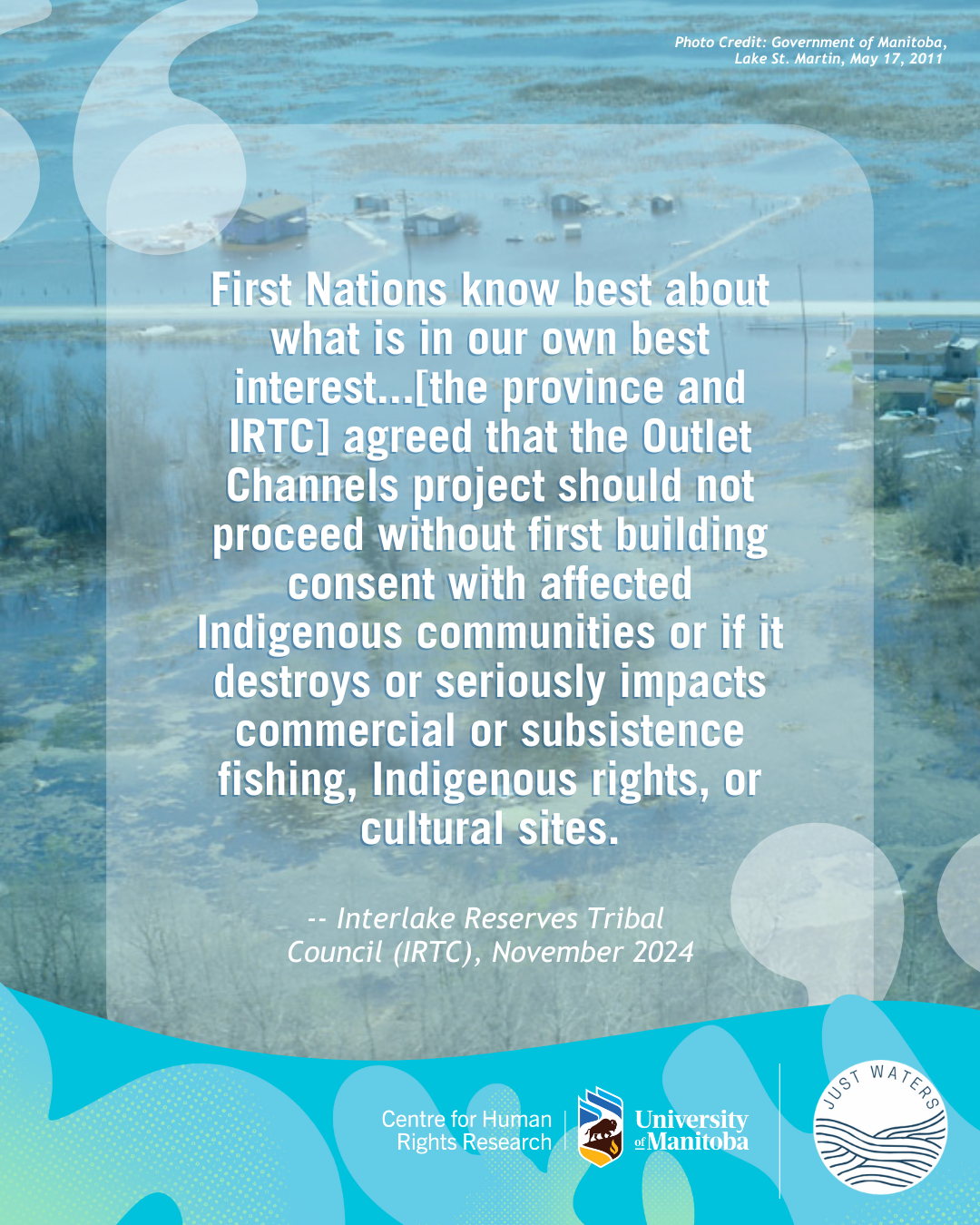
Water control structures have disempowered and displaced First Nations, destroying livelihoods in the name of development, upholding colonial systems and perpetuating environmental racism. One such case is that of Lake St. Martin and the Lake St. Martin First Nation.
As part of the Just Waters project, student RA Cameron Armstrong wrote a plain language summary giving an account of 50+ years of artificial flooding that have impacted the Lake St. Martin First Nation in a myriad of ways, including long term evacuation. Download the resource to find out more.
History in the Hot Seat Zotero Library
History in the Hot Seat Zotero Library
2025
Author
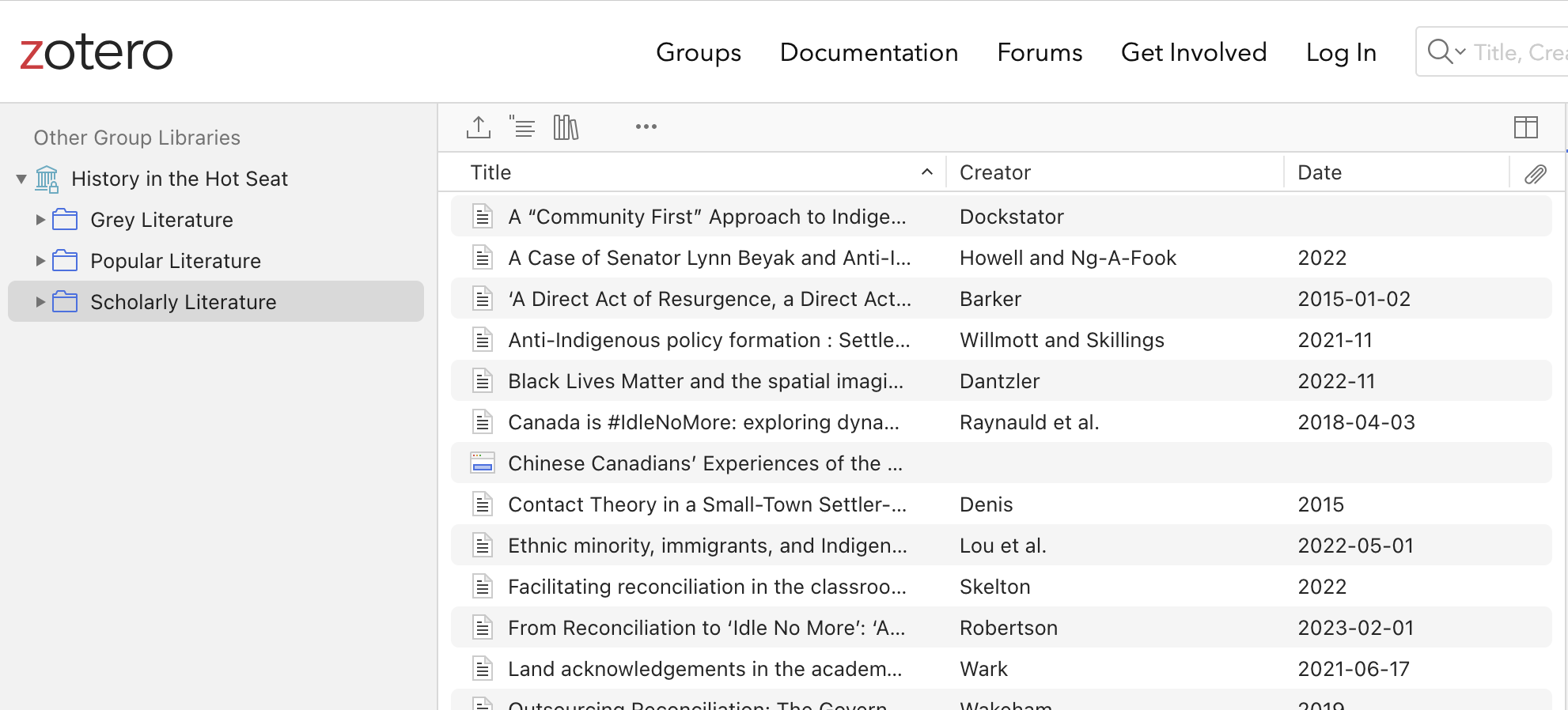
As a part of History in the Hot Seat; Colonialism and the Knowing and Teaching of Canada’s Past, a Zotero library was created to aid in gathering and organizing resources related to the project. Zotero is a free, easy-to-use tool to help you collect, organize, annotate, cite, and share research.
To access the Zotero library, click here.
The creation of this library was a collaborative project. We are grateful to student research assistants Hannah Belec, Katja Buchholz, and Jamie Nienhuysen for their work on this project.
History in the Hot Seat is a Knowledge Synthesis Grant funded by Social Sciences and Humanities Research Council (SSHRC) in partnership with Canadian Heritage, Genome Canada, and UK Research and Innovation’s Arts and Humanities Research Council (UKRI-AHRC) that aimed to mobilize, examine and synthesize social sciences and humanities research on Evolving Narratives of Cultures and Histories. To learn more about History in the Hot Seat, visit https://chrr.info/current-projects-2/past-projects/history-in-the-hot-seat-the-teaching-and-knowing-of-canadas-past/.
Contact Us
We’d love to hear from you.
442 Robson Hall
University of Manitoba
Winnipeg, Manitoba
R3T 2N2 Canada
204-474-6453
Quick Links
Subscribe to our mailing list for periodic updates from the Centre for Human Rights Research, including human rights events listings and employment opportunities (Manitoba based and virtual).
Traditional Territories Acknowledgement
The University of Manitoba campuses are located on the original lands of the Anishinaabeg, Ininiwak, Anisininewuk, Dakota Oyate, Dene and Inuit, and on the National Homeland of the Red River Métis.

Centre for Human Rights Research 2023© · Privacy Policy